


Two vehicles pull up to the same London kerb at 9am. The first is a non-compliant van, already £30.50 down in Congestion Charge and ULEZ before the driver starts hunting for parking. The second is a 4 wheel electric cargo bike: it pays neither charge, slides up to the door and is unloading while the van circles. That gap is why more London operators now run a cargo ebike for business in London instead of a van, and it is the question this guide answers.
Quick answer (as of October 2026): A 4 wheel electric cargo bike is a pedal-assisted, four-wheel cargo vehicle built for short, multi-stop city routes. If it meets the UK rules for an electrically assisted pedal cycle (EAPC) — working pedals, a 250W motor and assistance that cuts off at 25 km/h (15.5mph) — it is treated as a bicycle, so it needs no driving licence, registration or road tax. CityQ’s models carry 170–200kg, run up to 100km per charge and are certified to EN 15194 and EN 17860. A van still wins on heavy loads, long routes and motorway work.
Key facts at a glance
- Payload: 170–200kg on the three cargo models (CityQ 850, 1200 and Pickup & Customize).
- Range: up to 100km per charge, with batteries that swap in about 30 seconds.
- Rules: no licence, registration or road tax for a vehicle that qualifies as an EAPC. Minimum rider age is 14.
- Running cost, central London: £1,300–£2,100 a year for a CityQ, against £30,320–£35,320 for a non-compliant van (CityQ’s estimate).
- Running cost, UK average: £295 a year for an e-cargo bike against £6,169 for a small diesel van (Energy Saving Trust).
What is a 4 wheel electric cargo bike?
A 4 wheel electric cargo bike is a pedal-assisted vehicle with four wheels, a motor that helps you up to 25 km/h and a lockable box or flatbed on the back. Picture a delivery van that went on a diet, learned to use cycle lanes and never has to sit a driving test.
You pedal, the motor assists and the four wheels do the balancing. There is nothing to wobble, nothing to tip at the lights and no kickstand to fight with, and how the four-wheel bike works on a tilting road is worth a read before a first ride. The roof and windscreen keep the rider dry, which matters more than you would think on the fourteenth drop of a wet Tuesday.

Searchers call it a “4 wheel electric bike car”, an “electric bicycle car”, a “cargo electric bike”, a “delivery bike electric” or simply an “electric delivery bike”. It is also known as a four wheel cargo e-bike, a 4 wheel e cargo bike or an electric urban delivery cargo bike. Same machine, many nicknames. CityQ, one of the pioneers of 4-wheel cargo bikes, spent four years of development and two years of fleet data behind its range: the CityQ 850, the CityQ 1200, the CityQ Pickup & Customize and the CityQ Passenger.
Is a 4 wheel electric bike a bike, a microcar or a van?
It is a bike if it stays inside the EAPC limits, and that one test decides almost everything else. The “electric bicycle car” label causes the most confusion, so here is the line. A microcar (a light quadricycle, class L6e) is a motor vehicle that reaches 45 km/h, and in the UK it needs an AM licence at 16 or over, registration, road tax and insurance. A van needs a car licence and the full set of vehicle costs. A 4 wheel cargo e-bike that qualifies as an EAPC needs none of these, though you should confirm cover with your insurer.
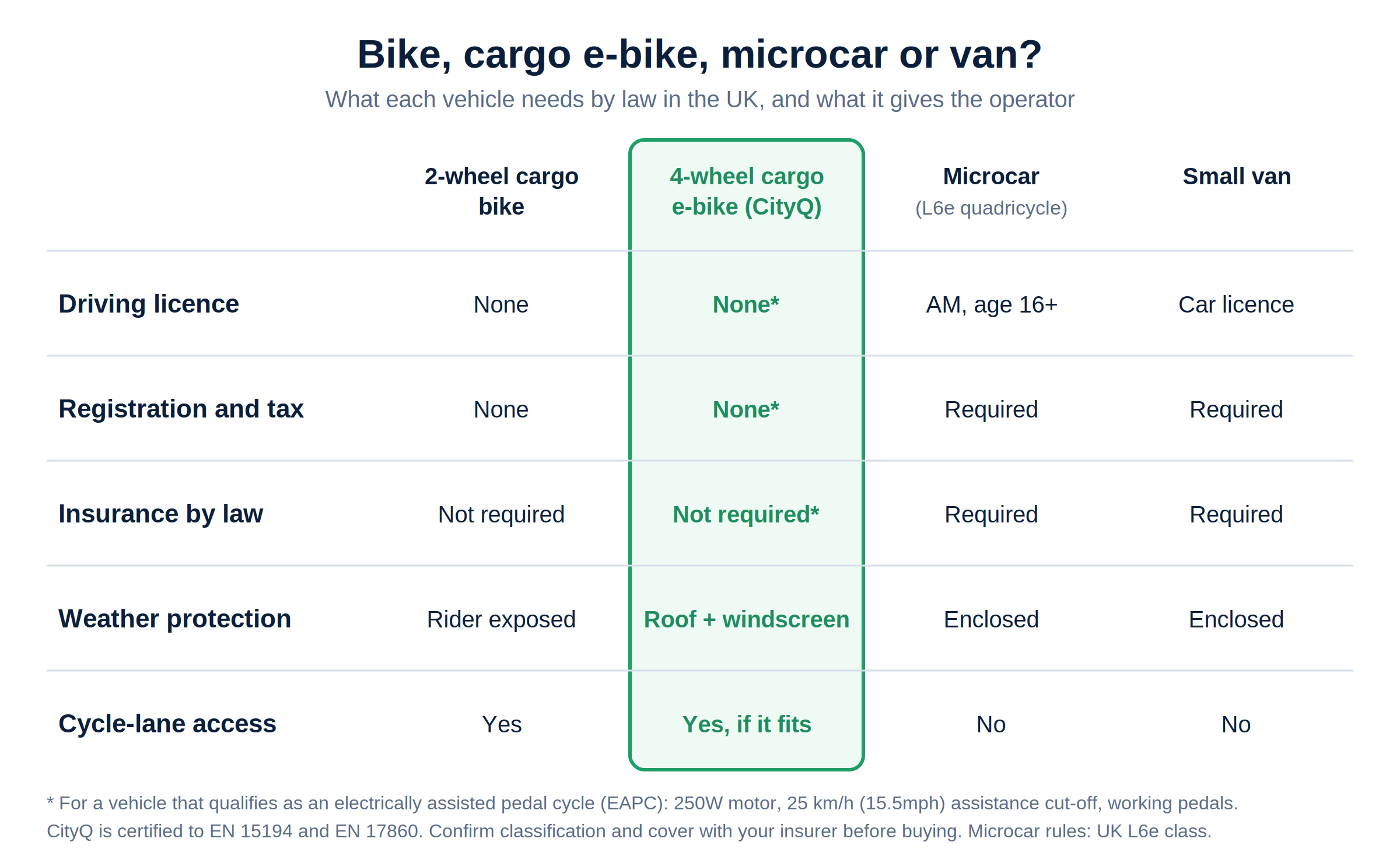
Most electric cargo bikes on UK streets are still two-wheelers, so the fairer fight is against the two-wheel cargo bike. The 4-wheel vs 2-wheel cargo eBike comparison is honest about it: a typical two-wheel bike carries 80–100kg in 0.2–0.5m³ and is about 65cm wide, while a CityQ is 89cm wide and carries 170–200kg in 1–1.7m³. The four-wheel layout removes the balance skill floor, which widens your hiring pool, and it is a big part of why four wheels feel safer in hectic cities. The two-wheel bike costs less upfront and clears older, tightly spaced bollards that an 89cm vehicle may not.
Is a 4 wheel electric bike legal in the UK, and do you need a licence?
Yes. UK law sets no limit on the number of wheels, so a 4 wheel electric bike is legal if it passes the same three EAPC tests as any e-bike: working pedals, a motor of no more than 250W and assistance that cuts off at 25 km/h (15.5mph). The Environmental Transport Association (ETA) guide to cargo bike law notes there is no legal restriction on wheels, weight or size. A vehicle that passes is a bicycle, with a minimum rider age of 14 and no licence, registration, road tax or compulsory insurance.
CityQ says its vehicles are built to those limits: two 125W motors totalling 250W, a 25 km/h assistance cut-off and pedalling required above 6 km/h. They are certified to EN 15194 and to the EN 17860 safety standard for cargo bikes, and CityQ reports it was Europe’s first 4-wheel cargo bike approved to a safety standard. Whether you need a driving licence for a 4-wheel e-bike in the UK comes down to that one classification test, and a vehicle that exceeds any limit is reclassified as a moped or motorcycle. This is general information, not legal advice: confirm classification and insurance for your own vehicles before you buy.
How much can a 4 wheel electric cargo bike carry, and how far does it go?
Between 170kg and 200kg of cargo on the three cargo models, and up to 100km on a single charge.
| Model | Payload | Cargo space | What it suits |
|---|---|---|---|
| CityQ 850 | 180kg | 1m³ | Lockable, detachable box for parcels, groceries and tools |
| CityQ 1200 | 170kg | 1.3m³ | Larger-volume loads, with side-door options |
| CityQ Pickup & Customize | 200kg | Up to 1.7m³ | Flatbed jobs, with options for your own box or a cooling box |
| CityQ Passenger | 260kg including driver | 1.1m³ in pickup configuration | Rear seat for 1–2 people plus a lockable compartment |
The part that surprises fleet managers is the energy. The LiFePO4 batteries are rated for 2,000–4,000 charge cycles, which CityQ puts at roughly 6–10 years of daily commercial service, and a swap takes about 30 seconds. A full charge costs 12p–75p, according to CityQ. Because the swappable LiFePO4 batteries come out and go back in, there is no waiting for a fixed charging point or an electrical upgrade at your depot. It is also why a cargo bike uses 90% less energy per kilometre than an electric van.
Range is not just a brochure number. CityQ reports Wolt riders in Oslo covering up to 100km a day, 365 days a year, in winters down to -10°C, which is part of why Wolt keeps scaling with 4-wheel logic. If uptime is your worry, the uptime playbook for always-on deliveries covers how to plan battery swaps around a shift.
How much does a 4 wheel electric cargo bike cost to buy and run?
Roughly £11,000 to buy (CityQ, January 2026), then £1,300–£2,100 a year to run in central London, against £30,320–£35,320 for a non-compliant van. [VERIFY: current list price and whether it includes the cargo box.] If you are weighing up a cargo e-bike delivery business in the UK, the purchase price is only the first line of the budget, and the Energy Saving Trust’s £3,000–£12,000 range for e-cargo bikes in general shows how wide the market is.
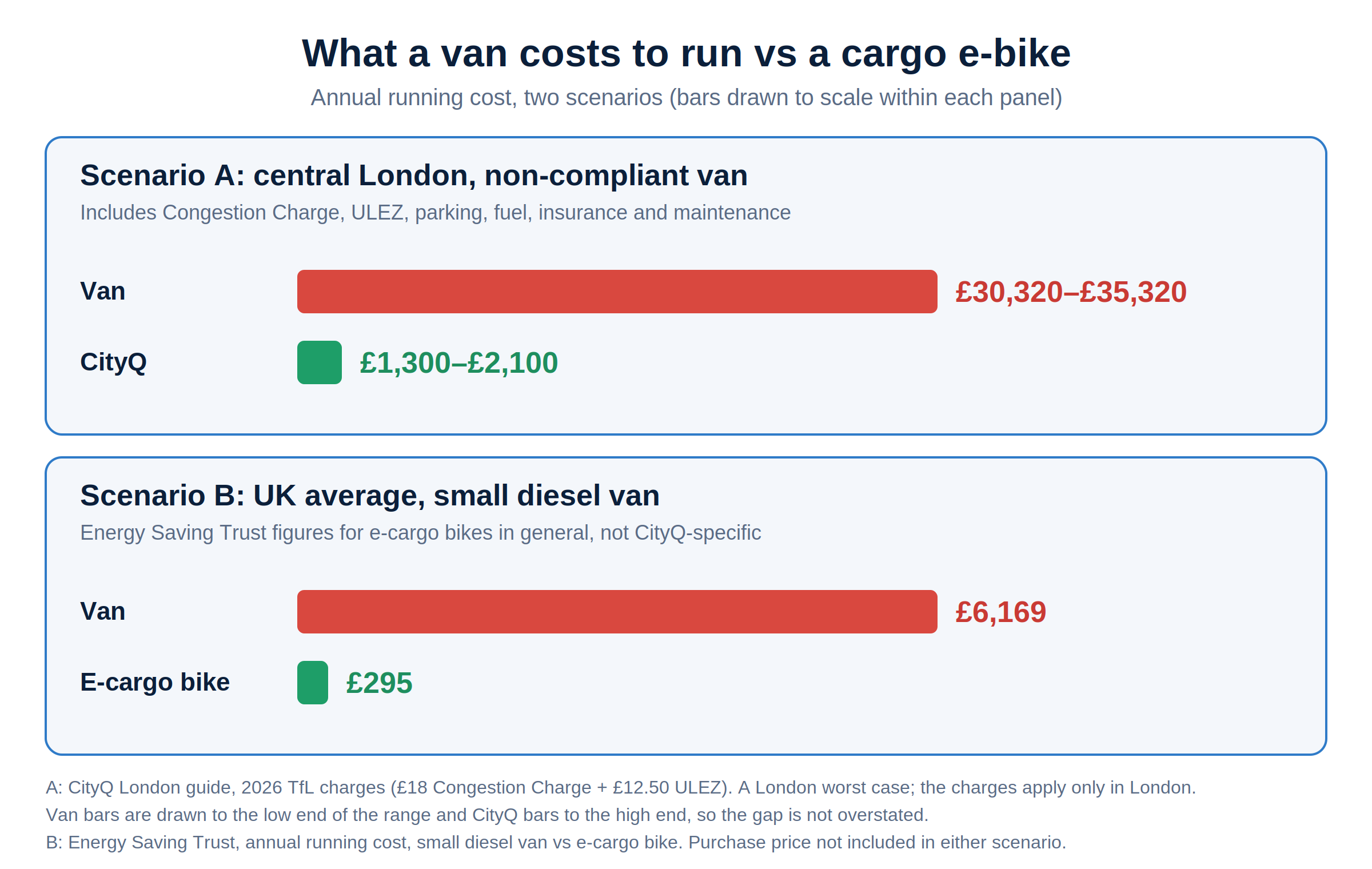
Here is where the van’s maths falls apart. This is CityQ’s own London worst case for a non-compliant van doing 10 paid stops a day over 240 working days.
| Annual cost item | Non-compliant van | CityQ |
|---|---|---|
| ULEZ (£12.50 × 240 days) | £3,000 | £0 |
| Congestion Charge (£18 × 240 days) | £4,320 | £0 |
| Parking (10 stops a day, £5 average) | £12,000 | £0 |
| Fuel | £7,000–£9,000 | £0 |
| Charging | — | £300–£500 |
| Insurance | £2,500–£4,000 | £500–£800 |
| Maintenance and MOT | £1,500–£3,000 | £500–£800 |
| Total | £30,320–£35,320 | £1,300–£2,100 |
Be careful with that table outside the capital. The zone charges apply only in London, and ULEZ applies only to non-compliant vehicles, so a compliant van or a route elsewhere shows a smaller gap, and the £295 against £6,169 comparison in the chart is the better guide. Every line of the London maths is broken down in the guide to running a cargo ebike for delivery in London, which is worth a read before you trust any headline saving. Your own fleet will tell a different story, so check whether you can replace a delivery van with a cargo eBike in the UK on your actual routes first. And if the purchase price is the sticking point, a local scheme like the Bristol electric cargo bike grant [VERIFY: confirm this grant is still open before publishing] can take a real bite out of it, so check what your own council offers.
Who should buy a 4 wheel electric cargo bike for commercial use, and when does a van still win?
Anyone running short, dense, multi-stop routes with loads under about 200kg. The longer list of who benefits most from a four-wheel cargo e-bike goes further, but CityQ reports it in daily use in these places:
- Food and parcel delivery: if you are hunting for the best bike for food delivery in the UK, the best cargo eBike for food delivery guide compares the options, while DHL’s two-year London operation shows how the parcel side holds up over time.
- Trades and field service: HVAC engineers carry tools and parts straight to kerbside jobs, and the window-cleaning firm Elite Vinduspuss replaced its van and reports a full Oslo winter without a parking fine.
- Cafes and independents: local rounds suit cafes, bakeries, restaurants and breweries that use the lockable box for short deliveries.
- Parks and public sector: The Dolmans maintains parks with CityQ vehicles across the Benelux, and councils and city services have tested them in the UK, from street cleaning to health services.
A van still wins in these cases, and it is better to know now:
- Heavy loads: anything regularly above 200kg, the top payload in the CityQ range.
- Long routes: days that need well over 100km of range without a battery swap.
- Motorway and regional work: CityQ’s assistance cuts off at 25 km/h.
- Tight access: older, closely spaced bollards can block an 89cm vehicle.
- A single rider with a light load: a two-wheel cargo bike costs less and clears narrower gaps.
Not sure which side of that list you are on? A cargo ebike for in-city delivery is easiest to judge on your own streets, and CityQ’s page on getting a free cargo eBike trial for your business in the UK explains how to arrange one.
FAQ's
Q1: What is a 4 wheel electric cargo bike?
A1: A 4 wheel electric cargo bike is a pedal-assisted cargo vehicle with four wheels, an electric motor that helps up to 25 km/h and a cargo box or flatbed. Built to the UK EAPC limits, it is treated as a bicycle, so businesses use it in place of a van on short urban routes. CityQ makes four models: the 850, the 1200, the Pickup & Customize and the Passenger.
Q2: Is a 4 wheel electric bike legal in the UK?
A2: Yes, if it meets the EAPC rules: working pedals, a motor of no more than 250W and assistance that cuts off at 25 km/h (15.5mph). UK law sets no limit on the number of wheels, weight or size. A vehicle that goes beyond these limits is classed as a moped or motorcycle and needs type approval, a licence, registration and insurance.
Q3: Do I need a driving licence for a 4 wheel electric cargo bike?
A3: Not for a vehicle that qualifies as an EAPC, which is how CityQ says its vehicles are certified (EN 15194 and EN 17860). The minimum rider age is 14. This is general information, not legal advice, so confirm the classification of your vehicle with CityQ and your insurer before you buy.
Q4: Is a 4 wheel electric bike a car or a bike?
A4: A CityQ is built as a bike, not a car: it has pedals, 250W of motor power and a 25 km/h assistance cut-off. A microcar (an L6e light quadricycle) is a motor vehicle that reaches 45 km/h, and in the UK it needs an AM licence at 16 or over, registration, road tax and insurance.
Q5: How much does a 4 wheel electric cargo bike cost?
A5: CityQ put its vehicle at roughly £11,000 in January 2026, so confirm the current price. Annual running costs in central London are £1,300–£2,100 for a CityQ against £30,320–£35,320 for a non-compliant van. Across the UK, the Energy Saving Trust gives £295 a year for an e-cargo bike against £6,169 for a small diesel van.
Q6: How much can a 4 wheel electric cargo bike carry, and how far does it go?
A6: The CityQ 850 carries 180kg in a 1m³ box, the CityQ 1200 carries 170kg in 1.3m³ and the CityQ Pickup & Customize carries 200kg on a flatbed with up to 1.7m³ of space. CityQ specifies a range of up to 100km per charge, and the batteries swap in about 30 seconds. A typical two-wheel cargo bike carries 80–100kg.
Q7: What is the best bike for food delivery in the UK?
A7: For multi-drop food rounds, look for a weatherproof lockable box, 150–200kg of payload, EAPC status and swappable batteries, which is the spec of a four wheel cargo e-bike such as the CityQ 850 or 1200. A two-wheel cargo bike can suit a single rider with a lighter load and narrow routes.
Q8: Can I use a cargo ebike for delivery in London?
A8: Yes. CityQ’s London guide says a vehicle that qualifies as an EAPC pays neither the £18 Congestion Charge nor the £12.50 ULEZ charge, which apply to London only. At 89cm wide, a CityQ can be blocked by older, closely spaced bollards, so check your routes first.
Q9: Is a 4 wheel cargo bike more stable than a 2 wheel one?
A9: Yes. Four wheels spread the weight across four contact points, so the vehicle is far harder to tip, it stands unaided without a kickstand and the rider needs no balancing skill. CityQ’s models are certified to the EN 17860 cargo bike safety standard.
Q10: Can I try a 4 wheel electric cargo bike before buying?
A10: Yes. You can book a CityQ test drive and ride it on the routes your team actually runs, which is the quickest way to check load, access and parking against your current van.
Back at that 9am kerb
Remember the two vehicles? The van is still circling, the meter is running and the driver is checking the parking app for the third time. The 4 wheel electric cargo bike has already unloaded, locked the box and moved on to stop two. If your routes look like that, book a CityQ test drive and ride one where your drivers actually work, or get an offer for the CityQ 1200 or another model that fits your loads.
So here is the only question left: which of those two vehicles will your next delivery arrive in?

