


The DHL cargo ebike UK operation has logged more than one million kilometres on CityQ four-wheel cargo e-bikes in London, with zero reported rider injuries. It has run for over two years on the same inner-city routes where vans queue in traffic, hunt for parking and pay up to £30.50 a day in Congestion Charge and ULEZ fees (2026 rates). UPS has taken a parallel path with its electric cargo bike UK pilots, trialling Fernhay eQuad four-wheel cargo bikes in London and other UK cities.
The business case for cargo bike last mile delivery in the UK rests on more than sustainability. It rests on speed, access and cost on dense urban routes.
TL;DR: DHL’s cargo ebike UK fleet is CityQ four-wheel cargo e-bikes, used for London inner-city delivery and for Formula 1 event logistics in Barcelona. UPS has run an electric cargo bike UK pilot with Fernhay eQuad four-wheel bikes in London and Norwich. Both chose cargo e-bikes for access to cycle lanes and pedestrianised zones that vans cannot use, plus lower emissions and running costs. In London in 2026, a van pays an £18/day Congestion Charge, plus £12.50/day ULEZ if it is not ULEZ-compliant, up to £30.50/day. A cargo e-bike that qualifies as an EAPC pays neither.

Why Are DHL and UPS Turning to Cargo E-Bikes?
Cities have changed, and vans have not. In London, Birmingham, Bristol and a growing list of UK cities, the conditions that made the van the default delivery vehicle now work against it: congested roads, tighter parking enforcement, contested kerbside space and zone charges.
In London, as of 2026, the Congestion Charge is £18 a day and the ULEZ charge is £12.50 a day for vehicles that do not meet the standard. A van that fails ULEZ and enters the Congestion Charge zone therefore pays up to £30.50 a day before fuel, insurance or parking. Going electric does not remove the Congestion Charge either: the discount that exempted electric vehicles ended on 25 December 2025.
A cargo e-bike that qualifies as an EAPC (Electrically Assisted Pedal Cycle) is legally a bicycle. It pays neither charge, can use cycle lanes, and pulls up at the delivery point instead of circling for a space.
DHL Cargo Ebike UK: How DHL Uses CityQ in London
DHL has operated CityQ four-wheel cargo e-bikes on London inner-city routes for over two years, and CityQ describes it as a commercial operation, no longer a pilot. In its two-year London operation, DHL has operated CityQ four-wheel cargo e-bikes on London inner-city routes for over two years, and CityQ describes it as a commercial operation, no longer a pilot. In its two-year London operation, DHL has logged over one million kilometres with zero reported rider injuries. Other fleets running the same bike, including JCDecaux, Wolt and German operators, use it as a cargo ebike for business on daily inner-city routes and report similar results.
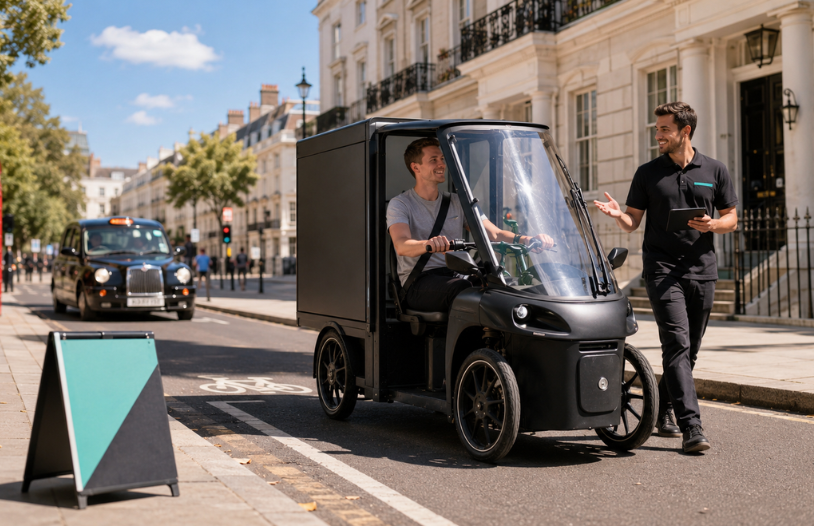
The design explains much of that record. The four-wheel layout is stable on uneven, wet London surfaces, the enclosed cargo box protects parcels in all weather, and EAPC status means no ULEZ charge, no Congestion Charge and no driving-licence requirement. That last point widens the pool of people who can be put on a route.
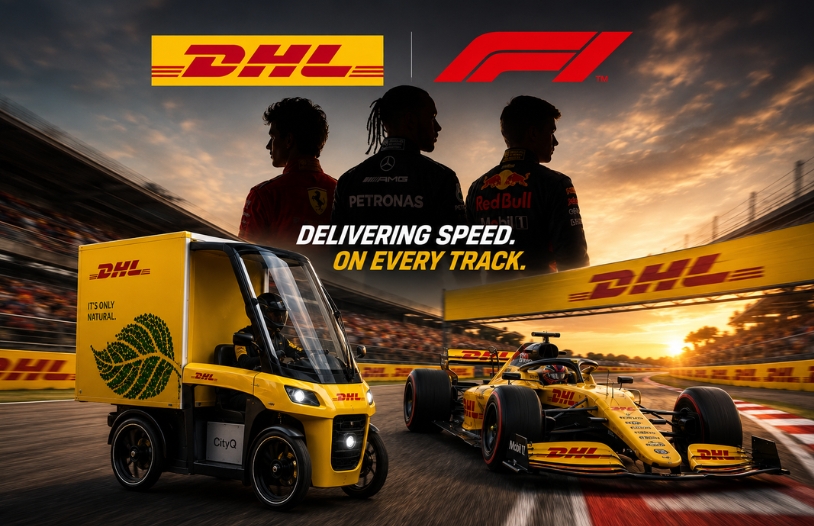
DHL also took CityQ bikes beyond London, using them for event logistics at the Formula 1 Grand Prix in Barcelona, where vehicle access is restricted.
DHL also took CityQ bikes beyond London, using them for event logistics at the Formula 1 Grand Prix in Barcelona, where vehicle access is restricted. It was a very different job from daily parcel rounds, and the same bike handled it.
How UPS Uses an Electric Cargo Bike in the UK
UPS began piloting the Fernhay eQuad in London in 2022, and later in other UK locations including Norwich. The eQuad is a four-wheeled, pedal-assist cargo bike with a lock-secured cargo container.
According to UPS, the eQuad is 84 cm wide and 3 m long, carries up to 210 kg, and travels about 60 km (37 miles) on a single charge from a standard plug, so no specialist charging infrastructure is needed. At that width it can use cycle lanes and dual-use pedestrian zones.
UPS e-cycle operator George Dann put the logic plainly: the bikes are a great way to beat traffic and reach addresses that are harder to reach by a traditional package car. Access matters as much as speed. A van cannot use a cycle lane or enter a pedestrianised zone. A cargo e-bike can, subject to local rules.
UPS says it has implemented more than 30 e-cycle projects across Europe, including Dublin, Paris, Copenhagen, Stockholm, Amsterdam, Rotterdam, Hamburg and Heidelberg (UPS, 2022). The UK pilots sit inside a wider programme.
Why Cargo E-Bikes Work for Urban Last-Mile Delivery
- Speed through traffic. A University of Westminster study (2021) used GPS data from Pedal Me cargo bike deliveries in central London and modelled the routes a van would have taken for the same parcels. Cargo bikes were on average 1.61 times faster, delivering nearly seven parcels an hour against four for vans. The study covered Pedal Me’s fleet, not DHL’s or UPS’s, but the mechanism is the same: vans lose time to congestion, traffic restrictions and parking.
- Kerbside access. A cargo e-bike stops at the door. A van has to find a space first, and every minute spent doing so comes off the working day.

- Regulatory cost elimination. Congestion Charge £18/day and ULEZ £12.50/day (non-compliant vans) are both £0 for an EAPC cargo e-bike. Clean Air Zones in cities such as Birmingham, Bristol and Bath apply to motor vehicles, not cycles.
- No licence requirement. An EAPC-classified cargo e-bike needs no driving licence, MOT or vehicle tax. That removes friction for seasonal, agency or multi-role staffing. Classification for four-wheelers depends on construction and certification, so check the rules on driving licence requirements for a 4-wheel e-bike before you plan around it.
- Payload that fits urban rounds. The CityQ 1200 carries up to 200 kg in a modular 1.3 m³ cargo box. That covers many parcel, food and tool-carrying rounds.
Cargo E-Bikes vs Delivery Vans
This comparison fits dense inner-city routes with many stops and loads under about 200 kg. Vans keep the advantage on longer routes, heavier payloads and suburban or rural work.
Swapping a diesel van for an electric one cuts tailpipe emissions, but it does not give you cycle lane access or a kerbside stop, and it still pays the Congestion Charge. An electric van also uses far more energy per kilometre. CityQ’s own cargo bike vs electric van analysis puts the van at roughly 30 kWh per 100 km of city route against about 3 kWh for a four-wheel cargo bike, and it also works through the charging costs.
| Factor | Diesel Van | 2-Wheel Cargo eBike | CityQ 4-Wheel Cargo eBike |
|---|---|---|---|
| Max payload | 1,000+ kg | Lower, varies by model | Up to 200 kg (CityQ 1200) |
| ULEZ charge (London, 2026) | £12.50/day if non-compliant | £0 | £0 |
| Congestion Charge (London, 2026) | £18/day | £0 | £0 |
| Cycle lane access | ✗ | ✓ | ✓ (width permitting) |
| Kerbside delivery | Limited | ✓ | ✓ |
| Enclosed weather protection | ✓ | ✗ | ✓ |
| Stability at full load | ✓ | Limited | ✓ |
| Driving licence required | ✓ | ✗ | ✗ |
| Range per charge | Fuel | Varies by model | Up to 100 km |
| Est. daily running cost, London | £75.50–£115.50 | Low | About £0.50 |
Daily running costs are CityQ’s own estimates from its London business guide.

The honest caveat: a cargo e-bike is not right for every job. Loads above roughly 170–200 kg, long routes and very narrow cycle lanes or bollard gaps remain van territory. For dense urban rounds with loads under that, the operational case is strong. If you are choosing a model, compare the best cargo e-bike for UK delivery options on payload and running cost. If you are asking whether you can replace a delivery van outright, the answer depends on payload, route length and legal status.
Costs and access vary by business type, so before you commit, our guide to running an electric cargo bike in London shows how the numbers play out on your own routes.
What This Means for the Future of UK Last-Mile Delivery
Transport for London’s 2023 Cargo Bike Action Plan estimated that cargo bikes could replace up to 17% of van kilometres in central London by 2030 (TfL). Clean Cities’ analysis of TfL cycle counts found cargo bike use in London rose 104% between 2022 and 2024, though growth slowed between the last two years.
Four-wheel enclosed cargo e-bikes suit operators who need year-round operation, payloads above what most two-wheelers carry, and weather protection for cargo. UPS piloted a four-wheel eQuad and DHL runs a four-wheel CityQ.
Where Does CityQ Fit Into This Shift?
CityQ is the cargo e-bike DHL uses in London: a four-wheel, chainless, pedal-assist bike built for urban delivery and certified to EN 15194. CityQ also says it is the first four-wheel cargo bike in Europe to hold EN 17860 certification, the safety standard written specifically for cargo bikes.
The DHL deployment is the most direct proof of commercial use: more than a million kilometres on London streets. CityQ’s position as the pioneer 4-wheel cargo ebike rests on four years of development and two years of fleet data from DHL, JCDecaux and Wolt. The CityQ 1200 is the higher-payload model, with up to 200 kg and up to 100 km range.
To see how a CityQ performs on your own routes, book a test drive.
Why Four-Wheel Electric Cargo Vehicles Could Be the Next Step
At higher payloads, two-wheel cargo bikes get harder to handle on wet or uneven surfaces and when cargo shifts. A four-wheeler stays upright at a standstill and at low speed, which helps with frequent kerbside stops and with riders of varying experience. The trade-offs of 4-wheel vs 2-wheel cargo e-bikes include cycle-lane and bollard width, where a narrower two-wheeler can win.
The CityQ’s configuration offers:

- Stability under load, tested to EN 17860, the cargo bike standard
- An enclosed, weatherproof cargo box
- A chainless drivetrain, removing chain wear as a maintenance point
- Swappable batteries for mid-route changes
- EAPC status, where the vehicle qualifies, with the access and cost exemptions that follow
Who Else Runs CityQ on Urban Delivery Routes?
How Has DHL Used CityQ Beyond Daily London Rounds?
DHL has operated CityQ cargo e-bikes on London inner-city routes for over two years, logging more than one million kilometres with zero reported rider injuries. Kerbside access, cycle lane use and exemption from ULEZ and the Congestion Charge feed directly into faster rounds and lower per-delivery cost, as the last-mile delivery in London results show. DHL also deployed CityQ bikes at the Formula 1 Grand Prix in Barcelona.

How Does Wolt Use CityQ for Quick Commerce?
Wolt runs CityQ 1200 bikes in Oslo for quick-commerce delivery, with year-round weather resilience a key reason. Quick commerce depends on short delivery windows, so the vehicle has to be reliable in all conditions, which is why Wolt’s Oslo operation is a useful reference for UK fleets.

FAQ's
Q1: Does DHL use cargo e-bikes in the UK?
A1: Yes. DHL has run CityQ four-wheel cargo e-bikes on London inner-city routes for over two years in commercial operation, logging more than one million kilometres with zero reported rider injuries. DHL also used CityQ bikes at the Formula 1 Grand Prix in Barcelona.
Q2: Does UPS use cargo e-bikes in the UK?
A2: UPS has piloted Fernhay eQuad four-wheel electric cargo bikes in London since 2022 and in other UK locations including Norwich. The eQuad carries up to 210 kg and travels about 60 km (37 miles) per charge. Check UPS for the current deployment status.
Q3: Why are major logistics companies switching to cargo e-bikes for UK delivery?
A3: Cargo e-bikes can use cycle lanes and pedestrian zones, reach the kerbside directly, and avoid zone charges. In London in 2026, a van pays an £18/day Congestion Charge, plus £12.50/day ULEZ if it is not ULEZ-compliant. An EAPC cargo e-bike pays neither.
Q4: What payload can a commercial cargo e-bike carry?
A4: Commercial four-wheel cargo e-bikes typically carry around 170 to 210 kg. The CityQ 1200 carries up to 200 kg in a 1.3 m³ modular cargo box, and the UPS Fernhay eQuad carries up to 210 kg.
Q5: Are cargo e-bikes faster than vans for urban delivery in the UK?
A5: A 2021 University of Westminster study of Pedal Me cargo bikes in central London found they were on average 1.61 times faster than vans, delivering nearly seven parcels an hour against four. The study modelled van routes from GPS data and covered one operator’s fleet.
Q6: Do cargo e-bikes need a driving licence in the UK?
A6: No, if the vehicle qualifies as an EAPC: motor of 250W or less, assistance cutting off at 15.5 mph, and working pedals. Qualifying cargo e-bikes are treated as bicycles, so no driving licence, registration or road tax applies.
Q7: Are cargo e-bikes exempt from London’s ULEZ and Congestion Charge?
A7: Yes, when they qualify as EAPCs. The charges apply to motor vehicles, and in 2026 the Congestion Charge is £18/day and the ULEZ charge is £12.50/day for non-compliant vehicles.
Q8: What is the range of a commercial cargo e-bike?
A8: Range varies by model. The CityQ 1200 offers up to 100 km per charge with swappable batteries for mid-route changes, and the UPS Fernhay eQuad offers about 60 km.
Q9: Which cargo e-bike does DHL use in London?
A9: DHL uses the CityQ four-wheel cargo e-bike in London. It has an enclosed cargo box, up to 200 kg payload and up to 100 km range, and is certified to EN 15194 and EN 17860.
Q10: Is cargo e-bike delivery viable outside London?
A10: Cargo e-bike delivery suits any UK city with dense streets, parking pressure or zone charges. UPS has run eQuad pilots in London and Norwich, and has more than 30 e-cycle projects across Europe.
The direction is set. The question is timing.
DHL has run a million kilometres on CityQ in London. The question for your operation is which routes, loads and stop patterns fit, and when the saving justifies the switch.
Before you decide, check how the Annual Investment Allowance makes a cargo eBike tax deductible in the UK. A free cargo eBike trial then puts a CityQ on your own routes with real loads and real stops, or you can book a test drive.


