


Customer Story
“People ask what cool car I’ve got. It’s a bike.”
Christian Pettersen turns heads on Karl Johan, Oslo’s busiest pedestrian street. He rolls past tourists, prams and tram tracks in something that looks like a compact car but moves like a bicycle — because that’s exactly what it is.
“I often get comments about what a cool car I’ve got,” Christian says with a grin. “But it’s a bike.”
Christian cleans windows for Elite Vinduspuss, a firm that works across some of the most parking-hostile streets in Norway. Where almost every other tradesperson and service worker in the city is tied to a van, he has — since autumn 2025 — done his entire daily round on a CityQ electric cargo bike: a four-wheel, enclosed, car-like cargo ebike designed and headquartered in Oslo.
It’s a small switch with an outsized effect. The van problem that quietly drains every urban service business — parking, access, hiring, cost — mostly disappeared the day Elite Vinduspuss parked the van and rolled out the bike.
This is the story of how, and why, and where it does and doesn’t make sense.
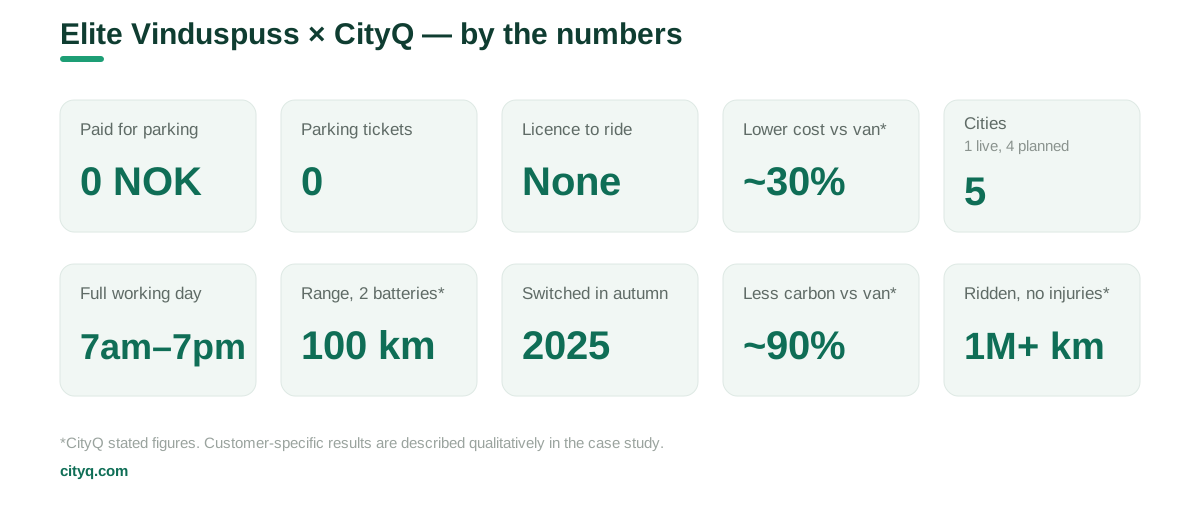
The Oslo van penalty: what a service round really costs
Fuel is the cost everyone notices. It’s almost never the one that hurts. For a city window-cleaning round, the expensive part of a van is everything that happens around the driving.
Start with parking. In Oslo’s central zone, a fossil-fuel vehicle pays roughly 90 NOK per hour on the street — and is capped at a two-hour maximum in the busiest tariff group. A window-cleaning round isn’t two hours in one spot; it’s a dozen short stops across the centre. So the van driver either feeds meters all day or moves the vehicle constantly, losing minutes each time to the search for the next legal space.
Then the ticket. Oslo’s parking penalties run in three tiers: 330 NOK for an expired or unmarked space, 660 NOK for parking against the regulations, and 990 NOK for misusing a disabled bay. The cruel part for a service business is the timing — a job almost always runs longer than the meter, and the fine lands while the worker is still up a ladder, unable to do anything about it.
Now add the parts that never show on an invoice: pedestrian zones and tram corridors a van simply can’t enter, the licence requirement that shrinks the hiring pool, and the growing expectation from large clients that their suppliers turn up clean and green. The false start: why the first cargo bike failed
Here’s the part most case studies leave out — and the part that matters most. Elite Vinduspuss didn’t fall in love with cargo bikes on the first try. Their first one was a disappointment.
“We had a lot of problems with the first bike we tried,” recalls Atle Fremstad, CFO of Elite Vinduspuss. For a service firm, an unreliable vehicle isn’t a minor irritation — it’s a day of lost jobs every time it fails. A cargo bike that spends mornings in the workshop is worse than the van it was meant to replace.
So the bar for switching wasn’t “is it greener?” It was “is it reliable enough to bet a working day on?” The technology had to be genuinely good enough first. For a long time, it wasn’t. Then it was.
The solution: a cargo bike that finally works like one
What changed Elite Vinduspuss’s mind was CityQ’s drive-by-wire platform — a software-based, chainless drivetrain with no traditional mechanical chain or belt linking pedal to motor.
“This one has drive-by-wire technology, which means far fewer problems,” says Fremstad. “It’s a completely new world compared to the first bike we had.”
Fewer mechanical parts means fewer things to break, fewer days off the road, and far lower maintenance — the difference between a green gesture and an actual work vehicle. On top of the drivetrain, the CityQ Christian rides gives Elite Vinduspuss four things a van never could in the city centre:
It goes where the work is. “You can get through anywhere with it — city streets, pavements, the lot,” Christian says. “So you reach your sites very easily.” Tourists, prams, tram tracks — he threads past all of it without breaking stride.
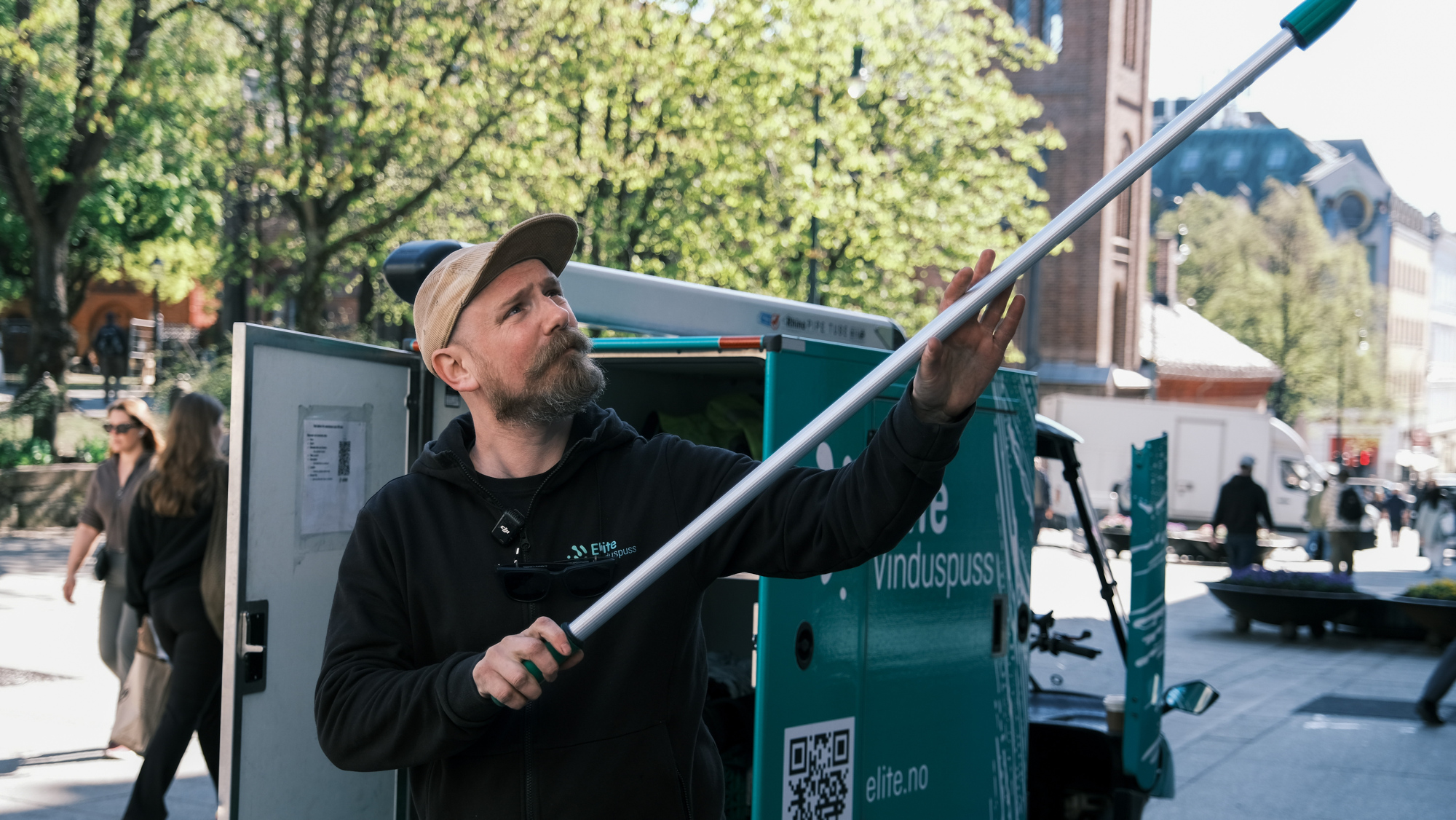
It parks itself out of the problem. Classified as what it is — a bicycle — it parks almost anywhere, with no fee and no fine. “Now I don’t have to search for a parking space in the centre at all,” Christian says.
It carries a full day’s kit, dry and secure. Water, cloths, chemicals, spare clothes and spare batteries all ride in the enclosed cargo box, protected from Oslo weather between jobs.
It runs the whole day. “I can ride from seven in the morning to between five and seven in the evening,” he says. “If it’s winter and cold, I bring extra batteries — and that works fine too.”
“CityQ is an amazing alternative to a car in the inner city. It’s easy to ride and park exactly where we do our window cleaning, and everything we need is in the bike. And no driving licence required — which was the reason we bought one in the first place.”
— Elite Vinduspuss, Oslo
A day on Karl Johan
Picture the round. Christian sets off at seven, the cargo box loaded, the telescopic reach pole strapped to the roof. He doesn’t plan the day around parking — there’s nothing to plan. He rides straight down Karl Johan, past the queues of traffic that a van would be sitting in, and stops directly outside the first storefront.
He parks at the door. No meter. No two-hour clock. No circling the block. He cleans the windows of his first three customers before most van-based crews have found their second parking space. When a job runs long, it simply runs long — there’s no penalty ticking down on a windscreen somewhere around the corner.
Between stops, the bike is a sealed, weather-proof cabin: he stays dry, the kit stays dry, the chemicals stay secure. At the top of the round he extends the roof pole to reach the upper-floor glass. Then he rolls to the next address — through a pedestrian zone, if that’s the shortest line — and does it again.
“I can ride from seven in the morning to between five and seven in the evening,” he says. A full working day, on a vehicle that costs almost nothing to keep on the road.
The results: cheaper, faster, easier to hire for
The business case, in Atle Fremstad’s own words:
“The bike is cheaper than a van, and we save money on parking and service. We can also hire people without requiring them to have a car driving licence.” — Atle Fremstad, CFO, Elite Vinduspuss
Three levers move the margin, and they compound:
1. Lower running cost. No fuel, no van servicing bill, and — decisive in the centre — no parking spend and no fines. CityQ states its cargo bikes run at roughly 30% less cost than a van.
2. A working day that holds together. Cycle-lane access and doorstep parking remove the two things that quietly destroy a service round: traffic and the parking search. CityQ puts that time saving at up to 50% more efficient transport than a car on inner-city routes — and on a multi-stop day, recovered time means recovered jobs.
3. A bigger hiring pool. Because no driving licence is required, Elite Vinduspuss can put any capable rider on the road. For many service firms — including this one — that single factor is the reason they switch at all.
For Christian, the headline benefit is simpler and entirely human: he never gets a parking ticket, and he never has to think about where to leave the bike.
Van vs CityQ, on an Oslo service round
| Service van, Oslo centre | CityQ cargo bike | |
|---|---|---|
| On-street parking | ~90 NOK/hour, 2-hour max in central zone | Free, no time limit where bikes park |
| Parking-fine risk | 330–660 NOK per ticket, often mid-job | None |
| Driving licence | Required | Not required |
| Pedestrian zones & cycle lanes | Restricted / blocked | Full access |
| Traffic | Sits in it | Rides past it |
| Fuel | Ongoing cost | None — electric, ~2.9 kWh for 100 km |
| Weather protection | Yes | Yes — enclosed, car-like cabin |
| Running cost | Baseline | ~30% lower (CityQ) |
| Carbon | Baseline | ~90% lower (CityQ) |
Parking rates and fine tiers are City of Oslo 2026 figures. Percentage figures are CityQ stated estimates.
Why the green angle is now a sales angle
For years, sustainability was the nice-to-have reason to consider a cargo bike. For Elite Vinduspuss, it has become a commercial requirement.
“Large clients require us to be environmentally friendly,” says Fremstad. “And beyond that, we’re a company that cares about the environment — not just the bottom line. We care about doing things the right way.”
A CityQ produces zero tailpipe emissions and, per CityQ’s figures, around 90% less carbon than a van over comparable use. For a supplier bidding on contracts with large, climate-conscious clients, turning up on a clean, quiet, zero-emission vehicle isn’t just good values — it’s increasingly the price of being on the tender list.
What happens next: from one bike to five cities
Elite Vinduspuss isn’t treating this as a novelty. “We’re establishing a proof of concept right now,” says Fremstad. “The ambition is to bring electric cargo bikes into the other cities we operate in too — Bergen, Stavanger, Haugesund and Kristiansand.”
That’s the pattern CityQ sees again and again: a business buys one bike for a single, concrete reason — parking, licence, cost, or a client’s sustainability demand — proves it on the ground, then scales it across the operation. One window cleaner on Karl Johan today; a national cargo-bike fleet tomorrow.
Riders in Oslo are kept on the road by Kaia Mobility at Filipstadveien 5 — a dedicated mobility hub for cargo-bike service, maintenance and repairs, and home to CityQ’s Oslo demo and visit centre. It’s what makes running a cargo-bike operation as straightforward as running a van fleet, without the van.
Is a CityQ right for your service business?
CityQ is at its best exactly where Elite Vinduspuss uses it: dense city rounds with multiple short stops, frequent load-and-unload, tight parking and restricted access. Window cleaning, facilities maintenance, HVAC, plumbing, electrical call-outs and inner-city service work all share that shape.
We’ll also tell you where it doesn’t fit. For heavy plant, full installations or long rural routes between distant sites, a van still wins. Most firms run both — CityQ for the city, a van for the heavy jobs. The honest answer is usually the most useful one.
The numbers behind the bike. CityQ is legally a bicycle: top speed 25 km/h, with pedal assist engaging beyond 6 km/h, and it’s certified to EU standards EN15194 and EN17860 (CE marked). The platform has carried riders for over one million kilometres with no reported injury. Depending on the work, models range from the CityQ 850 (180 kg payload, ~1 m³ cargo) up to the Pickup & Customize (200 kg, ~1.7 m³) — enough for a full day’s service kit, dry and locked.
Frequently Asked Questions
What is the best vehicle for a window-cleaning business working in a city centre?
For a dense round of multiple jobs a day, a four-wheel enclosed electric cargo bike like CityQ is increasingly the most practical option. It parks free at the exact address with no meter or fine risk during overruns, reaches the work through cycle lanes and pedestrian zones a van can’t enter, needs no driving licence, and carries a full day of poles, water, cloths, chemicals and spare batteries in a sealed, weather-proof cargo box. For long routes between distant sites, a van may still suit better — but for the daily city round, the cargo bike protects the billable time a van loses to traffic and parking.
Can an electric cargo bike really replace a van for window cleaning?
Yes, for inner-city work. Elite Vinduspuss in Oslo replaced a service van with a CityQ cargo bike in autumn 2025 and now runs a full day’s window-cleaning round on it — telescopic reach pole on the roof, all equipment in the cargo box, spare batteries for winter. The firm reports lower costs, easier parking and a wider hiring pool, and is now planning to roll cargo bikes out to its other Norwegian cities.
How much does a van pay to park in central Oslo — and how does a cargo bike avoid it?
In Oslo’s central tariff zone, a fossil-fuel vehicle pays roughly 90 NOK per hour and is limited to a two-hour maximum, with parking fines of 330–660 NOK for common violations. A CityQ is legally a bicycle, so it parks free wherever cycles are allowed, with no time limit and no fine risk — removing the cost and the mid-job ticket entirely.
How do window cleaners and tradespeople avoid parking tickets in the city?
By using a vehicle that is legally a bicycle. Because CityQ is classified and certified as a cargo bike (under EU standards EN15194 and EN17860), it can be parked free wherever bicycles are allowed — at the exact job address, with no meter to expire mid-job, which is when most service workers pick up fines. As Elite Vinduspuss’s rider puts it: with the cargo bike, he never gets a parking ticket.
Do you need a driving licence to operate a CityQ cargo bike for work?
No. CityQ is legally a bicycle, so no car driving licence is required. Any capable adult who can ride a bike can operate one after a short induction on the four-wheel platform. For service firms this is often the deciding factor — it widens the pool of riders and apprentices you can hire, which is exactly the reason Elite Vinduspuss cites.
Is a cargo bike cheaper than a van for a service business?
In the city centre, usually yes. There’s no fuel, no van service bill, no parking spend and no fines, and far lower running costs overall. CityQ states its cargo bikes run at around 30% less cost than a van. Elite Vinduspuss confirms the bike is cheaper than a van and that it saves money on both parking and servicing.
Can you fit window-cleaning equipment on a cargo bike?
Yes. The CityQ has a sealed, lockable, weather-proof cargo box plus a roof rack. Elite Vinduspuss carries water, cloths, cleaning chemicals, spare clothing and spare bike batteries inside, with a telescopic pole mounted on the roof to reach upper-floor windows — a complete mobile window-cleaning setup. Models range from around 1 m³ of cargo space up to 1.7 m³.
What is “drive-by-wire” on a CityQ cargo bike, and why does it matter?
Drive-by-wire is CityQ’s software-based, chainless drivetrain — there’s no traditional mechanical chain or belt linking the pedals to the motor. It means fewer moving parts to fail and far lower maintenance, which is why Elite Vinduspuss found this bike reliable enough to run as a daily work vehicle after an earlier cargo bike from another maker had proved too unreliable.
How long can a CityQ run on a full working day?
Elite Vinduspuss’s rider works a full day on the bike — roughly 7am to 5–7pm — and carries spare swappable batteries for cold winter conditions. CityQ offers up to 100 km of range on two swappable batteries (about 2.9 kWh), so a typical inner-city service round comfortably fits within a single day, even in Norwegian winter.
Is a cargo bike practical in winter and bad weather?
Yes. The CityQ is a fully enclosed, car-like cabin, so the rider and the equipment stay dry and protected. Elite Vinduspuss runs the bike through Oslo winters by carrying spare batteries, since cold weather reduces range — a simple swap keeps the bike working a full day.
Where can I service or repair a CityQ in Oslo?
Through Kaia Mobility at Filipstadveien 5 in Oslo — a dedicated mobility hub for cargo-bike service, maintenance and repairs, which is also where CityQ’s Oslo demo and visit centre is based.
CityQ designs and builds four-wheel, enclosed, car-like electric cargo bikes that replace vans and cars for inner-city logistics and service work — faster through traffic, free to park, no driving licence, and certified to EU standards. Headquartered in Oslo, Norway, with a German design and certification base in Stuttgart.
Ready to run your city round without the van? Get an offer · Book a test ride · See the models


