


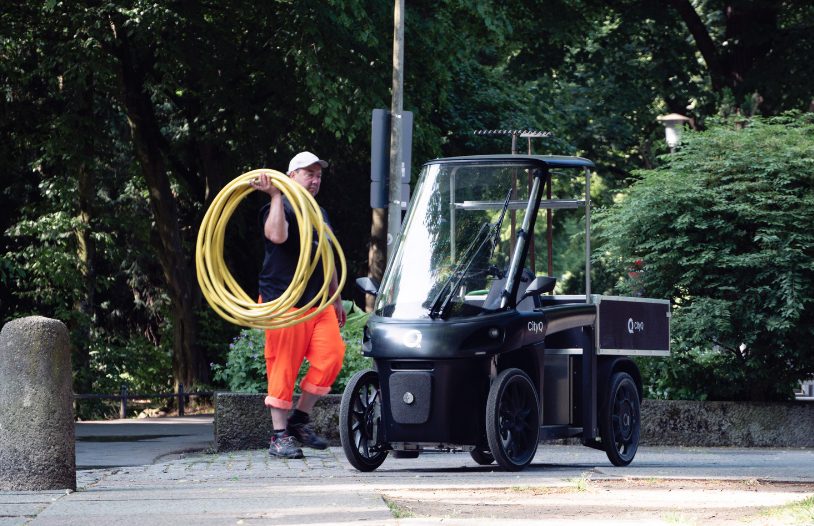
Urban service and repair businesses face a growing operational challenge. Whether it is electricians, HVAC technicians, plumbers, or facility maintenance teams, moving tools and reaching job sites quickly in dense cities is becoming increasingly difficult.
Traffic congestion, limited parking, and rising operational costs are affecting the efficiency of service teams across many European cities. In areas such as London, Stuttgart, and other dense urban environments, companies are exploring alternative mobility solutions that allow technicians to move more efficiently while carrying the equipment they need.
One emerging option being considered is the electric cargo bike for service businesses, particularly vehicles designed for stable urban operation. For technicians travelling through busy city streets, the stability and safety of four-wheel cargo e-bikes in cities can also be an important factor when evaluating alternative transport options.
The Mobility Challenge for Urban Service Teams
Traditional vans have long been the default vehicle for service technicians. However, in many city centres they are not always the most efficient solution.
Service teams often face challenges such as:
-
Time lost in traffic congestion
-
Difficulty finding parking close to job sites
-
Access restrictions in low-emission or limited-vehicle zones
-
Operational costs related to fuel, parking, and maintenance
For businesses that perform multiple service calls per day, even small delays can impact scheduling and productivity.
This is where electric cargo bikes can offer an alternative approach for certain types of service operations.
When Cargo E-Bikes Make Sense for Service Work
Electric cargo bikes are not designed to replace vans in every situation. However, for many urban service tasks involving tools, spare parts, and short-distance travel, they can provide practical advantages.
Technicians working within compact service areas often need to transport:
-
Tool kits
-
Diagnostic equipment
-
Spare components
-
Small replacement parts
In these situations, cargo e-bikes with enclosed storage compartments can support technicians moving between nearby service locations without relying entirely on vans.
CityQ as a Practical Option for Urban Service Mobility
The CityQ four-wheel electric cargo bike is designed to combine the flexibility of a bicycle with the stability and storage capacity required for professional use.
For service and repair businesses operating in dense city environments, vehicles like CityQ can potentially support daily operations in several ways.
1. Easier Navigation Through Urban Streets
Because electric cargo bikes can use cycling infrastructure where permitted, technicians may be able to move through congested areas more efficiently than larger vehicles.
This can be particularly useful for service calls located in busy city centres where vans often experience delays.
2. Closer Access to Service Locations
Finding parking near customer locations is a common challenge for service teams.
Cargo e-bikes typically require less space and can often be parked closer to the service location, reducing the time technicians spend walking between parked vehicles and job sites.
3. Transporting Essential Tools and Parts
The cargo storage area can allow technicians to carry commonly used tools and parts needed for routine service tasks.
While heavier equipment may still require vans, many day-to-day service visits involve relatively compact tool sets that can be transported using cargo bikes.
4. Supporting Flexible Fleet Operations
Some service companies are exploring mixed fleets that combine vans with smaller vehicles for urban work.
In these setups, vans can handle large equipment transport while cargo bikes are used for:
-
Quick service visits
-
Dense urban routes
-
Maintenance checks
-
Short-distance service calls
- No driver licence required
This approach can help businesses adapt their mobility strategy depending on the job type and location.
Potential Use Cases in the Service Industry
Electric cargo bikes may be useful for several types of urban service businesses, including:
Electrical service technicians
Carrying diagnostic tools, meters, and small electrical components.
HVAC maintenance teams
Transporting handheld equipment and replacement parts for routine service visits.
Plumbing services
Handling inspection visits or small repair jobs within city centres.
Facility maintenance teams
Managing building inspections, lighting maintenance, and small repair tasks across multiple nearby sites.
Property management services
Moving between buildings for inspections or scheduled maintenance.
The suitability of cargo e-bikes will depend on the specific tools required and the operating area.
A Complement to Existing Fleets
It is important to note that electric cargo bikes are not intended to replace all service vehicles.
Instead, they can complement existing fleets by offering an additional mobility option for certain types of service work, particularly in dense urban environments where manoeuvrability and parking access are key factors.
Companies evaluating cargo bikes often start by testing them on specific routes or service areas before expanding usage.
Rethinking Urban Service Logistics
As cities continue to evolve, service businesses are increasingly reviewing how their teams move through urban environments.
Electric cargo bikes represent one of several options that companies may consider when looking to improve operational efficiency, especially for short-distance service operations within busy city centres.
For organisations working in dense urban areas, exploring flexible transport solutions can help teams reach customers more efficiently while adapting to changing city mobility conditions.