And it accidentally revealed something important about the future of city delivery
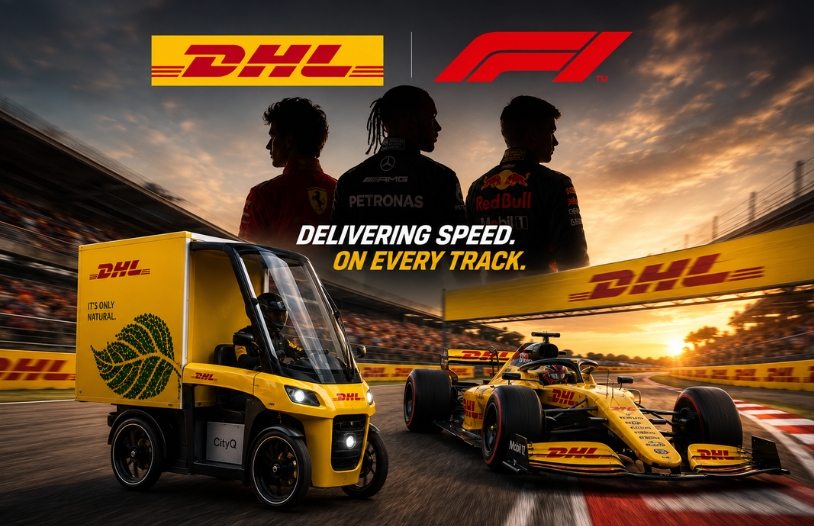
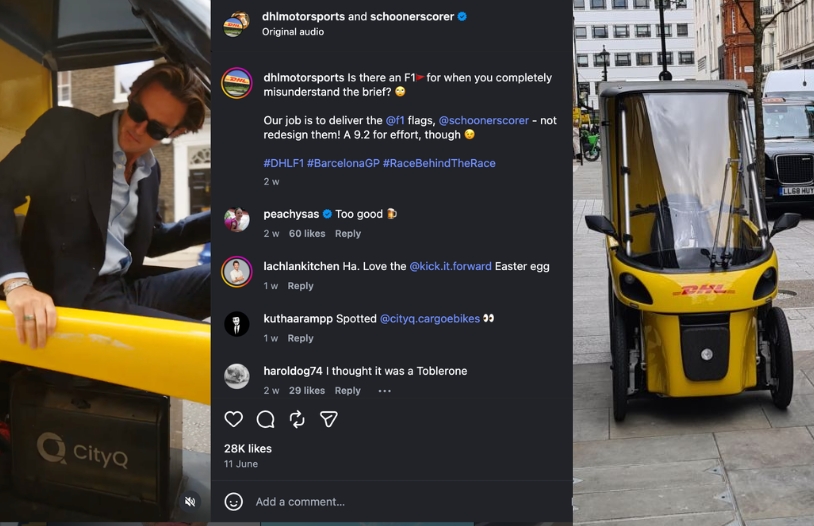
When DHL — the Official Logistics Partner of Formula 1 — posted their latest Instagram reel, they captioned it with one of the best pieces of self-aware marketing we have seen all year:
“Is there an F1 for when you completely misunderstand the brief? Our job is to deliver the F1.”
The video shows DHL riders on bright yellow CityQ four-wheel cargo bikes navigating city streets in Barcelona during Formula 1 weekend. No pit lane. No racing suits. No 200mph. Just a CityQ quietly, efficiently, getting packages to the door while the actual racing cars were doing something very different a few kilometres away.
We laughed. We also felt genuinely proud.
Because here is the thing — that video is not just funny. It is proof.
From London to Barcelona: How DHL and CityQ Built a Partnership That Works
The Barcelona video is the most visible moment so far in a relationship that started in London — and has been running successfully for more than two years.
DHL partnered with CityQ to introduce its chain-less e-cargo bikes in London as part of the Norwegian-German manufacturer’s UK launch. According to CityQ, carriers such as DHL are increasingly seeing cargo bikes as a good option for last-mile delivery in inner cities — not only sustainable but also very efficient, as riders can avoid congestion and go door-to-door without looking for parking spots. Deploying the e-cargo bikes also reduces the chance of parking fines, a major issue for last-mile deliveries. And the chain-less bikes also enable carriers to recruit drivers without driving licences.
Two years later, DHL’s own verdict is clear. From the testimonial on cityq.com:
“DHL has used CityQ for more than 2 years in London. The bikes are easy to ride and park in inner city — making it efficient as well as safe for the riders. And the bikes still get a lot of positive attention.”
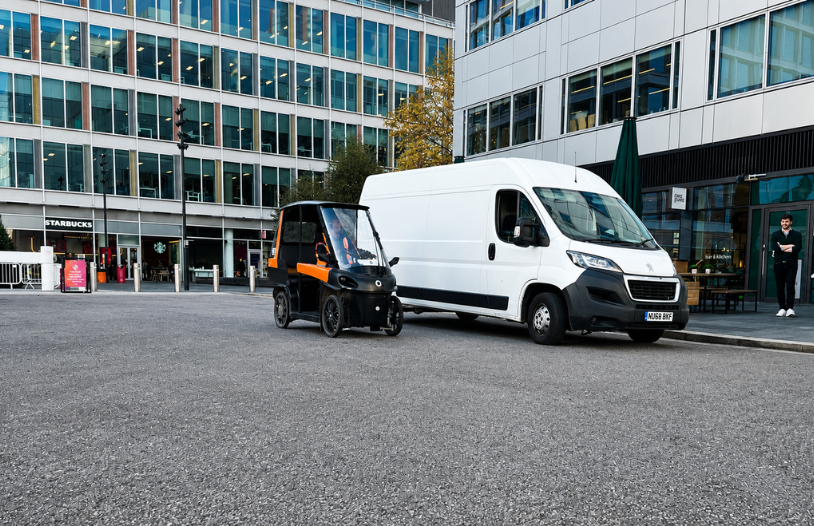
That last line says more than it might seem. In a profession where the delivery vehicle is usually invisible to the public, DHL riders on CityQ bikes get noticed. The four-wheel platform, the distinctive yellow branding, the enclosed cab — people stop and look. In busy London streets and Barcelona race weekends alike, that positive attention is real.
Why Barcelona Makes Perfect Sense — And Why It Is Not a Joke at All
DHL’s reel plays the Barcelona deployment for laughs. But strip away the caption and what you are actually seeing is a sophisticated logistics decision.
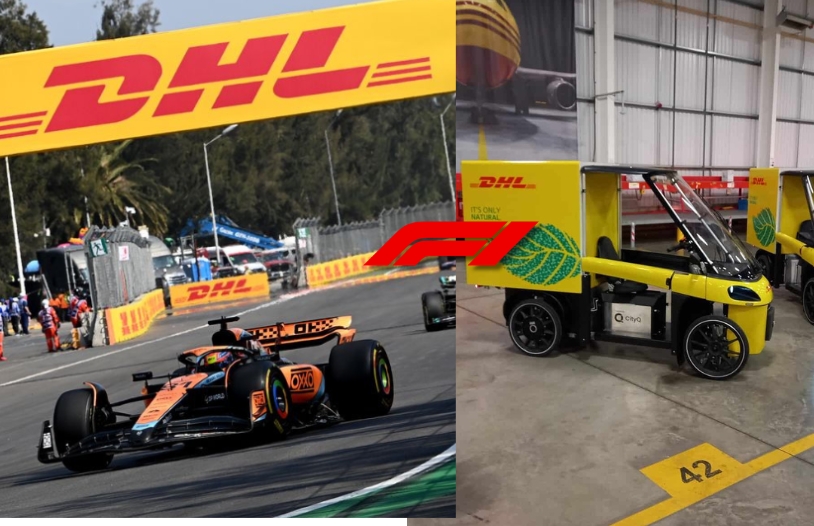
DHL has been recognised as the Official Logistics Partner of Formula 1 for decades, responsible for transporting up to 1,200 tons of freight per race across 24 circuits in 21 countries. At the circuit level, that means aircraft and heavy trucks. But at the city level during race weekend — moving packages through the streets of Barcelona, navigating restricted zones, reaching addresses that a van cannot access without a fine or a delay — the challenge is completely different.
A van in central Barcelona during F1 weekend faces: Congestion charge zones. Restricted access roads. Event-related road closures. Gridlock. Parking that simply does not exist.
A CityQ faces: None of those things.
It uses the cycle lane. It parks at the exact door. It carries the load. It moves on.
The video is funny because the contrast between Formula 1 and a cargo bike is absurd. But the operational logic is impeccable.
What Makes CityQ the Right Tool for DHL's Most Demanding Environments
DHL does not choose vehicles based on novelty. They choose based on performance. So what is it about CityQ that earned a two-year partnership with the world’s most demanding logistics company?
1. Chainless pedal-by-wire drivetrain. CityQ has been recognised for its unique car-like design, safety and comfort — as well as for its technology platform including connectivity and a chainless “pedal by wire” drivetrain. No chain means no chain wear, no lubrication, no mechanical failure from daily commercial use. For a fleet manager, that translates directly to uptime.
2. No licence requirement. The chain-less bikes enable carriers to recruit drivers without driving licences. In a market where qualified drivers are scarce and expensive, opening up recruitment to any capable rider is a significant operational advantage.
3. 100km range. Swappable batteries. CityQ is a highly reliable bike with a chainless drivetrain and up to 100km range per charge — able to ride 24/7 with swappable batteries. The software-based drivetrain enables upgrades and new features. A communication module enables tracking, distance monitoring and theft protection.
4. Zero city charges. Allowed in car-free zones and bike lanes, with free parking and no licence required. Perfect for efficient, flexible urban deliveries. 100km range on just 2.9kWh. No fuel costs, no EV charging hassle — just plug into any socket.
5. All-weather, all-year operation. The four-wheel enclosed cab means rain, wind and cold do not affect the working day. DHL’s London operation runs 365 days a year. So does CityQ.
The Van Penalty Is Real — and DHL Knew It Before Most
What DHL understood early — and what is now becoming unavoidable for every business operating in UK and European city centres — is that the traditional delivery van has become a financial liability in urban environments.
London’s 2026 transport landscape has made the traditional delivery van a financial liability. CityQ’s 4-wheel logic is the only way to bypass the growing Van Penalty of ULEZ, Congestion Charges and parking fines. By switching to the CityQ 1200 or Pickup, businesses regain hours of lost productivity by using cycle lanes and parking directly at the doorstep. With a payload of up to 200kg and a modular 1.3m³ cargo box, you get van-grade capacity without the need for a driver’s licence.
For a business running regular city routes in 2026, the numbers are stark. An electric van entering central London now pays £9/day Congestion Charge. A petrol or diesel van pays £18/day. Add ULEZ at £12.50/day, parking across 40–60 daily stops, road tax and MOT — and the van starts to look very expensive indeed.
A CityQ pays £0 in all of those categories. Every day.
DHL saw this coming in 2023. Their two-year London operation, extended now to Barcelona and F1 logistics, is what operational conviction looks like.
What DHL's CityQ Partnership Means for Your Business
DHL is the world’s largest logistics company. They have access to every vehicle on the market, every supplier, every technology. They chose CityQ. They kept it for two years. They took it to Formula 1.
If your business runs city routes — restaurant supplies, parcel delivery, trade services, grocery, healthcare, facility management — the same operational logic that led DHL to CityQ applies to you. The routes are the same type. The city friction is the same. The van penalty is the same.
The scale is different. The decision is not.
Try It on Your Own Routes
The best way to know whether CityQ works for your operation is the same way DHL found out — put it on your actual routes with your actual loads and see what happens.
We offer free demos across the UK. Bring your delivery challenge. We will ride your routes with you.
Frequently Asked Questions
1. Is CityQ actually being used by DHL in real operations — or is the Barcelona video just marketing?
Both the London operation and the Barcelona video are real. DHL has used CityQ for more than 2 years in London in active daily delivery operations. The Barcelona deployment during F1 weekend is an extension of that same real-world partnership, not a one-off marketing stunt.
2. Do DHL riders need a driving licence to operate a CityQ?
No. The chain-less CityQ bikes enable carriers to recruit drivers without driving licences. Under EN15194 and EN17860 e-bike regulations, CityQ is classified as an electrically assisted pedal cycle — meaning no driving licence, no road tax and no MOT are required anywhere in the UK or EU.
3. How long has DHL been using CityQ and where?
DHL has used CityQ for more than 2 years in London. The partnership started as part of CityQ’s UK launch and has since extended to other European operations including the Barcelona F1 weekend deployment shown in the Instagram video.
4. What makes CityQ different from other cargo bikes on the market?
CityQ has been recognised for its unique car-like design, safety and comfort — as well as for its technology platform including connectivity and a chainless “pedal by wire” drivetrain. The four-wheel platform provides stability at every stop, the enclosed cab provides all-weather operation, and the sealed chainless drivetrain eliminates the most common maintenance failure point in commercial cargo bikes.
5. Can a CityQ really replace a delivery van on city routes?
For dense urban routes with multiple stops, loads under 200kg and distances under 15km — yes. With a payload of up to 200kg and a modular 1.3m³ cargo box, CityQ delivers van-grade capacity without the need for a driver’s licence, road tax, MOT, ULEZ charge or Congestion Charge. DHL’s London operation is the clearest real-world proof of this.
6. How much does it cost to charge a CityQ compared to fuelling a van?
CityQ has a 100km range on just 2.9kWh — no fuel costs, no EV charging hassle, just plug into any socket. At current UK electricity rates, a full charge costs approximately 12p. Compare that to the fuel, road tax, MOT, Congestion Charge, ULEZ and parking costs of running a van on the same city routes every day.
7. Is CityQ available for businesses outside London?
Yes. CityQ operates across the UK and Europe. Book a demo at cityq.com/book-a-test-drive/ and the team will advise on availability and delivery timescales for your location.
8. Why does CityQ get “a lot of positive attention” on city streets?
The bikes still get a lot of positive attention because the CityQ platform is visually distinctive — a four-wheel enclosed cargo bike with professional branding is something people have not seen before. In a delivery landscape dominated by anonymous vans and two-wheel bikes, a yellow DHL-branded CityQ on a London or Barcelona street turns heads. That visibility has real brand value for operators willing to put their logo on the cargo box.
CityQ — Smarter cities. Cleaner deliveries. Better business.
Scandinavian design. German engineering. CE certified. EN15194 and EN17860 compliant. No driving licence required.