


The Delivery Deadlock: Why Wolt is Scaling with 4-Wheel Logic
In the hyper-competitive landscape of quick-commerce, the “speed of now” is hitting a physical wall. While customer demand for instant delivery continues to surge, the infrastructure of our cities is moving in the opposite direction. From the removal of parking spots to the expansion of pedestrian-only zones, the “Delivery Deadlock” is making it nearly impossible for traditional vehicles to maintain the performance customers expect. This evolution is a direct extension of the Oslo Paradox and the shifting tides of urban logistics. To break this deadlock, industry leaders are moving toward a new standard: 4-Wheel Logic.

The Problem: The Fragility of the Last Mile
The quick-commerce model, once built on the back of a moped, is currently being squeezed by three massive urban pressures:
-
The “Fair-Weather” Bottleneck: Mopeds and standard e-bikes are fragile tools. When the Nordic rain or snow hits, delivery times plummet, surge pricing kicks in, and rider safety risks skyrocket. Reliability cannot be seasonal.
-
The Volume Constraint: You cannot deliver a week’s worth of groceries, home appliances, or “stacked” retail orders in a courier bag. The shift from “pizza delivery” to “everything delivery” has made the moped cargo-obsolete.
-
The Regulatory Wall: Cities are no longer asking vans and mopeds to move; they are forcing them out. With tightening zero-emission zones and the systematic removal of loading areas, the “Van Penalty” (spending 30% of a shift looking for parking) is killing profit margins.

Moving beyond the courier bag: how smart urban planning is driving the switch to 4-wheel logic.

The Solution: Infrastructure-Agnostic Logistics
The answer isn’t a faster bike or a bigger van; it’s a vehicle that occupies the “Goldilocks Zone” of urban transport. By adopting the CityQ platform, delivery fleets are unlocking a level of efficiency that was previously impossible:
-
Van-Grade Capacity, Bike-Lane Agility: With 1.3m³ of cargo space, a single 4-wheeler can handle the payload of a small van while utilizing the 180km of bike lanes to bypass gridlock entirely.
-
365-Day Operational Uptime: The enclosed cabin and 4-wheel stability turn a “fair-weather” service into a year-round industrial machine.
-
Scaling the Workforce: Because these vehicles are legally classified as e-bikes, platforms can tap into a labor pool that is five times larger. By removing the driving license requirement, companies can scale instantly to meet peak demand with “riders” who enjoy car-like safety.
Case Study: Why Wolt Switched to 4-Wheel Logic
The most definitive proof of this shift is the strategic pivot by Wolt. Born in the harsh winters of Helsinki, Wolt understands that urban logistics is an engineering challenge, not just a delivery service. Their switch to CityQ 4-wheel e-bikes was driven by a deep understanding of the 2026 urban environment:
From Restaurant to Retail: As Wolt expanded into “Wolt Market” and large-scale retail partnerships, they outgrew the courier bag. They needed a vehicle that could carry heavy crates of groceries and multiple retail orders in a single “loop” without returning to the hub.
Defeating the “Winter Gap”: By utilizing an enclosed 4-wheel platform, Wolt ensures that their service remains stable even when snow stops their two-wheeled competitors. This 365-day reliability is what builds long-term customer loyalty.
Algorithm Optimization: Wolt’s proprietary routing algorithm is built for “drop density.” The CityQ/Wolt partnership allows the algorithm to stack more orders per rider, reducing “dead-head” travel time and making every minute of a shift more profitable.
Conclusion: Beyond the Courier Bag
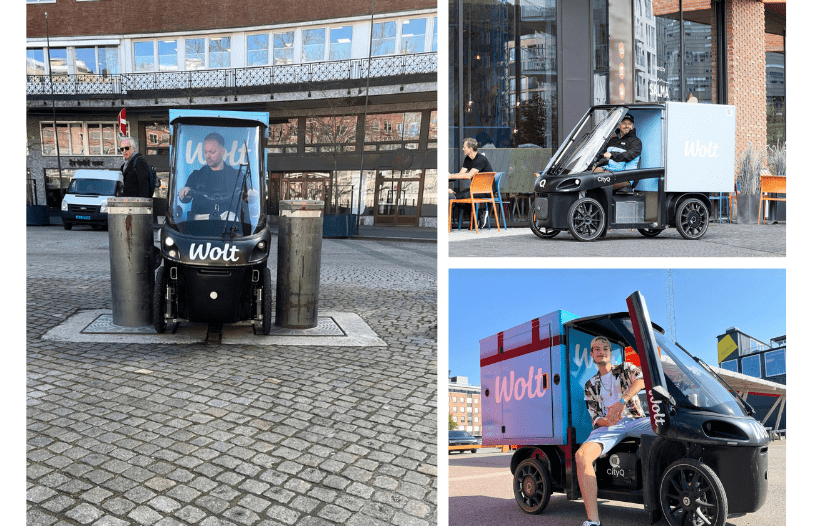
The Wolt case study isn’t just an experiment; it’s a preview of the new industry standard. The “Delivery Deadlock” is being broken by those who stop trying to fit old vehicles into new cities. By embracing 4-wheel logic, delivery platforms are no longer just “moving food” they are future-proofing the very fabric of urban commerce with software-defined, infrastructure-agnostic tools.
FAQ's
1. How does Wolt solve the “Delivery Deadlock” in congested cities?
Wolt addresses the Delivery Deadlock by transitioning from traditional mopeds and vans to 4-wheel e-bike logic. By using the CityQ 1200, Wolt couriers can bypass heavy traffic using dedicated cycle infrastructure while maintaining the cargo capacity of a small van. This allows for faster transit times and direct “last-meter” access to customer doorsteps in pedestrian-only or zero-emission zones.
2. Why is “4-Wheel Logic” more efficient for grocery and retail delivery?
Traditional courier bags are limited by volume and weight, making them “cargo-obsolete” for the growing quick-commerce retail sector. 4-Wheel Logic provides up to 1.3m³ of cargo space, allowing platforms like Wolt to handle large grocery crates and “stacked” retail orders in a single trip. This increases drop density and optimizes delivery algorithms, making every delivery route more profitable.
3. How do enclosed cargo e-bikes ensure 365-day delivery uptime?
One of the biggest hurdles in last-mile logistics is weather volatility, often called the “Winter Gap.” CityQ’s 4-wheel e-bikes feature a fully enclosed, weather-protected cabin and car-like stability. This ensures that couriers remain safe and productive during Nordic rain or snow, allowing Wolt to maintain consistent service levels and reliable delivery times throughout the entire year.
4. Do drivers need a license to operate Wolt’s 4-wheel delivery vehicles?
No. Because these vehicles are legally classified as e-bikes, they do not require a traditional driving license. This allows delivery platforms to scale their workforce rapidly by tapping into a labor pool that is up to five times larger than the licensed driver pool. It removes a significant barrier to recruitment while offering riders the safety, comfort, and stability of a professional four-wheeled vehicle.

