The electric cargo bike London operators are switching to in 2026 is not the two-wheel courier bike most people picture. London does not run like any other city in the world. It runs at 9,648 people per square kilometre, through streets built before the motor vehicle existed, under a regulatory framework that has made operating a van in the capital a daily financial decision rather than a default. The businesses finding the clearest path through that environment in 2026 are not the ones with newer vans or better parking strategies. They are the ones that have changed the vehicle entirely. If you have already looked at the real results from businesses using a cargo eBike for business across six operators and five cities, this article goes further — into London specifically, what the electric cargo bike London market looks like in 2026, which operations benefit most, and what the first six months looks like for a business that makes the switch.
Why London in 2026 Is the Electric Cargo Bike's Strongest Market
No other city in the UK has created the conditions that London has for electric cargo bike adoption. Three forces are converging simultaneously — and each one makes the case independently.
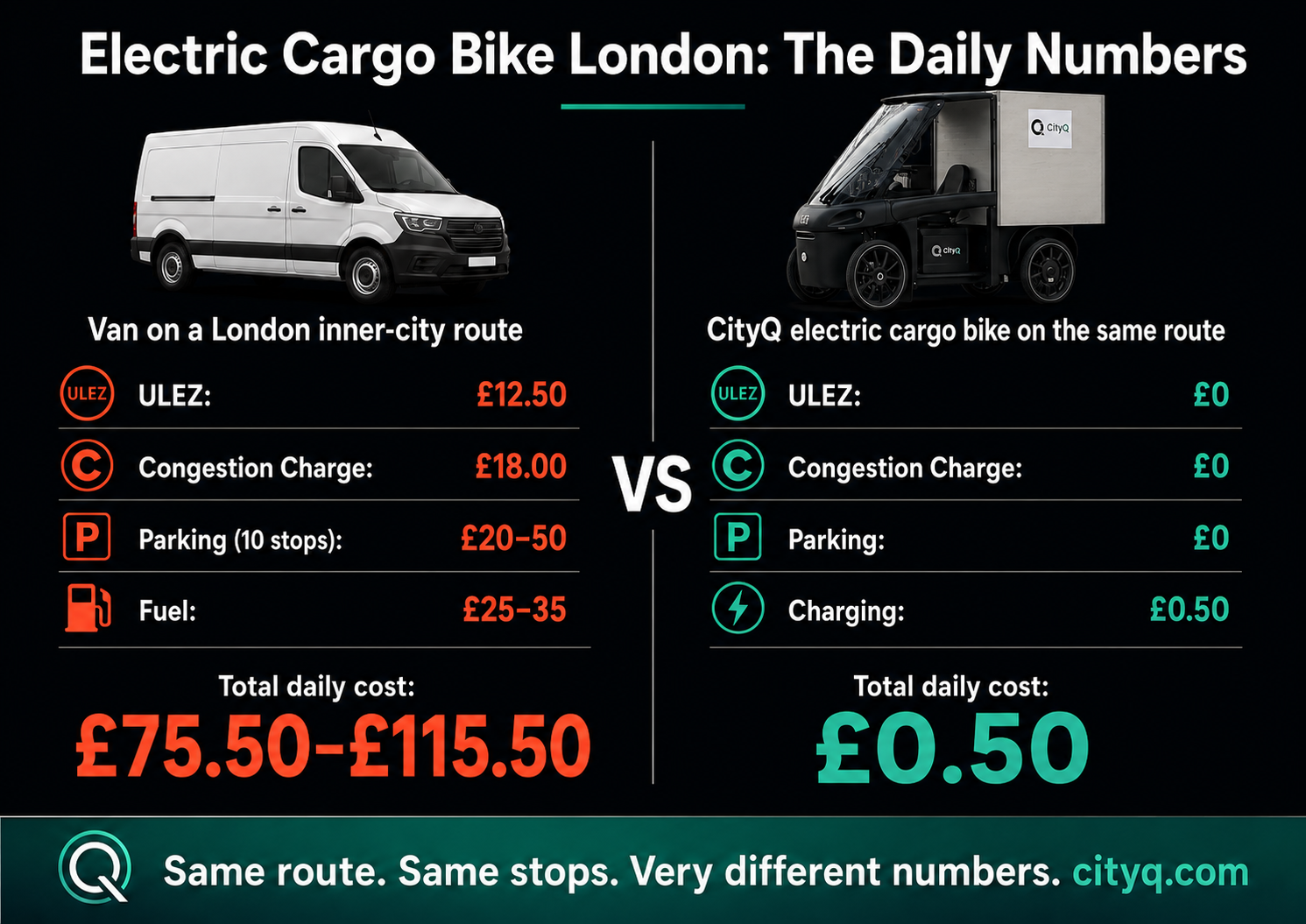
Regulatory cost: The ULEZ covers all 32 boroughs at £12.50 per day. The Congestion Charge runs at £18 per day in the central zone. A van operating in inner London pays both — £30.50 per day, £7,320 per year in ULEZ alone, over £11,000 per year combined. An electric cargo bike certified under EN15194 and EN17860 pays neither. Not as a grant or temporary exemption — as a permanent function of its legal classification as a bicycle.
Access restriction: Eighty-five London boroughs have implemented or are implementing Low Traffic Neighbourhood schemes. Oxford Street is progressing toward pedestrianisation. Cycle Superhighways now run faster than the main roads they run beside. The city is structurally narrowing the space available to motor vehicles and widening the space available to bicycles. An electric cargo bike is a bicycle. It goes where vans increasingly cannot.
Driver shortage: There are over 100,000 unfilled logistics vacancies across the UK. In London specifically, the competition for licensed drivers is acute. An electric cargo bike requires no driving licence — any adult who can ride a bicycle can operate one legally from day one. For London fleet managers, this is not a marginal advantage. It is a structural change to the hiring equation.
The businesses switching from vans to electric cargo bikes in London are responding to all three forces simultaneously — and finding that one vehicle addresses all three at once.
What an Electric Cargo Bike in London Actually Does Differently
The gap between understanding why an electric cargo bike makes sense in London and understanding what it actually does on a London route is significant. These are the operational differences that matter on real city streets.
It parks at the delivery point: Every time a van on a ten-stop London route spends a measurable proportion of every shift either circling for a parking space or accepting the risk of a penalty charge notice. On routes through Soho, Clerkenwell, Shoreditch or any central London neighbourhood, legal parking at the exact service point is rarely available. The electric cargo bike parks at the kerb, at the door, legally, for free, every time. On a ten-stop route, this eliminates 30–60 minutes of daily parking friction — before any zone charge saving is calculated.
It uses the cycle lane: London’s cycle infrastructure has expanded significantly. Cycle Superhighways now connect outer London to the centre on routes that consistently move faster than the parallel main roads during peak hours. An electric cargo bike certified as an e-bike has full legal access to every cycle lane in London. A van has none. On routes where a van sits in traffic for 45 minutes, the electric cargo bike is already at the next stop.
It enters everywhere: Low Traffic Neighbourhoods, pedestrianised zones, market streets, hospital campuses, university grounds, hotel service areas — the spaces where London’s delivery and facilities management operations actually happen are increasingly the spaces where vans are restricted or prohibited. An electric cargo bike enters all of them. The cargo 4-wheel eBike updates for the UK in 2026 covers the full regulatory picture nationally.
It costs almost nothing to run: Fuel: none. Road tax: none. MOT: none. ULEZ: none. Congestion Charge: none. Parking: none. Annual running cost including charging: under £1,500 per vehicle. The electric cargo bike for business in London savings analysis puts the full annual saving on a single London vehicle at over £25,000 compared to a non-compliant van on the same route.
The London Sectors Switching to Electric Cargo Bikes in 2026
Not every London operation converts at the same rate. The ones finding the clearest case share specific characteristics — and they span a wider range of sectors than most fleet managers initially expect.
Inner-city parcel and last-mile delivery
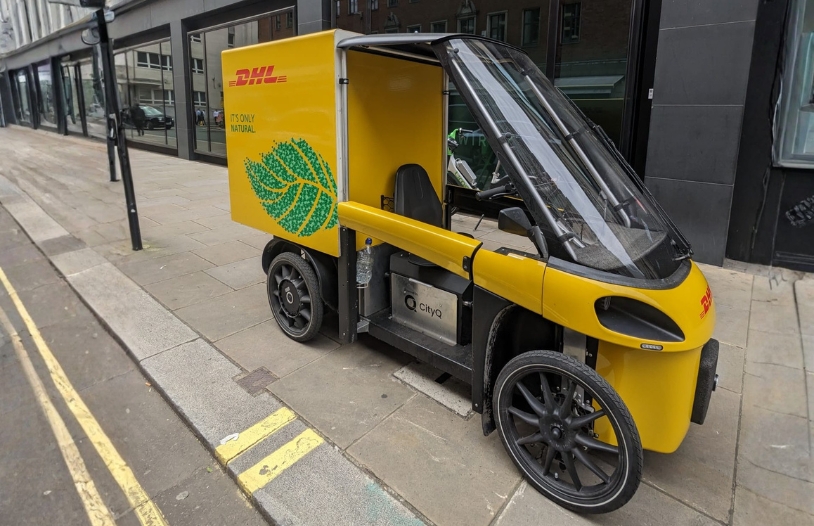
This is where the electric cargo bike London case is most established. DHL inner-city operations have run CityQ on London routes for over two years without reversal. Riders cite three things consistently: the stability of the four-wheel platform in slow London traffic, the weather protection of the fully enclosed cab, and the ability to park at the exact delivery point at every stop without a fine. The route performs better than the van it replaced. The operation stayed.
For parcel operators, courier networks and last-mile logistics businesses, the electric cargo bike is not a supplement to van operations — it is a replacement for the van on every urban route under 15 kilometres with multiple stops in a dense area.
Facilities management on central London sites
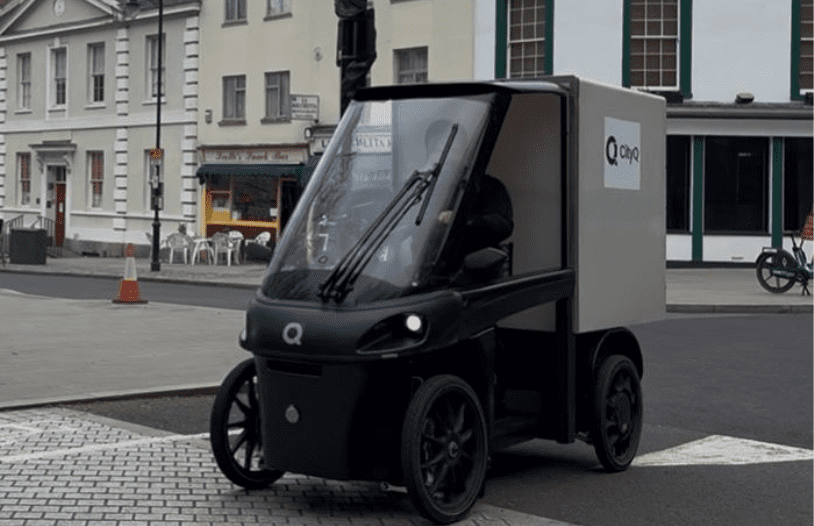
Historic buildings, hotel estates, museum and cultural venue back-of-house logistics, corporate campus service routes — central London is full of sites where van access is restricted, parking is impossible, and the service requirement is daily. A facilities management team that cannot get a van to the service point has historically relied on manual carrying or expensive time-slot bookings. An electric cargo bike reaches every point a van cannot, carrying up to 175kg in a weatherproof locked cargo box.
JCDecaux runs 16 CityQ bikes across Paris on exactly this model — service crews to public infrastructure maintenance sites, faster and without parking costs, on a vehicle that tested better than 14 competitors. The London facilities management sector has the same profile and the same need.
Council and public sector logistics
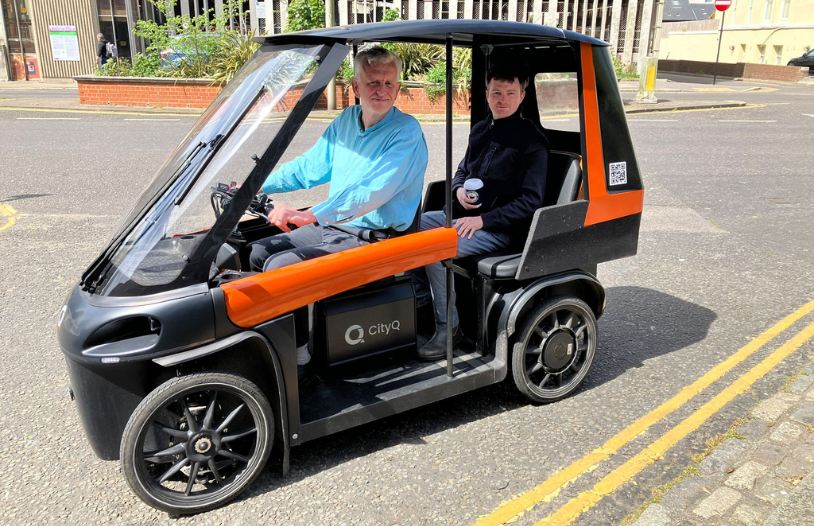
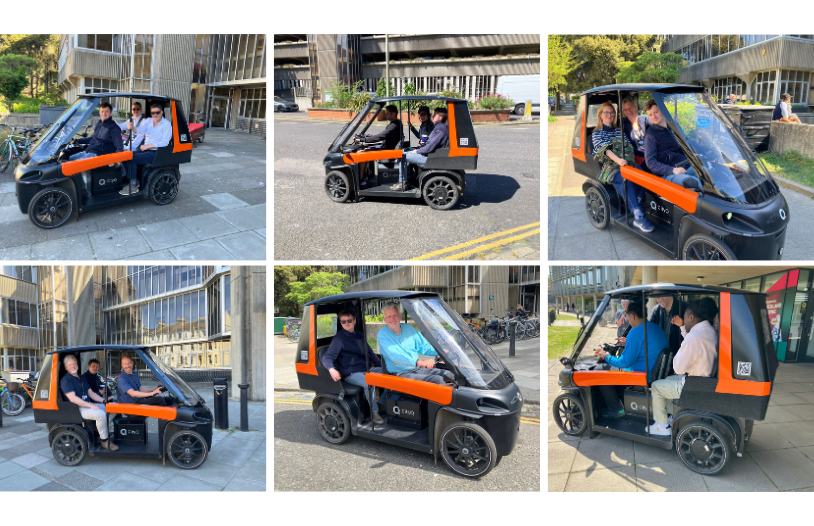
Brighton and Hove City Council — street cleaning, postal delivery, health services — tested CityQ across multiple departments at our recent demo days and found the same result across every use case: the vehicle is stable, intuitive to operate, and solves access problems that larger vehicles create rather than solve. Councillor Trevor Muten, Cabinet Member for Transport and City Infrastructure, rode the vehicle and engaged directly with the swappable battery advantage — no fixed charging infrastructure required, which removes the single biggest obstacle to fleet electrification for councils operating across dispersed sites.
London boroughs face identical access, cost and staffing pressures. The electric cargo bike addresses all three simultaneously.
Food, catering and hospitality logistics
Restaurant groups, dark kitchen operators, hotel supply chains, event catering businesses — the food logistics sector in London runs on tight windows, dense routes and constant parking pressure. An electric cargo bike that parks at the service entrance for free, every time, on a route where a van would circle for ten minutes before accepting a penalty charge notice, changes the economics of every delivery run.
Trade and service businesses
Electricians, plumbers, maintenance engineers, facility technicians whose tools and parts fit within the cargo box and whose daily routes run through central London. The electric cargo bike is not a consumer vehicle for this sector — it is a working vehicle that carries the tools, accesses the site, parks at the door and costs under £1,500 per year to run on routes where a van costs ten to twenty times that figure.
The Brighton Signal for London
Our recent demo days in Brighton with the University of Brighton and Brighton and Hove City Council produced a consistent finding across two very different audiences. University facilities managers described the difficulty of navigating larger vehicles on campus. Council officers from street cleaning, postal delivery and health services tested the vehicle and commented on its stability and accessibility. Councillor Trevor Muten engaged with the swappable battery system as a direct solution to the charging infrastructure gap that blocks most council fleet electrification.
The signal for London operations is direct. If the electric cargo bike solves access, cost and staffing problems for a council and a university campus in Brighton — it solves them for the equivalent operations across every London borough. The vehicle does not change. The problems are identical.
Electric Cargo Bike London — The Cost Case in Full
The annual cost comparison on a single London inner-city vehicle:
| Cost item | Van (non-compliant) | CityQ electric cargo bike |
|---|---|---|
| ULEZ — 240 days | £3,000 | £0 |
| Congestion Charge — 240 days | £4,320 | £0 |
| Parking — 10 stops/day, £5 average | £12,000 | £0 |
| Fuel | £7,000–£9,000 | £0 |
| Charging | — | £300–£500 |
| Insurance | £2,500–£4,000 | £500–£800 |
| Maintenance and MOT | £1,500–£3,000 | £500–£800 |
| Total annual cost | £30,320–£35,320 | £1,300–£2,100 |
| Annual saving | — | £28,220–£33,220 |
On a five-vehicle London operation the annual saving exceeds £140,000. On a ten-vehicle operation it exceeds £280,000. These figures use conservative parking estimates operations in central London with higher-frequency stops will see larger savings.
FAQs
What is an electric cargo bike and is it legal in London?
An electric cargo bike is a pedal-assisted electric vehicle designed to carry cargo or passengers. Certified under EN15194 and EN17860, it is classified as a bicycle under UK law — fully legal on all London roads, cycle lanes and paths open to bicycles. No driving licence, vehicle registration, road tax or MOT required.
Is an electric cargo bike ULEZ exempt in London?
Yes. A CityQ electric cargo bike certified under EN15194 and EN17860 is permanently exempt from the ULEZ, the London Congestion Charge, and every clean air zone or low emission zone charge across the UK. The exemption is a function of the vehicle’s legal classification, not a policy subject to review.
How much can an electric cargo bike carry in London?
The CityQ 850 carries up to 175kg in a weatherproof, lockable rear cargo box. The CityQ 1200 handles larger volume loads. Most inner-city London delivery runs carry well under 100kg per trip — payload is rarely the limiting factor on London routes.
Do electric cargo bike riders need a driving licence in London?
No. CityQ is certified under EN15194 and EN17860 — no driving licence required. Any adult who can ride a bicycle can legally operate a CityQ on London roads from day one. This significantly widens the hiring pool for London fleet operators currently competing for licensed drivers.
Can an electric cargo bike operate in London’s Low Traffic Neighbourhoods?
Yes. An electric cargo bike certified as an e-bike is a bicycle under UK law and has full access to every Low Traffic Neighbourhood that permits bicycle entry. This is one of the most significant access advantages over vans and electric vans, which are motor vehicles and subject to LTN restrictions.
How does an electric cargo bike handle London’s weather?
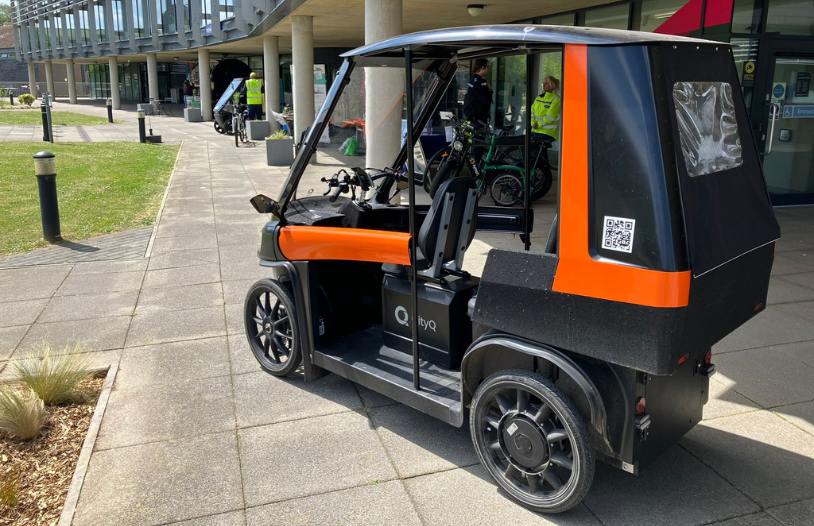
The CityQ has a fully enclosed rider cab — windscreen, wiper, sealed floor, full side protection. London rain, wind and cold do not affect operations. The same vehicle runs in Oslo through Norwegian winters 365 days per year. London weather is not an operational constraint.
What routes in London are best suited to an electric cargo bike?
Routes under 15 kilometres with multiple stops in a dense urban area, currently suffering from parking delays, ULEZ charges or access restrictions. Inner-city parcel delivery, facilities management, food logistics, council service routes and trade deliveries in central and inner London are the highest-converting route types.
How do I start a London electric cargo bike fleet trial?
Book a test drive with the CityQ team. The trial runs on your actual London routes with your actual loads — not a car park demonstration. Most operators reach a clear decision within three days of a real operational trial.
The London Electric Cargo Bike Decision in 2026
London has made the van expensive. It has made parking scarce. It has made licensing a constraint. It has made access to its most important commercial areas increasingly dependent on vehicle type. All of those pressures point in the same direction — toward a vehicle that is smaller, cheaper to run, easier to staff, and legally classified as a bicycle.
The electric cargo bike London market is not at the start of that transition. It is in the middle of it. DHL inner-city operations, council departments from Brighton to London boroughs, facilities management businesses, courier networks and food logistics operators are all arriving at the same vehicle through different routes.
The question for any London business still running vans on inner-city routes is not whether the transition is coming. It is whether they start before or after the next charge increase.
Book a CityQ fleet trial and find out what your three highest-cost London routes look like when the vehicle pays nothing to run them.