Most articles about switching to a cargo eBike for business stop at the theory. The operational logic is explained, the van costs are compared, and the ULEZ exemptions are listed. What gets left out is what actually happened when real businesses made the switch the conversations, the hesitations, the first week, and the results six months later.
Across the CityQ fleet, from inner-city lab couriers in Munich to a global advertising giant running routes through Paris, the pattern is consistent in ways that are worth reading carefully if you are still weighing the decision. And if you have already followed the case for cargo bike last mile delivery in London and understand the operational fundamentals, this article goes deeper — into the operators themselves, what they were carrying, what they were afraid of, and what they would tell you now.
Why the Cargo eBike for Business Case Has Shifted From Interesting to Urgent
There is a version of this argument that has been made for years, and it mostly lived in sustainability reports and smart city presentations. That version is not what drives decisions today. What drives them today is far more prosaic: parking fines, van access restrictions, zero-emission zone charges, and a hiring market that makes finding licensed drivers increasingly difficult and expensive.
The businesses using CityQ did not arrive at this vehicle because they had a green fleet policy to fulfil. They arrived because they had a specific operational problem that vans were solving poorly, expensively, or not at all. That is a useful frame, because it means the cargo eBike for business argument is not about ideology — it is about whether the vehicle can do the job better than the alternative. In every case below, the answer turned out to be yes. But the reasons are different for each operator, and that variation is the point.
According to the University of Westminster, cargo bikes complete urban deliveries up to 60% faster than vans in dense city centres. That figure holds across multiple European cities, and it holds because of a simple physical reality: a vehicle that can use cycle lanes, park at the kerb, and navigate streets that vans cannot reach does not compete with a van — it outmanoeuvres it.
DHL London: Two Years, Inner-City Parcels, and a Fleet That Keeps Expanding
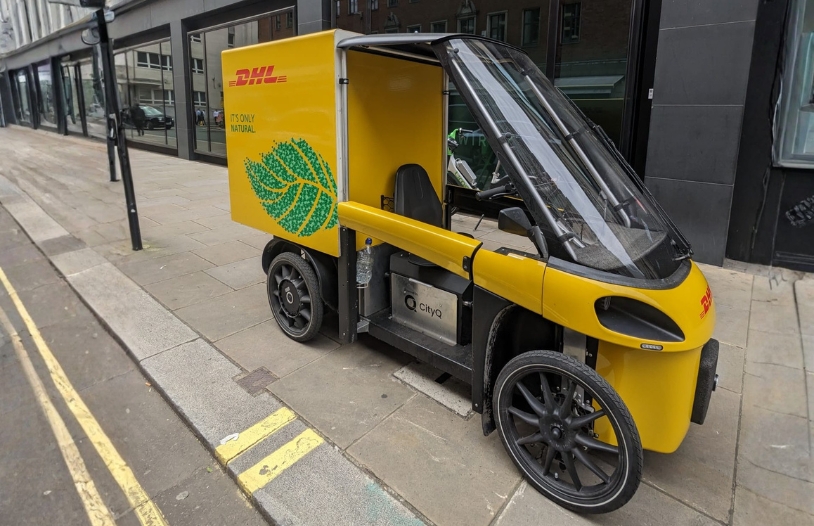
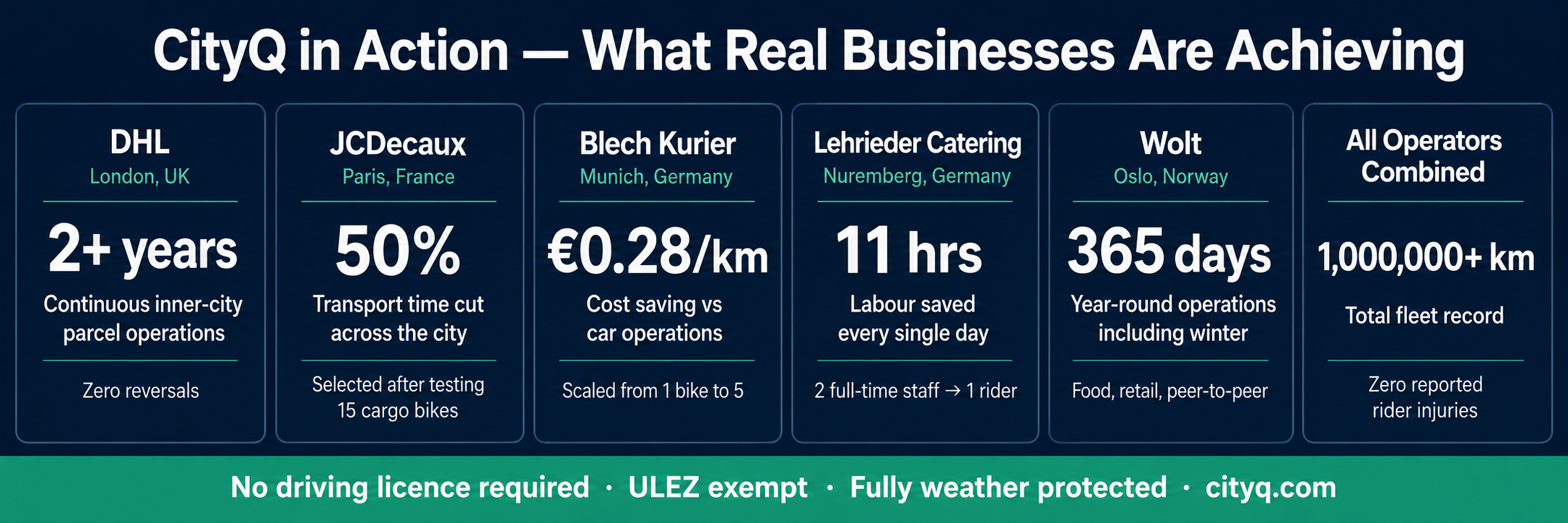
DHL has been running CityQ bikes for inner-city parcel delivery in London for over two years and has not reversed the decision. Riders consistently cite stability, weather protection, and kerb-side parking without fines as the reasons the route works better than a van. For fleet managers still weighing the switch, DHL London is the proof that this is not a six-week pilot — it is a proven operating model at commercial scale.
JCDecaux Paris: 15 Bikes Tested, One Winner, 50% Time Saved
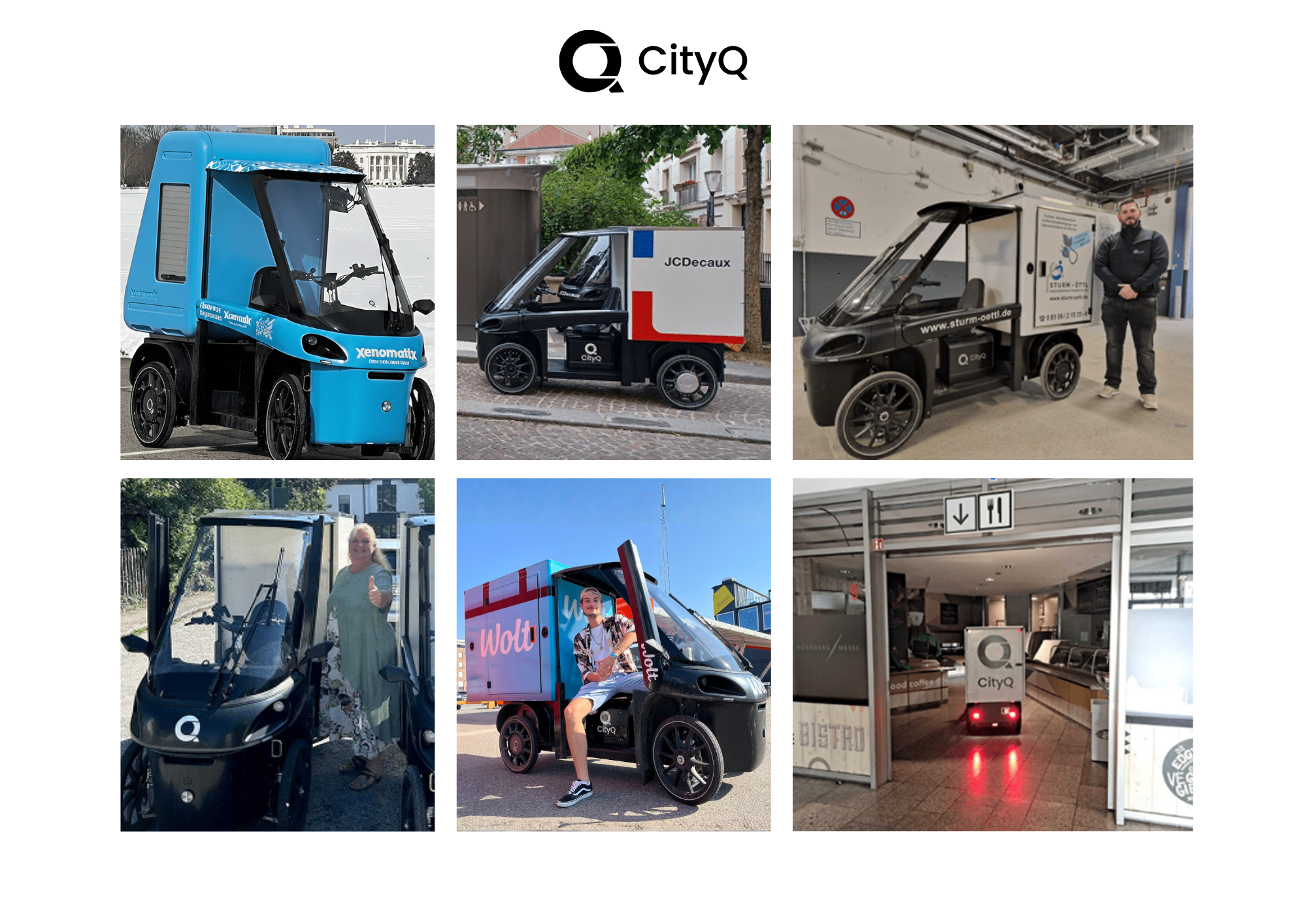
JCDecaux — the global outdoor advertising and facilities management company operating in 75 countries — needed to get service crews to public toilet maintenance sites across Paris faster and without parking fines eating into daily overheads. They ran two pilot rounds and tested 15 different cargo bikes side by side. CityQ won.
Vincent Noel, Director at JCDecaux, gave three reasons: size and narrow width for city efficiency, comfort and safety that made the vehicle popular with staff and easier to recruit around, and reliability that let the team get the job done. The fleet now runs 16 bikes — 7 maintaining public toilets in central Paris, 1 in Bordeaux replacing billboards, 5 fitted with winter side-window protection. Average monthly usage since mid-2024 is over 300 kilometres per bike. Transport time across Paris has been cut by 50%.
For any facilities management business still evaluating a cargo eBike for business: a company operating in 75 countries, with full procurement evaluation processes, tested 15 competitors and chose CityQ. That question has been answered.
Blech Kurier Munich: From One Bike to Five, at 100 Kilometres a Day
Blech Kurier runs specialist laboratory courier routes across Munich. Their clients require eco-friendly delivery as a contractual condition — a missed or delayed lab sample has consequences a late parcel does not. After testing a competing bike first, they switched to CityQ. Cost per kilometre dropped by €0.28 compared to car-based operations. The fleet grew from one bike to five, each running 100 kilometres per day and up to 2,000 kilometres per month.
Sabine Blech, Owner and General Manager, was direct: “We are fundamentally convinced by 4-wheeled cargo bikes. We chose CityQ because we trust the technology and were impressed by the equipment and design. They also offered strong local service — and the overall price was fair.”
The Blech Kurier story answers a question specialist operators ask consistently: does the cargo eBike for business model hold when delivery content is sensitive and requirements are tight? Across two years and five bikes at 100km each per day, the answer is yes.
Lehrieder Catering Nuremberg: 11 Hours Saved Every Single Day
Lehrieder Catering supplies and maintains every restaurant across the Nuremberg Messe — 170,000 square metres across 15 exhibition halls. For years it meant two full-time employees transporting food on foot across the entire site. One CityQ changed that.
Mathias Ledermann put it simply: “The CityQ saved my life. Before I needed two full-time employees transporting the food by feet. Now I can use only one, which can handle the work in just 5 hours.”
That is 11 hours of labour recovered per day from a single vehicle. The bike has been in use for nearly two years on a campus where no van ever had access — which makes it one of the clearest demonstrations of what a cargo eBike for business can do in an environment where the van was never even an option.
Sturm – Oettl Gebäudedienste Munich: The Licence Advantage Nobody Talks About
Sturm handles electric cargo bike service and repair operations at the Augustiner brewery in central Munich — a dense historic site where parking a van near service points is either impossible or costly. The access and parking problem drove the switch to CityQ, but there is a second angle worth noting: the driving licence.
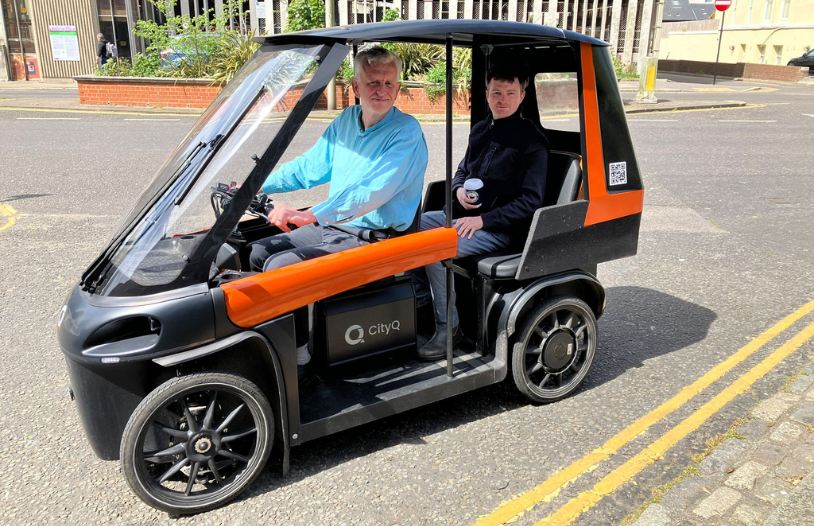
CityQ is certified as an EPAC under EN15194 and EN17860 — no driving licence, vehicle registration, road tax or MOT required. Sturm gained not just a more agile vehicle — they gained a wider hiring pool. As the analysis of which operations benefit most from a four-wheel cargo eBike makes clear, that recruitment advantage is one of the most underreported reasons businesses make the switch.
Wolt Oslo: 365 Days a Year, Through Norwegian Winters
The question asked at almost every fleet meeting is whether the cargo eBike for business holds in bad weather. Wolt is scaling with four-wheel logic across Oslo on a 365-day schedule — not 300 days, not weather-permitting, every day including the heart of Norwegian winter.
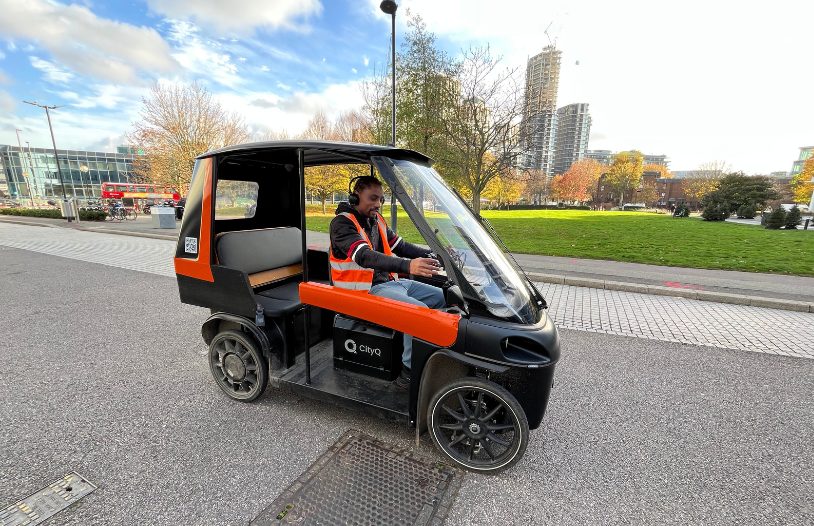
The fully enclosed cabin — windscreen, wiper, sealed floor, full side protection — is what makes year-round operation possible. The Wolt operation has expanded from food into clothing, tools, sports equipment and peer-to-peer deliveries. In Oslo, the cargo eBike for business is not a van replacement for one specific use case — it is the primary delivery vehicle across an entire city’s on-demand economy.
Across all CityQ fleet partners combined, the vehicles have now covered over one million operational kilometres with zero reported rider injuries.
Ready to run your own pilot? CityQ is available to buy, rent or lease. Explore the full CityQ model range to find the right configuration for your operation.
What Every Operator Had in Common Before They Switched
None of them switched because they read a white paper. JCDecaux tested 15 vehicles. Blech Kurier piloted one bike before scaling to five. Wolt runs the most demanding weather environment in Europe. DHL London has been running for two years without reverting. Lehrieder has used the same bike for nearly two years on a site where no van ever had a role.
Each had a vehicle that was technically doing the job — but doing it with mounting friction. The switch happened when that friction became expensive enough to justify a different answer.
Which Businesses Get the Most From a Cargo eBike for Business
Parcel and last-mile delivery teams in dense cities — where DHL London is the proof point — see the fastest payback through ULEZ, congestion and parking cost elimination.
Facilities management and service teams — JCDecaux and Sturm — see the sharpest operational improvement in access speed and parking overheads.
Campus and site logistics operations — Lehrieder at Nuremberg Messe — see the most dramatic labour efficiency gains, especially where vans have no access at all.
Specialist couriers with eco-delivery requirements built into client contracts — Blech Kurier — find the cargo eBike for business is not just a preference but a commercial prerequisite.
FAQs
What types of businesses use a cargo eBike for business?
Parcel delivery, facilities management, campus logistics, catering, laboratory couriers and quick commerce operators are the most active sectors. CityQ clients span London, Paris, Munich, Nuremberg and Oslo across radically different business types — with one shared result: the van was slower and more expensive for their urban routes.
Do riders need a driving licence to operate a CityQ?
No. CityQ is certified as an EPAC under EN15194 and EN17860 — no driving licence, vehicle registration, road tax or MOT required. Any adult can ride one legally from day one, which is a significant hiring advantage for facilities and logistics teams.
Is a cargo eBike for business safe in all weather?
Yes. The fully enclosed cabin means year-round operation. Wolt runs CityQ across Oslo 365 days per year including Norwegian winters. CityQ has logged over one million operational kilometres across all fleet partners with zero reported rider injuries.
How does the cost compare to running a van?
Blech Kurier recorded a €0.28 per kilometre saving versus car-based operations. London businesses eliminate ULEZ charges, congestion fees, parking fines and fuel costs daily. The direction of the comparison is consistent across every operating environment CityQ has data from.
How long does it take to onboard a new rider?
Most riders reach full operational confidence within two to four hours. No licence, no formal test, no training cost — onboarding is faster than for any other comparable delivery vehicle.
The Decision Every Business on This List Made Eventually
At some point, the evidence became sufficient. The cargo eBike for business question — can it actually do what we need it to do? — got answered by the vehicle itself. If you want to reach that point for your operation, the fastest route is to get behind one. Book a test drive with the CityQ team and run your own route.