Something historic just happened on the streets of London.
According to recent traffic data published by LEVA-EU, bikes now officially outnumber motorized vehicles in the City of London. Driven heavily by the explosion of shared micro-mobility and corporate delivery fleets, cycles make up an incredible 40% of all road traffic in the square mile.
The message from City Hall is loud and clear: The era of the combustion van dominating the capital is dead.
As part of London’s aggressive clean-air strategy, the city is actively pushing to get 12,000 cargo bikes onto the streets to replace space-hogging, emissions-heavy delivery vans. With tighter low-traffic neighborhoods (LTNs), rising congestion charges, and a shrinking layout for full-sized vehicles, operations managers face a choice: adapt their fleets now or get left behind in gridlock.
For fast-growing, funded startups, this isn’t just an environmental trend—it’s a massive competitive loophole. And the smartest operators aren’t just buying standard cargo bicycles; they are investing upfront in 4-wheel “Car-E-Bikes.”
The 12,000 Van Replacement Goal: Why Standard Vans are a Startup Money Pit
Traditional commercial vans are becoming a massive liability for London business logistics. Between the daily £12.50 ULEZ charge, the £15 Congestion Charge, and the near-certainty of picking up multiple £130 parking tickets every week just for stopping near a delivery point, the data shows that a single traditional van can cost an operational fleet over £20,000 to £28,000 per year in fees alone.
Worse yet, traditional vans sit trapped in a city where average traffic speeds have crawled down to just 7–9 mph.
London’s policy push to replace vans with 12,000 cargo bikes is opening up the cycle lanes to heavy commercial transport. By legally classifying your delivery vehicles as electric-assisted pedal cycles (EAPCs), your startup can bypass traffic, drop congestion fees to zero, and park right at the doorstep of your customers without penalties.
Enter CityQ: The 4-Wheel Advantage for High-Value Fleets
While standard two-wheel cargo bikes work fine for light payloads, premium startups—like on-demand catering, rapid e-commerce, high-end electronics repair, and Q-commerce platforms—require more security, weather protection, and payload capacity.

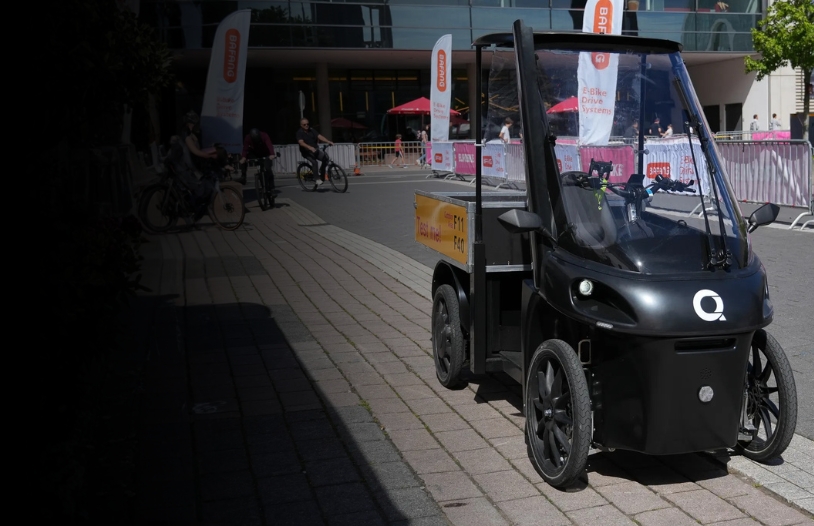
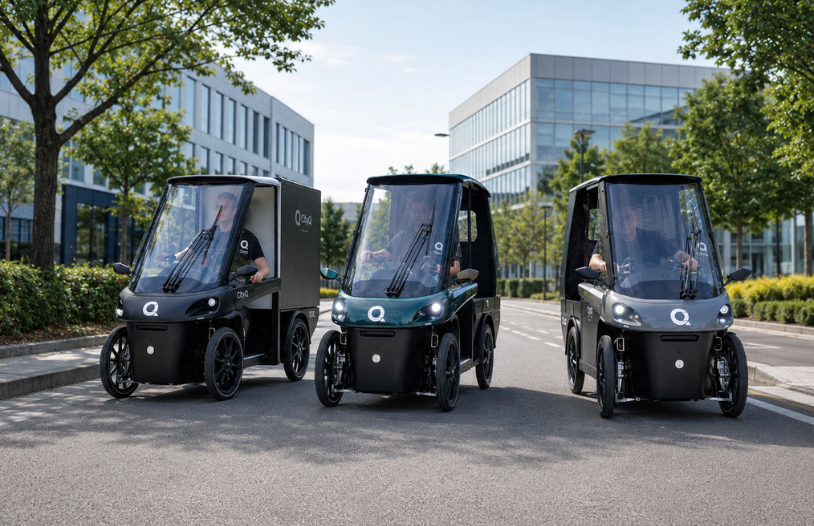
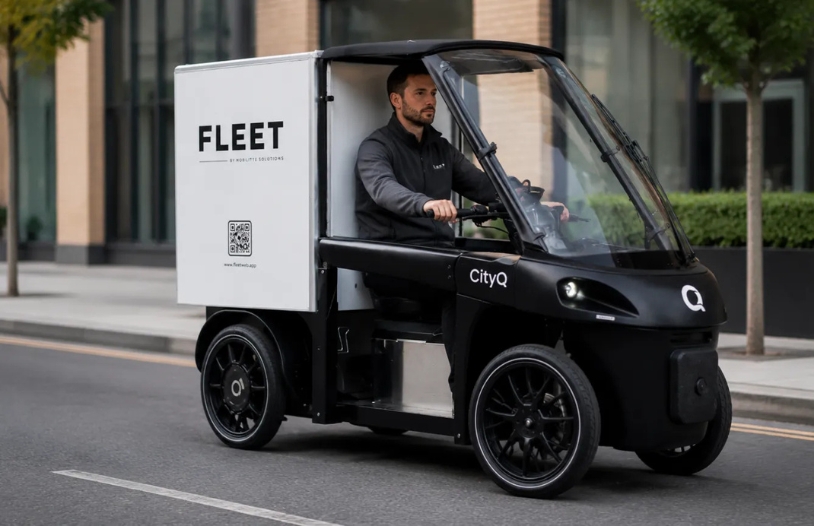
This is exactly where the CityQ Cargo eBike bridges the gap between a van and a bicycle.By purchasing a CityQ asset outright using your investment capital, your operation unlocks distinct technical advantages that a standard cargo bike simply cannot match:
-
All-Weather Enclosure & Rider Comfort: London’s weather is notoriously unpredictable. CityQ features a full roof, windshield, and doors. Keeping your riders warm and dry keeps your staff retention high and your operation running 365 days a year.
-
A Software-Driven Digital Powertrain: Traditional cargo e-bikes use mechanical chains and gears that constantly snap under the weight of heavy cargo, causing expensive downtime. CityQ operates on a chainless “pedal-by-wire” digital drive, drastically reducing mechanical failures.
-
Massive 1.3 m³ Stable Capacity: With 4 wheels instead of 2 or 3, a CityQ offers absolute lateral stability. Your riders never have to worry about balancing a heavy load at a red light, and you can securely lock up to 1,200 liters of inventory behind a weatherproof cabin.
-
The Ultimate Rolling Billboard: Because you buy the asset completely, you have 100% freedom to wrap the vehicle in your startup’s branding. In a city where bikes outnumber cars, a sleek, futuristic 4-wheeler acts as a high-visibility, zero-cost out-of-home (OOH) marketing campaign in wealthy London neighborhoods.
The Financial Play: Why Smart CFOs Buy Assets Outright
Because CityQ deals exclusively in direct vehicle sales, funded businesses can maximize their upfront capital efficiency. In the UK, cargo e-bikes qualify under the Annual Investment Allowance (AIA). This means your startup can write off 100% of the purchase price against corporation tax in the very first year, turning a massive operational asset into a smart tax optimization play.
By eliminating continuous leasing fees, your ongoing monthly fleet burn rate drops to zero—outside of a few pence to charge your swappable batteries.
Put CityQ to the Test on Your Actual London Delivery Routes
You don’t need to lose half a day traveling to a showroom to see if CityQ fits your business model. We bring the vehicle directly to you.
Our dedicated London representative will meet your team right at your office, dark kitchen, or fulfillment hub. Bring out your actual boxes, test-load the cargo bay, let your operations director inspect the digital drivetrain, and take it out for a spin on your trickiest local delivery routes.
The CityQ Efficiency Blueprint (By the Numbers)

When you look at the raw data comparing traditional electric vans or cars to a Car-E-Bike fleet, the operational advantages become undeniable. Here is exactly what the data from image shows your startup saves by replacing a traditional commercial vehicle with a CityQ:
-
75% Less Congestion: Traffic jams represent massive chunks of unbilled, wasted driver downtime. By shrinking your vehicle width down from a standard car or van size 180 cm to a sleek car-e-bike profile 89 cm, you dodge gridlock entirely by utilizing London’s integrated cycle networks.
-
75% Less Parking Space: Finding a legal parking spot for a van in central London is a logistical nightmare that burns both time and money in parking fines. A single standard car parking space can comfortably fit four CityQ vehicles parked side-by-side, entirely eliminating the delivery stop parking friction.
-
80% Less $CO_2$ Emissions: With intense regulatory pressure to decarbonize inner-city logistics, switching to a cargo bike cuts your emissions per kilometer by a massive 80% compared to even a standard full-sized electric vehicle (EV).
-
90% Less Energy Usage: Heavy commercial EVs require massive, expensive battery packs that cost a fortune to charge and maintain. CityQ uses a highly efficient powertrain that requires 90% less energy and fewer battery cells to transport your cargo the same distance.
-
100% Zero Car Charging Infrastructure Costs: High electrification costs and waiting around for public charging hubs kill startup momentum. Because CityQ runs on compact, swappable batteries, you have zero reliance on standard electric car charging stations. Your fleet can run 24/7 simply by swapping batteries at your fulfillment hub.
Customers experience Transport with CityQ being 50% more time efficient than vans in inner city
Frequently Asked Questions
1. Do I need a driving licence to operate a CityQ in London?
No. Because CityQ is engineered and legally classified as an Electric-Assisted Pedal Cycle (EAPC), it does not require a UK driving licence, vehicle registration, or compulsory road tax. This allows your business to recruit from a massive pool of standard courier riders without hitting a driver licensing bottleneck.
2. Can CityQ legally use London cycle lanes?
Yes. CityQ meets all legal width and speed restrictions under UK EAPC criteria, allowing it to legally zoom down London’s integrated cycle superhighways and low-traffic neighborhoods (LTNs). This allows your fleet to easily bypass gridlocked traffic lanes where traditional commercial vans get stuck.
3. How does your London vehicle demonstration work?
We offer a flexible “We Come to You” concierge demo service. Instead of forcing your busy team to travel to a distant showroom, our dedicated London representative will bring a CityQ vehicle directly to your office, dark kitchen, or fulfillment hub. This allows your operations director and riders to test-load actual inventory and trial the vehicle on your actual daily delivery routes.
4. Does CityQ offer vehicle leasing or rental programs?
No. CityQ deals exclusively in direct asset sales rather than monthly leasing or rentals. This approach is highly favored by funded startups looking to efficiently deploy capital upfront, avoid adding ongoing monthly liabilities to their recurring burn rate, and maintain 100% ownership control over custom vinyl vehicle wraps and branding.
5. What are the tax advantages of buying a CityQ fleet upfront?
In the UK, purchasing electric cargo bikes for commercial use qualifies for the Annual Investment Allowance (AIA). This means a business can typically write off 100% of the vehicle purchase price against their corporation tax in the very first year, making it an incredibly efficient tax optimization play for companies with freshly raised investment capital.
6. How do you handle charging infrastructure for a CityQ fleet?
You do not need to install expensive commercial EV charging stations or rely on public car chargers. CityQ operates on a modular, high-efficiency battery setup. The compact batteries can be easily swapped out at your local fulfillment center or office in under a minute, giving your fleet infinite uptime to run 24/7.