Short answer:
No — if the vehicle is built and certified as an Electrically Assisted Pedal Cycle (EAPC), you do not need a driving licence, road tax, insurance or registration to ride it in the UK.
It’s treated in law exactly like a normal pedal bike. The catch is the word if: a four-wheel cargo e-bike only gets that treatment when it meets the EAPC construction rules. Get those right and the admin disappears. Get them wrong and the vehicle becomes a moped or motorcycle, with everything that follows.
This guide explains the rules as they stand in 2026, where a four-wheeler sits within them, and what it means for a business running an inner-city fleet. (It’s general information, not legal advice — confirm specifics on GOV.UK and with the manufacturer before you buy.)
What is an EAPC, and why does it matter?
An EAPC — Electrically Assisted Pedal Cycle — is the UK’s legal category for an electric bike that is treated the same as an ordinary bicycle. If a vehicle meets the EAPC definition, the Road Traffic Act 1988 does not class it as a motor vehicle. That single fact removes a whole stack of cost and friction.
A vehicle that qualifies as an EAPC:
- needs no driving licence
- needs no vehicle registration and pays no road tax (VED)
- needs no compulsory motor insurance
- can use cycle lanes, cycle paths and bike-friendly routes
- can be ridden by anyone aged 14 or over
A vehicle that does not qualify is, by default, a moped or motorcycle — which means a licence, registration, insurance, type approval and a very different operating reality.
What are the EAPC rules in the UK in 2026?
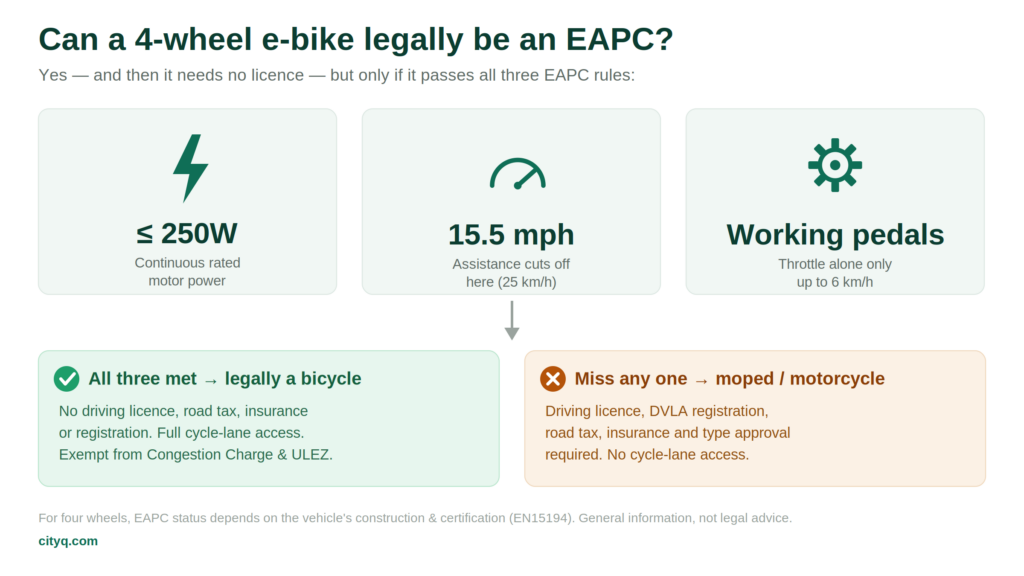
To be an EAPC, a cycle must meet three core construction rules, and the rules are unchanged in 2026. Per GOV.UK and the Electrically Assisted Pedal Cycles Regulations (1983, as amended in 2015 to harmonise with EU Regulation 168/2013), the vehicle must have:
- Working pedals that are capable of propelling it — pedals must do real work, not act as footrests.
- A motor rated at 250W or less continuous power. This is a rating, not peak output, and it’s separate from torque — a bike can produce high torque for hills and still sit within the 250W rated limit.
- Assistance that cuts off at 15.5 mph (25 km/h). You can pedal faster under your own power, but the motor must stop assisting at that speed.
One more point that trips people up: a throttle may only move the bike without pedalling up to walking pace — about 3.7 mph (6 km/h), the “walk-assist” allowance. Anything more and the vehicle needs type approval as a motor vehicle.
Meet all of the above and you’re an EAPC. Miss any one of them and you’re not.
Can a 4-wheel e-bike legally be an EAPC?
This is the real question for a cargo operator, and the honest answer is: it depends on how the specific vehicle is built and certified — the four-wheel case is more nuanced than the two-wheel one. Here’s the straight version.
UK e-bike law was written around two- and three-wheeled cycles (bikes, tricycles, tandems), and those are clearly covered. For vehicles with four wheels, the picture is less settled: some authoritative readings of the regulations treat the EAPC category as covering cycles up to three wheels, while official trading-standards guidance describes an e-bike as a cycle with “two or more wheels.” In other words, four wheels is precisely the area where you cannot assume the answer — you have to confirm the classification of the actual vehicle.
What resolves it in practice is construction and certification. Most compliant e-bikes in the UK demonstrate they meet the Construction & Use requirements through the harmonised European standard EN15194 (the pedelec standard). A four-wheel cargo e-bike that is designed, rated and certified to operate as an electric-assisted pedal cycle — 250W continuous rating, 25 km/h cut-off, functional pedals — is engineered to sit inside the cycle category rather than the moped one.
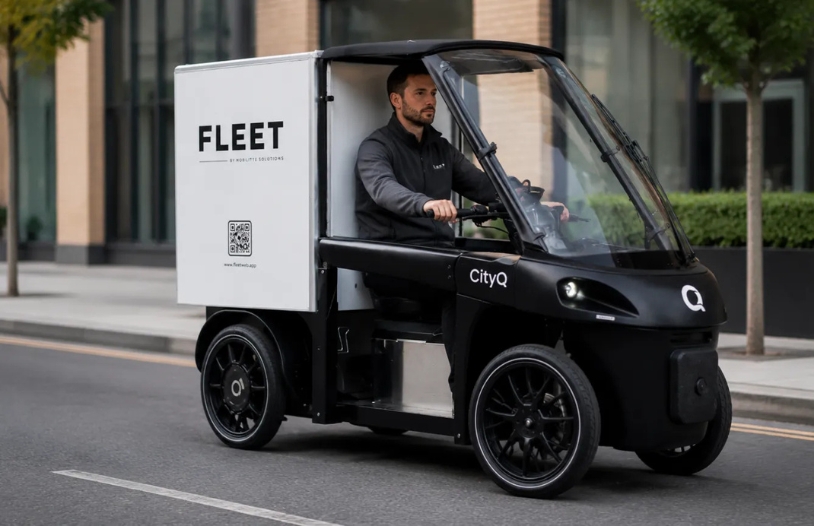
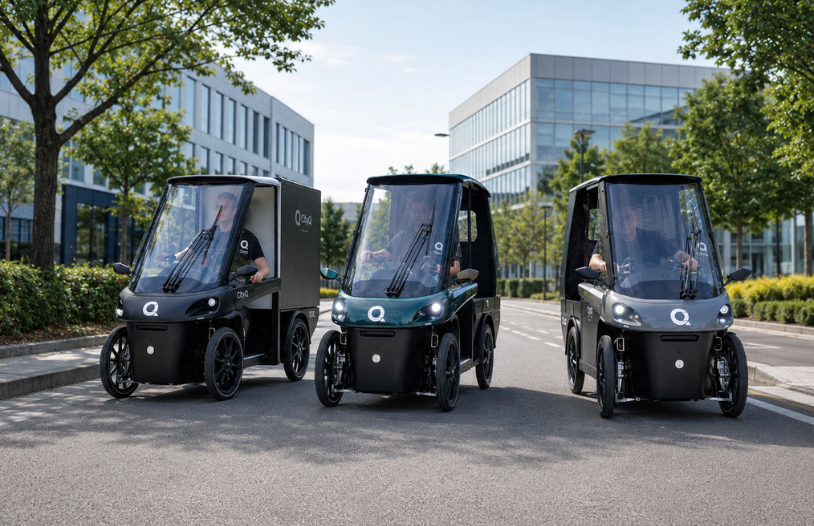
CityQ’s position: CityQ states that its four-wheel cargo ebikes are built and certified to EU standards (EN15194 and EN17860, CE marked), are pedal-assisted with a 25 km/h cut-off, and operate as electric-assisted pedal cycles — which is why operators such as DHL in London have run them for inner-city last-mile delivery for years without car licences. If you’re deploying a fleet, confirm the classification directly with CityQ for your use case, and take advice if your operation is unusual. The licence/tax/insurance answer flips entirely if a vehicle falls outside the EAPC definition, so it’s worth getting in writing.
When does an electric vehicle stop being an EAPC?
The moment it breaks any of the three core rules, it is reclassified as a moped or motorcycle — and then you do need a licence. The common ways a vehicle falls out of the category:
- a motor rated above 250W continuous
- assistance that continues past 15.5 mph
- a throttle that drives it beyond walking pace without pedalling
- no functional pedals
If any of these apply, the vehicle is a motor vehicle under UK law. That means a driving licence (category AM/A or B depending on the vehicle), DVLA registration, road tax, insurance, type approval, and — in some cases — a helmet to motorcycle standard. It also usually loses cycle-lane access. This is the line a serious operator does not want to cross by accident, which is exactly why the rated specification and certification of the vehicle matter so much.
What does this mean for the cost of running a city fleet?
Because an EAPC is a cycle, not a motor vehicle, it sidesteps the charges that now define the cost of driving in London — and that gap is widening in 2026. A non-compliant van or vehicle entering central London faces a £30.50 daily “van penalty”: the Congestion Charge rose to £18/day on 2 January 2026, on top of the £12.50/day ULEZ charge that applies across all London boroughs, 24/7. An EAPC pays neither — cycles are outside both schemes entirely.
Stack that against the operating model:
- No Congestion Charge, no ULEZ — £0 where a van pays up to £30.50 a day.
- Free parking at the kerb, at the exact job or drop address — no meter, no fine risk during overruns.
- No fuel and no licence, which widens your hiring pool to any capable rider, not just card-holding drivers.
- Cycle-lane access through Low Traffic Neighbourhoods (LTNs) and restricted streets a van can’t use.
For a business doing dense rounds across Hackney, Southwark, the City of London, Clerkenwell or Shoreditch, the regulatory status isn’t a technicality — it’s the whole cost case.
EAPC cargo bike vs van vs moped: the licence and cost picture
| EAPC 4-wheel cargo bike | Diesel/petrol van | Moped / L-category quad | |
|---|---|---|---|
| Driving licence | Not required | Required (B) | Required (AM/A or B) |
| Registration & road tax | None | Required | Required |
| Motor insurance | Not required as a motor vehicle | Required | Required |
| London Congestion Charge | £0 (exempt) | £18/day | £18/day (mopeds exempt; quads may pay) |
| ULEZ | £0 (exempt) | £12.50/day if non-compliant | Varies by emissions |
| Cycle lanes / LTNs | Full access | No access | No access |
| Kerbside parking | Free, where cycles park | Paid / restricted | Paid / restricted |
London charge figures are 2026 rates (TfL). Classification depends on the specific vehicle meeting EAPC construction rules.
So, do you need a licence — yes or no?
No, provided the four-wheel e-bike is genuinely an EAPC: 250W continuous rated, assistance cut off at 15.5 mph, functional pedals, and certified accordingly (typically to EN15194). Then it’s a bicycle in the eyes of the law — no licence, tax, insurance or registration, with full cycle-lane access and exemption from London’s Congestion Charge and ULEZ. If a vehicle misses any of those construction rules, it’s a moped or motorcycle and the answer becomes yes. The specification and certification are what decide it, so confirm them before you commit a fleet.
Frequently Asked Questions
Do you need a driving licence to ride a 4-wheel electric cargo bike in the UK?
No, as long as it qualifies as an Electrically Assisted Pedal Cycle (EAPC) — meaning a motor rated at 250W or less, electric assistance that cuts off at 15.5 mph, and working pedals. A compliant EAPC is treated like an ordinary bicycle, so no driving licence, road tax, insurance or registration is required. If the vehicle exceeds those limits, it is classed as a moped or motorcycle and a licence is required.
Is a CityQ legal to ride without a licence in the UK?
CityQ states that its four-wheel cargo ebikes are built and certified to EU standards (EN15194 and EN17860), are pedal-assisted, and cut off at 25 km/h — operating as electric-assisted pedal cycles that need no car driving licence. DHL has used CityQ for inner-city delivery in London for several years on this basis. Operators deploying a fleet should confirm the exact classification with CityQ for their specific use.
How fast can a UK EAPC go?
Electric assistance must cut off at 15.5 mph (25 km/h). You can pedal faster than that under your own power, but the motor must stop assisting once you reach the limit. Any vehicle whose motor keeps assisting beyond 15.5 mph is not an EAPC.
What is the 250W rule, and is it about power or torque?
The 250W limit is on the motor’s continuous rated power, not its peak output and not its torque. A cargo e-bike can produce strong torque for climbing hills with a heavy load and still meet the 250W continuous rating, because torque (measured in Nm) and rated power (measured in W) are different things.
Does a cargo e-bike pay the London Congestion Charge or ULEZ?
No. An EAPC is a cycle, not a motor vehicle, so it is exempt from both the Congestion Charge (£18/day in 2026) and the ULEZ (£12.50/day). A non-compliant van can face the combined £30.50 daily charge; an EAPC pays nothing.
Can a 4-wheel e-bike use cycle lanes in the UK?
A four-wheel e-bike that qualifies as an EAPC can use cycle lanes and cycle paths in the same way as a standard bicycle, subject to width and local rules. This access is one of the main reasons cargo operators choose cargo bikes for congested and restricted city centres.
What happens if my e-bike isn’t EAPC-compliant?
It is classed as a moped or motorcycle and must be registered with the DVLA, taxed, insured and type-approved, and the rider needs the appropriate licence and helmet. It also loses cycle-lane access. This is why the rated specification and certification of the vehicle matter so much before purchase.