


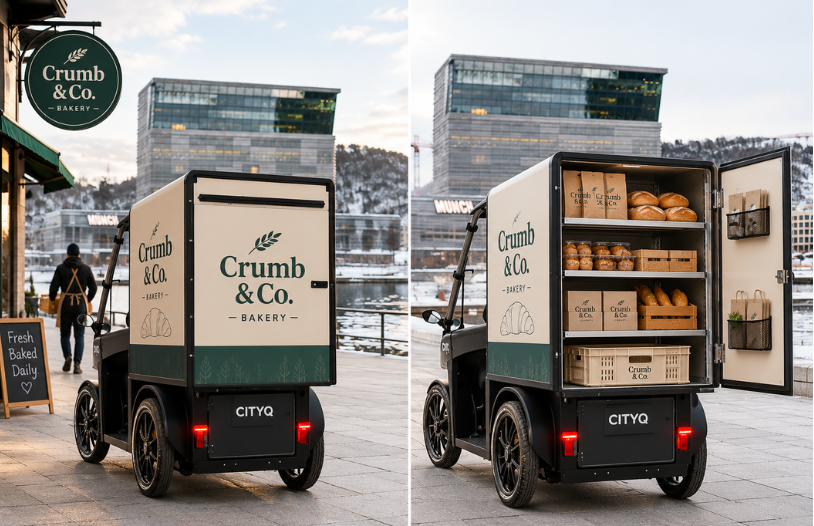
Running food delivery by van in a UK city means eating £30.50 a day in ULEZ and Congestion Charge fees before a single order goes out — plus a driving licence, MOT, insurance, and a parking bay you’re never guaranteed. That’s the exact cost problem pushing operators to look at how to replace delivery van with cargo ebike UK-wide, and it’s why the best cargo ebike food delivery UK businesses are switching to is a 4-wheel, enclosed model like the CityQ 1200: van-level payload, bike-level legal status, and none of the daily charges that eat into a delivery margin before the first order even goes out.
What Makes a Cargo eBike "The Best" for UK Food Delivery?
Not every electric cargo bike food courier UK operators see on the street is built for the job. Food delivery has specific demands that separate a genuinely capable cargo ebike from a glorified delivery bag on wheels:
- Payload and volume — enough space for stacked food containers, drink crates, or a full catering order, not just a single bag.
- Insulated box compatibility — a cargo ebike insulated box UK riders can fit food-safe liners into keeps hot food hot and cold items cold across a multi-stop round.
- Weather protection — an enclosed cabin means orders (and riders) survive a wet British winter without delays.
- Legal classification — EAPC status (motor ≤250W, assistance cutting off at 15.5mph, working pedals) is what unlocks bike-lane access, free parking, and no driving licence requirement.
- Reliability across a full shift — swappable batteries and low-maintenance drivetrains matter when a bike is doing 6-10 hours of stop-start work a day.
CityQ 1200: The Best Cargo eBike for UK Food Delivery
| Spec | CityQ 850 | CityQ 1200 | Why it matters for food delivery |
|---|---|---|---|
| Payload | 180kg | Up to 200kg | Handles multiple stacked orders or a full catering run in one trip |
| Cargo capacity | 1m³ | 1.3m³ | Fits crates, insulated boxes, and drink cases without repacking |
| Legal status | EAPC (bicycle) | EAPC (bicycle) | No licence, no MOT, no road tax, bike-lane access |
| Best fit | Solo courier / smaller cafés | Restaurants, quick-commerce, catering fleets | Matches order volume to vehicle size |
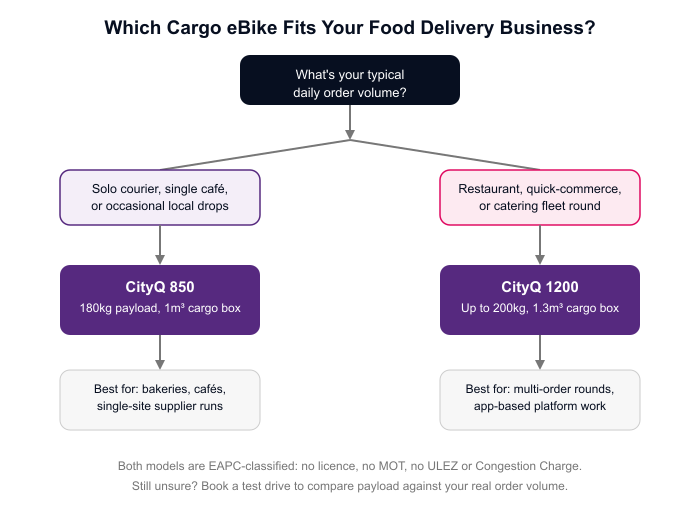
Both models are certified under CE, EN15194, and EN 17860 — the EU standards that also underpin their UK EAPC classification. Neither is the automatic “better” choice: a solo courier or single café doing short, light rounds is often better served by the 850, while restaurants, quick-commerce, and catering fleets running stacked multi-order rounds get more use out of the 1200’s extra payload and volume. Match the model to your order volume, not the other way round.
How Does a Cargo eBike Compare to a Delivery Van?
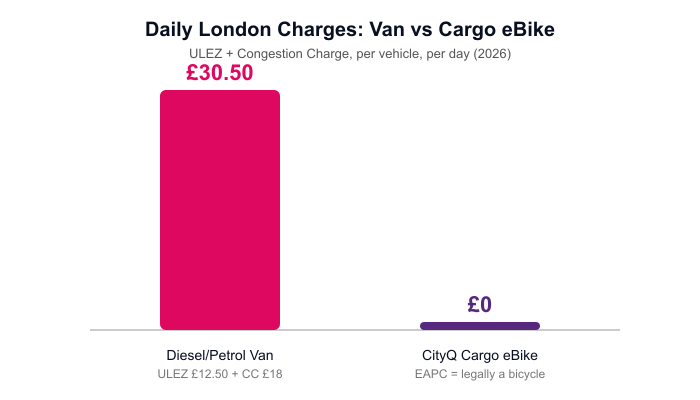
For food businesses weighing up a food delivery van alternative UK operators are already switching to, the comparison usually comes down to three things: cost, speed, and access.
| Factor | Delivery Van | Cargo eBike |
|---|---|---|
| ULEZ + Congestion Charge (London) | £30.50/day combined | £0 (EAPC = legally a bicycle) |
| Driving licence required | Yes | No |
| Parking | Paid bays, risk of fines | Free, wherever bikes can park |
| Loading/unloading time per stop | ~12 minutes | ~3 minutes |
| Best for | Long-haul, bulky, rural routes | Short, dense, repeat urban rounds |
That loading-time gap isn’t a CityQ figure — it’s from a University of Southampton study commissioned by courier firm CitySprint, which found cargo bikes completing urban delivery jobs up to 50% faster than small vans during peak weekday traffic. Deliveroo’s own smartphone data backed this up, showing cyclists beating cars and scooters on inner-city trip times. It’s the same performance gap behind why quick-commerce platforms are scaling with 4-wheel cargo ebikes instead of vans — a cargo ebike isn’t a full van replacement for long-haul or bulky loads, but for dense, last-mile food rounds it already wins on the two metrics that matter: time per stop and access to restricted streets.
Cargo eBikes and UK Quick-Commerce: How Food Delivery Platforms Are Adapting
This isn’t a future-of-delivery pitch — it’s already reshaping how UK food and quick-commerce operators move orders. As delivery volumes shift from a single meal in a courier bag to “everything delivery” — groceries, retail items, multiple stacked orders per loop — two-wheeled couriers and mopeds are hitting a capacity wall, and operators need van-grade cargo space with bike-lane agility to keep up, or riders end up making multiple trips instead of one consolidated round.
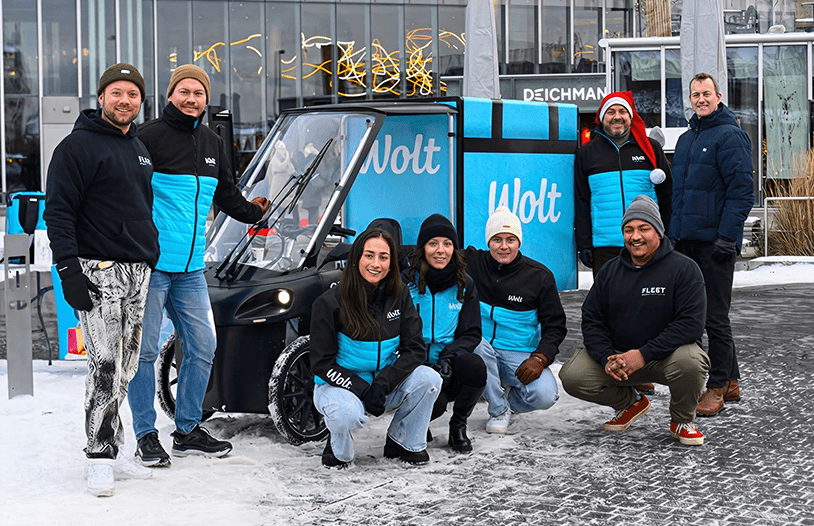
Wolt is a clear example of how far this goes. Beyond restaurant meals, Wolt has expanded into full retail and grocery delivery using cargo bikes — clothes, tools, toys, sports equipment — through Wolt Market, carrying a fuller basket per trip instead of a single courier bag. It’s the same logic behind the wider shift toward cargo ebikes across quick-commerce platforms: once an app moves beyond single-meal drops, an enclosed 4-wheel cargo ebike is the vehicle that can keep up with order volume and weather, 365 days a year.
This isn’t just a food-app story either. Amazon now runs e-cargo bikes from more than 40 cities across the UK and Europe, and Evri has publicly stated a plan to grow its e-cargo bike fleet from 33 to 3,000 over the next decade — cargo bike grocery delivery UK operations are moving from pilot projects to standard fleet strategy across the whole delivery sector.
Best Cargo eBike for Restaurants, Cafés, and Catering
For food and beverage businesses running their own deliveries rather than relying on third-party apps, the case is slightly different — it’s less about matching app order volume and more about killing van-level costs on short routes. Short trips still trigger fuel, insurance, servicing, city-charge, and admin costs at van scale, even when the actual round is a five-minute supplier run — which is exactly the gap cargo bike restaurant delivery UK operations are built to close for bakeries, cafés, restaurants, and breweries.
In practice, that use case breaks down as:
- Bakeries — morning trade drops and midday top-ups without needing a van on the road all day.
- Cafés — stock runs between sites and corporate coffee/catering kits.
- Restaurants — supplier and packaging runs plus planned local deliveries.
- Breweries — local sample drops and taproom-to-venue support.
If your business can apply for external funding rather than covering the full cost upfront, it’s also worth checking eligibility for schemes like the Bristol electric cargo bike grant — Bristol City Council, for example, is currently offering grants of up to £20,000 (covering 50% of costs) to businesses, schools, charities, and community organisations replacing vans and cars with electric cargo bikes, with 75% of the grant paid upfront.
What Does It Cost to Run a Cargo eBike Food Delivery Business in the UK?
For anyone weighing up a food delivery cargo ebike 2026 launch — whether as an independent courier, a quick-commerce contractor, or a restaurant, café, or bakery adding its own delivery round — the up-front number is usually the deciding factor. A solo operator can typically be on the road for between £10,000 and £12,000 all-in, with annual running costs under £2,000. Under the UK’s Annual Investment Allowance, the full purchase cost of a qualifying cargo ebike can be deducted from taxable profit in year one, which can bring the effective first-year cost down to roughly £8,250 before a single delivery is even made. There’s no fuel to budget for, no ULEZ or Congestion Charge, no MOT, and no driving licence requirement to factor into hiring.
For a bakery or café running its own local delivery round rather than outsourcing to a third-party app, that cost picture is even lighter in practice — a single cargo ebike can usually cover multiple daily supplier runs and local drops that would otherwise need a van sitting outside all day racking up parking, insurance, and city-charge costs. CityQ’s full breakdown of every UK startup cost, insurance requirement, and funding route — including the Annual Investment Allowance and regional grants — covers exactly what it takes to launch a cargo ebike delivery business UK operators can realistically run in 2026.
FAQ
1. What’s the best cargo ebike for food delivery in the UK?
A 4-wheel, enclosed cargo ebike like the CityQ 1200 is currently the strongest fit — it carries up to 200kg, qualifies as an EAPC (so no licence or MOT is needed), and avoids ULEZ and Congestion Charge fees that add £30.50/day to a van’s running cost in London.
2. Do I need a licence to ride a food delivery cargo ebike in the UK?
No — provided the vehicle qualifies as an Electrically Assisted Pedal Cycle (motor rated 250W or less, assistance that cuts off at 15.5mph, and working pedals), it’s legally a bicycle and needs no driving licence, road tax, insurance, or registration.
3. Can a cargo ebike keep food hot or cold during delivery?
Yes — an enclosed cargo box can be fitted with insulated food-safe liners or crates, and the fully weatherproof cabin (window, floor, doors, wiper) protects both the food and the rider from rain, unlike an open two-wheeled courier setup.
4. Is a cargo ebike faster than a van for food delivery in cities like London?
For short, dense urban rounds, often yes. A University of Southampton study for CitySprint found cargo bikes completing deliveries up to 50% faster than vans at peak times, with loading/unloading averaging around 3 minutes per stop versus roughly 12 minutes for a van.
5. How much does it cost to start a cargo ebike food delivery business in the UK?
A solo operator can typically launch for £10,000-£12,000 all-in, with annual running costs under £2,000. The UK’s Annual Investment Allowance can bring the effective first-year cost down to around £8,250 by allowing the full purchase price to be deducted from taxable profit.
6. Are there UK grants available for cargo ebikes used in food delivery?
Some are, and they change by council. Bristol City Council, for instance, currently offers grants of up to £20,000 (covering 50% of costs) for businesses — including food and hospitality operators — replacing vans and cars with electric cargo bikes, with 75% paid upfront.
Ready to see whether a cargo ebike fits your food delivery rounds? Book a test drive with CityQ, or explore the full CityQ 1200 spec sheet to check payload against your typical order volume.

