Starting a commercial delivery fleet in the UK used to follow a predictable formula:
Starting a commercial delivery fleet in the UK used to follow a predictable formula: lease a few diesel or electric vans, hire licensed drivers, and start booking routes. Today, that exact approach has become an operational money pit. Between escalating vehicle costs, severe driver shortages, and an endless stream of £180 parking tickets, a traditional van fleet can quickly drain your profit margins. If you are looking to launch a highly profitable cargo ebike delivery business UK fleets can reliably scale with, the path forward isn’t to buy a bigger van—it’s to eliminate it entirely.
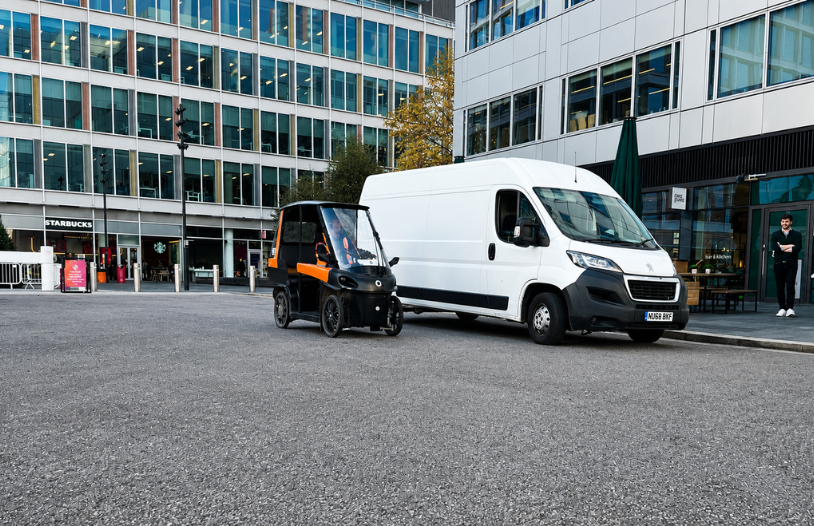
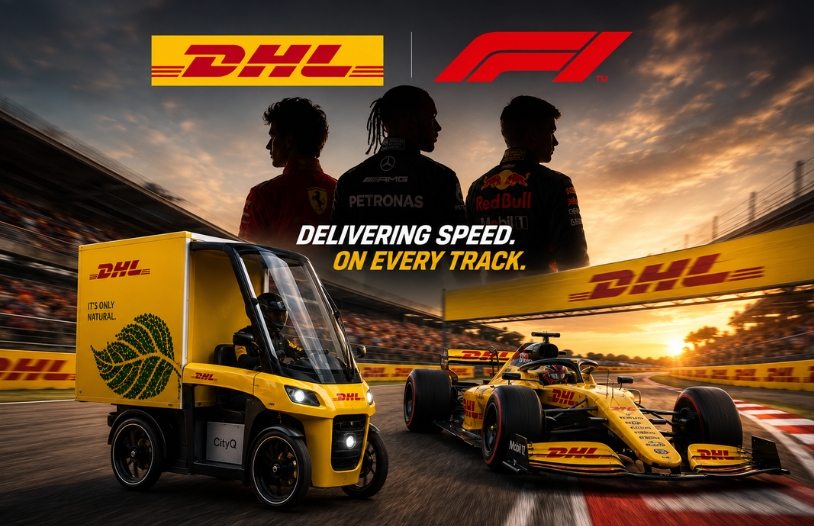
The viability of building a high-volume delivery business without traditional vehicle overheads is a proven commercial reality. Take a look at how the world’s largest logistics operator manages its most demanding bottlenecks: the DHL CityQ cargo bike fleet proves that four-wheeled platforms can seamlessly maintain tight delivery schedules even during hyper-congested events like the Formula 1 weekend in Barcelona and daily rush hours in central London. Because these commercial four-wheelers legally operate under e-bike regulations, they completely bypass gridlock, roll straight past traffic, and drop cargo directly at a customer’s doorstep with zero municipal emission fees.
But if you want to know how to start an urban delivery network from scratch, what are the actual startup costs involved? Below, we break down the exact capital investments, operational expenditures, and return-on-investment metrics required to build a modern, zero-emission fleet.
The Catalyst: Why a Delivery Business Without Van UK Operations is Highly Profitable
Before calculating upfront numbers, it is vital to understand the regulatory forces shaping your cargo bike business plan UK. In major UK cities, operating a traditional van has become financially punitive. Central London’s Congestion Charge (£18/day) paired with the Ultra Low Emission Zone (ULEZ) charge (£12.50/day) means a non-compliant van incurs thousands of pounds annually just in access fees.
Furthermore, widespread Low Traffic Neighbourhood (LTN) schemes create severe physical and operational bottlenecks for traditional commercial vehicles. As highlighted by numerous funded startups opting for a heavy-duty 4-wheel cargo ebike, these modern vehicles legally bypass access fees, avoid parking fines by utilizing bike lanes, and move up to 40% faster in city centers.
The Financial Blueprint: CapEx vs. OpEx Breakdown
To calculate your true cargo ebike delivery service cost, expenses must be split into upfront Capital Expenditures (CapEx) and recurring monthly Operational Expenditures (OpEx).
1. Fleet Procurement & The Downtime Trap (CapEx)
The most common mistake new operators make when launching an electric cargo bike delivery startup is purchasing consumer-grade or fragile 2-wheel cargo bikes to save on upfront costs. In a rigorous multi-shift delivery environment, traditional mechanical chains, external derailleurs, and heavy-loaded spokes snap under daily 150kg+ payloads. This results in devastating fleet downtime and costly mechanical repair bills.
Heavy-duty 4-wheel “Car-E-Bikes” like the CityQ solve this through a software-managed, chainless “pedal-by-wire” drivetrain. No chains mean zero chain wear, no lubrication, and vastly lower fleet maintenance over time.
-
Outright Purchase: A premium commercial 4-wheel cargo e-bike with a massive, weather-protected 1.3 m³ (1,200-liter) cargo box typically costs around £10,000 per unit depending on custom branding wraps. Under the UK’s Annual Investment Allowance (AIA), funded startups can write off 100% of this asset cost against taxable profits in the first year.
-
Commercial Leasing: For businesses prioritizing initial capital efficiency, equipment leasing or hardware-as-a-service (HaaS) models convert this CapEx into a manageable OpEx line item, averaging £250 to £400 per month per vehicle, which frequently includes routine servicing.
2. Micro-Hubs & Infrastructure (OpEx)
Operating a successful courier cargo bike business UK wide does not require an expensive, out-of-town warehouse. Instead, you need a centrally located “micro-hub”—a small urban footprint like a repurposed railway arch, basement parking bay, or local retail storage unit where larger cargo trucks can drop off bulk inventory for cross-docking onto your cargo e-bikes.
-
Micro-Hub Rent: Expect to budget £800 to £2,500 per month depending on the city and location.
-
Charging Infrastructure: £0. Unlike electric commercial vans that require thousands of pounds in specialized high-voltage infrastructure, a CityQ fleet utilizes dual swappable batteries that plug directly into standard 3-pin household wall sockets, drawing 90% less energy than a full-size electric vehicle.
3. Drivers, Licensing, & Recruitment (OpEx)
The UK logistics sector is currently battling a severe shortage of qualified van drivers, driving up hourly wage expectations. By building your fleet on 4-wheel e-bikes, you legally sidestep this bottleneck.
-
No License Requirement: Because the vehicles qualify as Electrically Assisted Pedal Cycles (EAPCs), you can recruit from a massive, flexible pool of riders without a driving license, which sharply reduces your recruitment costs and ongoing HR friction.
-
Rider Kits & Training: Budget roughly £300 per rider for professional urban cycling safety courses, branded weatherproof uniforms, and safety helmets.
| Operational Metric | Traditional Delivery Van (Diesel/EV) | Standard 2-Wheel Cargo Bike | CityQ 4-Wheel Cargo eBike |
| UK Clean Air / Congestion Fees | £11,000+ per year (London) | £0 | £0 |
| Driving License Needed? | Yes (Severe Driver Scarcity) | No | No (Expanded Labor Pool) |
| Mechanical Failure Risk | Medium (Transmission/Engine) | High (Snapped Chains/Spokes) | Ultra-Low (Chainless Pedal-by-Wire) |
| Rider Weather Protection | High | Zero (Drives High Staff Churn) | High (Full Cabin Enclosure & Wipers) |
| Parking Fine Risk | High (£80 – £130 per ticket) | None | None (Legally Parks on Pavements/Bays) |
| Energy Consumption | Baseline (100%) | 95% Less than Van | 90% Less than Van |
Field-Proven ROI: Real-World Case Studies by Delivery Category
When validating your financial forecasts, real-world data from active fleets provides the ultimate proof of concept. CityQ’s operational footprint spans multiple delivery sectors, proving that right-sizing your vehicles directly translates to immediate cost reductions.
Category A: Post, Parcel, & Express Courier Services
High-density courier routes are notoriously vulnerable to parking fines and traffic bottlenecks. Heavy-duty 4-wheel e-bikes allow couriers to completely decouple delivery times from urban traffic congestion.
-
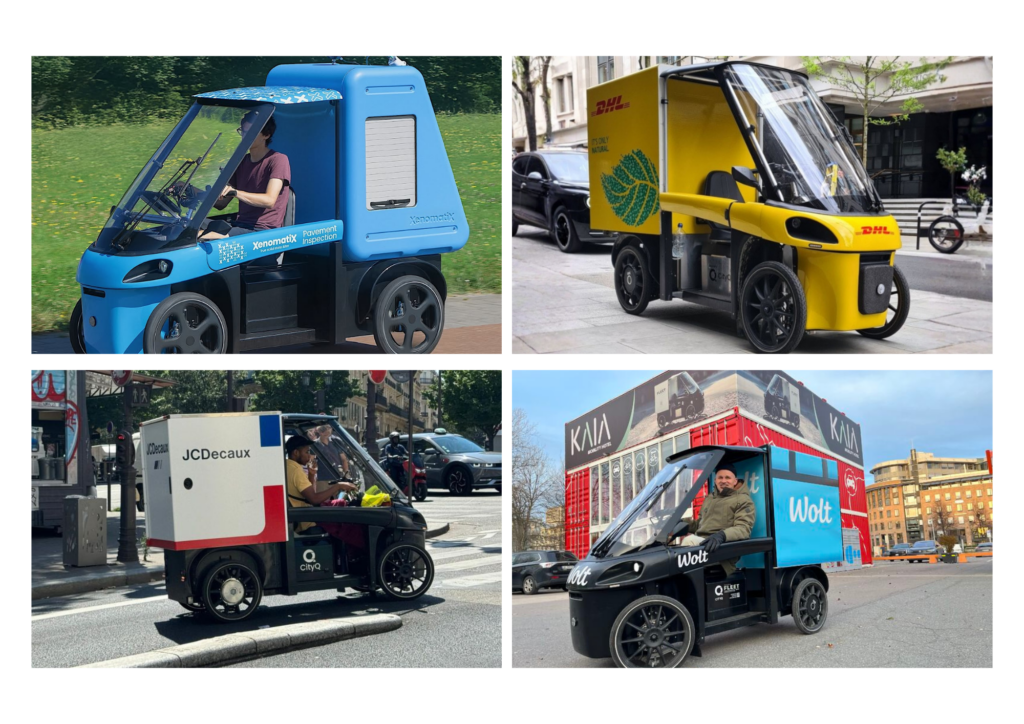
DHL (London): DHL’s rigorous implementation of CityQ platforms for last-mile delivery in central London over a multi-year period has shown that 4-wheel cargo bikes move significantly faster than traditional vans door-to-door, navigating cycle infrastructure while completely avoiding time spent searching for legal parking spaces.
-
Blech Kurier (Germany): Tasked with the time-sensitive pick-up and delivery of medical laboratory probes, Blech Kurier deployed a fleet of 5 CityQs running up to 100km per day. By swapping traditional service vehicles for four-wheelers, they reduced operational costs by €0.28 per kilometer, eliminated costly parking fines, and found that the comfortable enclosed cabin made it significantly easier to recruit and retain high-quality riders.
Category B: Food, On-Demand, & Quick-Commerce (Q-Commerce)
On-demand food and grocery logistics require temperature control, cargo stability, and 100% vehicle uptime regardless of the weather.
-
Wolt (Oslo): To maximize their quick-commerce delivery efficiency, Wolt successfully deployed CityQ fleets to run 100km a day for over a year and a half in sub-zero temperatures (−10°C). The enclosed cabin kept riders comfortable, while the stable 4-wheel chassis ensured that delicate food payloads remained perfectly balanced through ice, snow, and rain.
Category C: Field Deliveries, Smart-City Infrastructure, & B2B Cargo
Moving payloads for corporate field operations, asset delivery, and multi-site facilities loops requires a platform rugged enough to replace a traditional trades van.
-
JCDecaux (Paris): Facing extreme gridlock and costly parking tickets while managing civic infrastructure, JCDecaux deployed a fleet of 16 custom-configured CityQ vehicles across Paris. By transitioning away from conventional vans, they cut their transit times across Paris by a staggering 50%, completely eliminated parking fines, and drastically simplified their rider recruitment process due to the vehicle’s superior cabin comfort.
-
Lehrieder Catering (Germany): Managing food transport and maintenance across a massive 170,000 m² exhibition center, Lehrieder Catering replaced time-consuming on-foot transfers with a single CityQ. Operating in areas where standard cars and vans cannot legally enter, the 4-wheel cargo e-bike optimized their operations so intensely that it saved 11 hours of labor per day, turning a two-person, full-time manual hauling task into a streamlined, single-rider shift completed in just 5 hours.
The Bottom Line: Total Launch Capital Required
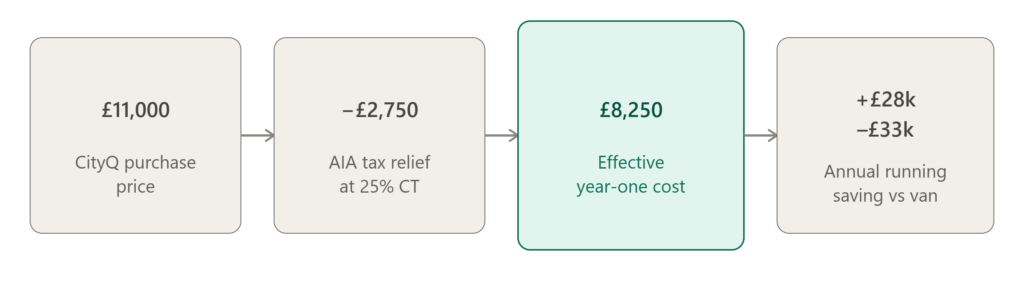
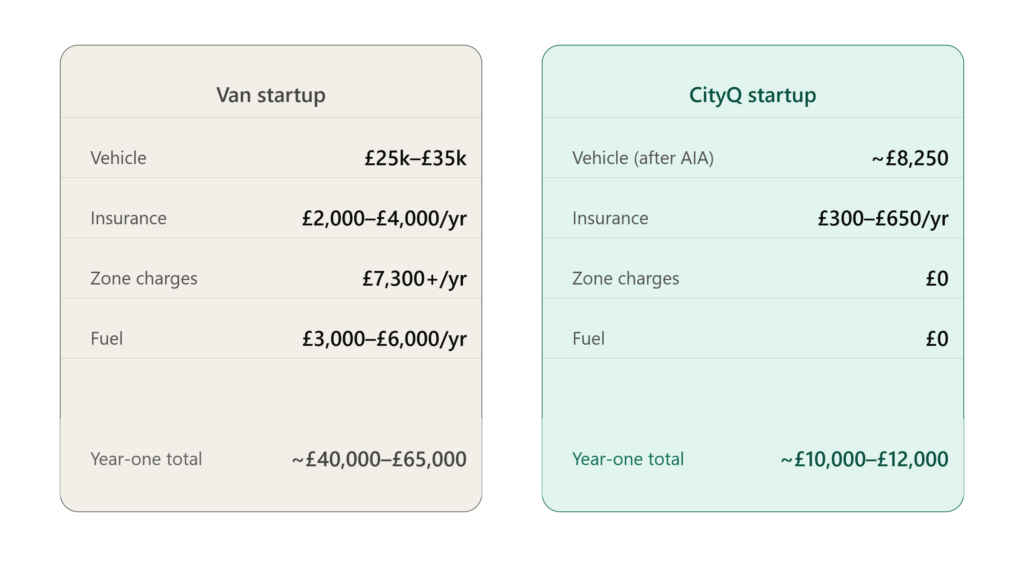
When you calculate your absolute cargo ebike startup costs UK 2026 baseline, you can get a professional 3-bike delivery fleet off the ground with an initial capital injection of roughly £8,000 to £12,000 assuming you leverage commercial vehicle lease deposits rather than outright upfront purchases. This budget comfortably covers your initial HaaS deposits, micro-hub entry rent, routing software, and public liability insurance.
By eliminating fuel, congestion fees, and parking penalties, right-sizing your delivery fleet yields up to a 70% reduction in total cost of ownership (TCO) per kilometer compared to traditional vans. You aren’t just building a green business—you are unlocking a highly optimized, future-proof cash flow machine
FAQs
1. Do riders need a driving license to operate a commercial 4- heel cargo e-bike in the UK?
No. Under UK law, a 4-wheel cargo vehicle like the CityQ is registered as an Electrically Assisted Pedal Cycle (EAPC). As long as the motor assists up to a maximum speed of 15.5 mph, anyone aged 14 or over can legally ride it on public roads and cycle paths without a driving license, vehicle registration, or road tax.
2. How much weight can a CityQ cargo e-bike legally transport?
The vehicle is engineered specifically for heavy-duty commercial payloads. It features an automotive-grade chassis that handles a total cargo weight of up to 200kg, accompanied by a massive 1.3 m³ volume capacity, making it perfect for stacked parcels, quick-commerce groceries, or bulk catering setups.
3. How do you charge a 4-wheel cargo e-bike fleet?
You do not need to invest in commercial EV charging bays or expensive high-voltage infrastructure. CityQ uses modular, dual swappable batteries located directly under the driver’s seat. These batteries provide up to 100km of range and can be removed in seconds to plug into any standard domestic 3-pin household wall socket.
4. How do 4-wheel cargo bikes handle winter weather conditions?
Unlike traditional 2-wheel cargo bikes that leave riders exposed to elements and vulnerable to slipping on ice, CityQ features a fully enclosed cabin with a windscreen, side doors, and windshield wipers. The 4-wheel configuration provides maximum low-speed stability and traction, allowing fleets like Wolt in Oslo to maintain continuous operations in freezing temperatures down to −10°C.