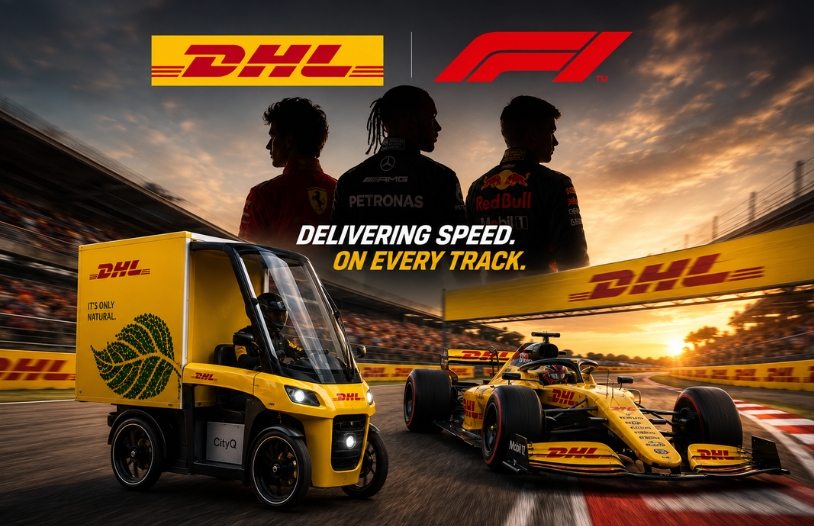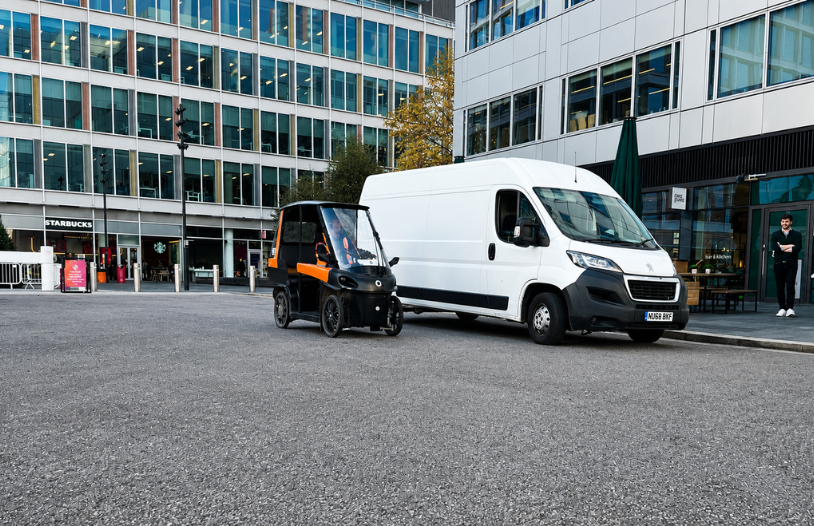
DHL has run CityQ four-wheel cargo eBikes across London for two years, using them to sidestep a Congestion Charge and ULEZ combination that now costs £30.50 per day, per van. That is not a pilot anymore it is a working template for exactly the question most UK operators are asking in 2026, whether you’re switching an existing fleet or starting a cargo ebike delivery business in the UK from scratch: can a cargo ebike actually take over from a van, or is this still a bike-lane gimmick?
Quick answer: Yes, a 4-wheel cargo ebike like the CityQ 1200 can replace a delivery van for the large majority of UK urban routes — typically anything under a 25–45 mile round trip carrying up to 200kg. It legally counts as a bicycle (an EAPC), so it skips ULEZ, the Congestion Charge, van parking restrictions, and the need for a driving licence. It is not a full van replacement for long-haul runs, bulky single-item loads, or routes with no safe cycling infrastructure — for those, a van still wins.
What exactly counts as a "cargo ebike" here?
Not every electric bike with a basket qualifies. The vehicles actually being trialled by DHL, FedEx, Amazon and Wolt in UK cities are 4-wheel, pedal-assisted cargo quadricycles — sometimes called “car-e-bikes” built with an enclosed cargo box roughly the size of a small van’s rear compartment. The CityQ 1200, for example, carries up to 200kg in a 1.3m³ modular cargo box, while remaining legally classified as a bicycle rather than a motor vehicle.
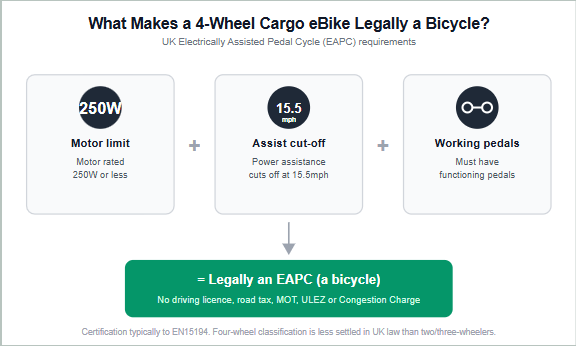
That classification is the whole point. In the UK, a vehicle qualifies as an Electrically Assisted Pedal Cycle (EAPC) if the motor is rated 250W or less, assistance cuts off at 15.5mph, and it still has working pedals. Two- and three-wheelers have long been treated this way; the rules are somewhat greyer for four-wheelers, and classification hinges on the vehicle’s construction and certification (typically to EN15194). CityQ’s models are built and certified to meet this standard, which is how DHL has been able to operate them on UK streets without drivers needing a driving licence, road tax, insurance, or vehicle registration.
How much can a cargo ebike actually carry vs a van?
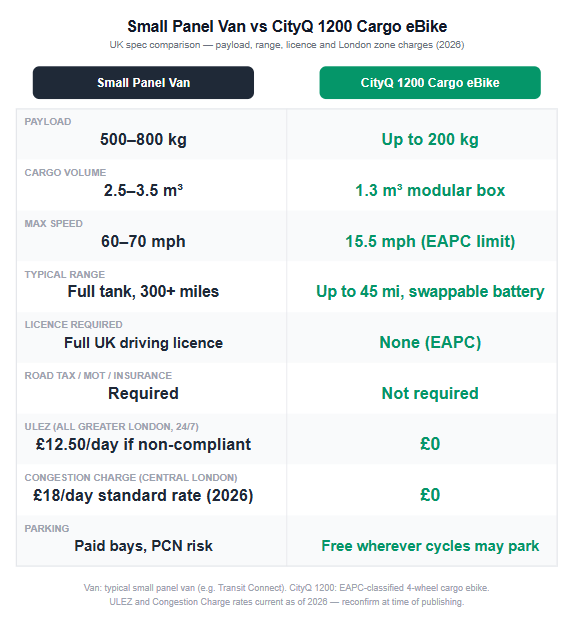
| Small panel van (e.g. Transit Connect) | CityQ 1200 cargo ebike | |
|---|---|---|
| Typical payload | 500–800kg | Up to 200kg |
| Cargo volume | 2.5–3.5m³ | 1.3m³ modular box |
| Max speed | 60–70mph | 15.5mph (pedal-assisted, EAPC limit) |
| Typical range per charge | Full tank, 300+ miles | Up to 45 miles per battery, swappable |
| Licence required | Full UK driving licence | None (EAPC) |
| Road tax / MOT / insurance | Required | Not required for an EAPC |
| ULEZ (all Greater London boroughs, 24/7) | £12.50/day if non-compliant | £0 — not a motor vehicle |
| Congestion Charge (central London, charging hours) | £18/day standard rate (2026) | £0 |
| Parking | Paid bays, PCN risk | Free wherever cycles may park |
A cargo ebike carries a fraction of a van’s payload and moves at a fraction of its top speed. That is precisely why it is not a blanket van replacement — it is a replacement for the specific delivery pattern most urban operators actually run: frequent stops, modest parcel sizes, short distances between drops, all within a dense city core where a van spends more time parked and fined than driving.
Where does a cargo ebike genuinely beat a van in the UK?
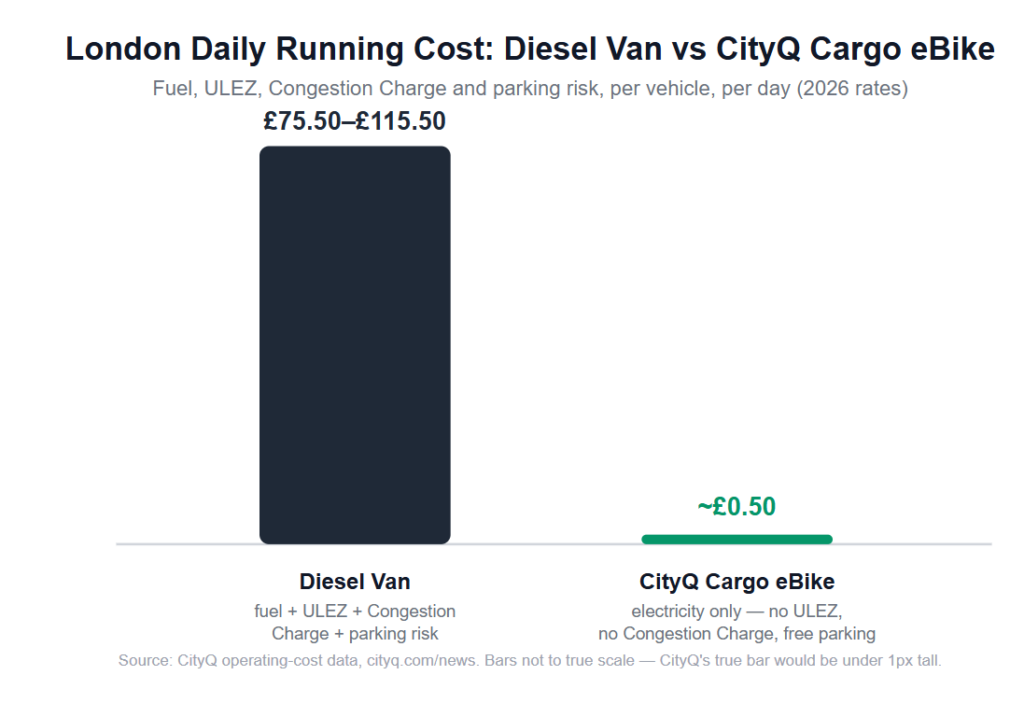
- Zero-emission zone charges. ULEZ applies 24/7 across all Greater London boroughs at £12.50 per day for any non-compliant vehicle. The Congestion Charge is a further £18 per day in central London during charging hours (rising to £21 if paid late) — and from January 2026 even electric vans lose their full exemption, paying a reduced £9/day rate on Auto Pay instead of nothing. A non-compliant diesel van hit by both charges is looking at £30.50 a day before a single mile is driven. A CityQ, as a legally classified bicycle, is liable for neither.
- Parking. A van parked on double yellows or in a loading bay outside its window is a Penalty Charge Notice waiting to happen. A cargo ebike parks anywhere cycles are permitted, free, at the kerb closest to the drop-off.
- Speed through congestion. Cycle-lane access lets a cargo ebike bypass queued traffic that a van sits in. CityQ’s own operator data across six real deployments — including DHL in London — shows routes running roughly 50% faster once switched from van to cargo ebike, driven mainly by parking and congestion avoidance rather than raw top speed.
- Hiring pool. No driving licence requirement means operators can recruit riders faster and more widely, which matters in a market with a persistent driver shortage.
- Running cost. Electricity for a cargo ebike costs a small fraction of diesel or even EV van charging, with no MOT and dramatically lower maintenance given the simpler drivetrain.
Where does a van still win?
CityQ’s own content is consistently honest about this, and the pattern holds industry-wide: a van still wins on long-haul or multi-drop routes beyond a cargo ebike’s practical range, on single loads too bulky or heavy for a 200kg/1.3m³ box (a sofa, a pallet, a fridge), on routes with genuinely no safe cycling infrastructure, and in weather-independent, all-night operations at motorway speed. If your delivery pattern is dominated by long inter-city runs rather than dense last-mile drops, a van or a mixed fleet remains the right tool.
What does switching actually cost?
Because a cargo ebike is treated as plant and machinery rather than a car for capital allowance purposes, a UK business buying one for genuine business use can typically claim the Annual Investment Allowance (AIA) — 100% first-year tax relief on the purchase, up to the current £1 million annual limit, the same relief available on a van but specifically unavailable on cars. That turns the headline purchase price into a materially lower effective cost in year one. Wondering whether a cargo eBike tax deductible claim actually applies to your purchase? CityQ’s dedicated guide walks through the mechanics, a worked calculation, and the current AIA figures in full worth reading before you buy, since capital allowance rules are exactly the kind of detail that changes from one Budget to the next.
Running costs follow the same pattern: no fuel, no ULEZ, no Congestion Charge, minimal maintenance. If you’re weighing this as a full startup decision rather than a fleet swap, it’s worth working through the full running-cost breakdown for a solo operator covered in detail in the cargo ebike delivery business UK guide linked earlier in this post.
Is it actually legal to run one for deliveries without a licence?
Yes, provided the vehicle qualifies as an EAPC — 250W motor or less, assistance cutting off at 15.5mph, working pedals, and appropriate certification (typically EN15194). The full 4-wheel e-bike licence UK rules are covered in detail on CityQ’s site, including where UK law is less settled for four-wheelers than for two- and three-wheelers and meeting that standard is exactly how DHL has been able to operate a UK fleet without drivers holding a driving licence.
A real UK example: DHL, London
DHL has operated CityQ four-wheel cargo bikes across London for two years, using them specifically to avoid the £30.50 daily “van penalty” of ULEZ plus the Congestion Charge, while recruiting riders without requiring a driving licence. Over that operation, CityQ’s platform has logged more than one million kilometres of business use with no reported rider injuries, and DHL’s routes have run with a documented speed advantage in congested central zones. It’s a genuine, sustained commercial deployment rather than a short trial — a useful reference point for any UK operator weighing the same switch.
FAQ
Can a cargo ebike really replace a delivery van in the UK? For dense urban, last-mile routes with frequent stops and payloads under roughly 200kg, yes — operators including DHL, FedEx and Amazon are already running cargo ebikes at scale across UK cities. For long-haul or bulky single-item loads, a van remains the better tool.
How much weight can a UK cargo ebike carry compared to a van? A model like the CityQ 1200 carries up to 200kg in a 1.3m³ box, versus 500–800kg and 2.5–3.5m³ for a typical small panel van. The ebike trades capacity for access, speed through traffic, and zero zone charges.
Do I need a driving licence to operate a cargo ebike for deliveries in the UK? No, provided the vehicle is classified as an Electrically Assisted Pedal Cycle (EAPC): 250W motor or less, 15.5mph assistance cut-off, and working pedals. It requires no driving licence, road tax, MOT, or vehicle insurance in the way a van does.
Does a cargo ebike pay ULEZ or the Congestion Charge in London? No. Because an EAPC-classified cargo ebike is legally a bicycle rather than a motor vehicle, it is exempt from both the £12.50/day ULEZ charge and the £18/day (2026) central London Congestion Charge, which now apply to non-compliant vans and, since January 2026, even to electric vans and cars.
Is a cargo ebike tax deductible for a UK business? It can qualify for the Annual Investment Allowance, giving 100% first-year tax relief on the purchase up to the current £1 million annual limit — the same relief category as a van, and one cars specifically cannot claim. Confirm the current limit and rules before purchase, as capital allowance thresholds can change at each Budget.
Where does a delivery van still beat a cargo ebike? Long-haul routes beyond a cargo ebike’s practical range, single loads too large or heavy for a 200kg/1.3m³ box, and routes with no safe cycling infrastructure. Most operators run a mixed fleet rather than eliminating vans entirely.