


In May 2026, officers from Brighton & Hove City Council’s street cleaning, postal delivery and health services teams tested a CityQ, a four-wheel electric cargo bike for councils and city services, on a demo day, and Councillor Trevor Muten, the council’s Cabinet Member for Transport and City Infrastructure, rode it himself. He engaged directly with the swappable battery: no fixed charging point, no capital works, no wait for an electrical upgrade. London boroughs face the same access, cost and staffing pressures, and the electric cargo bike London operators are switching to in 2026 is the same four-wheel, weatherproof vehicle.
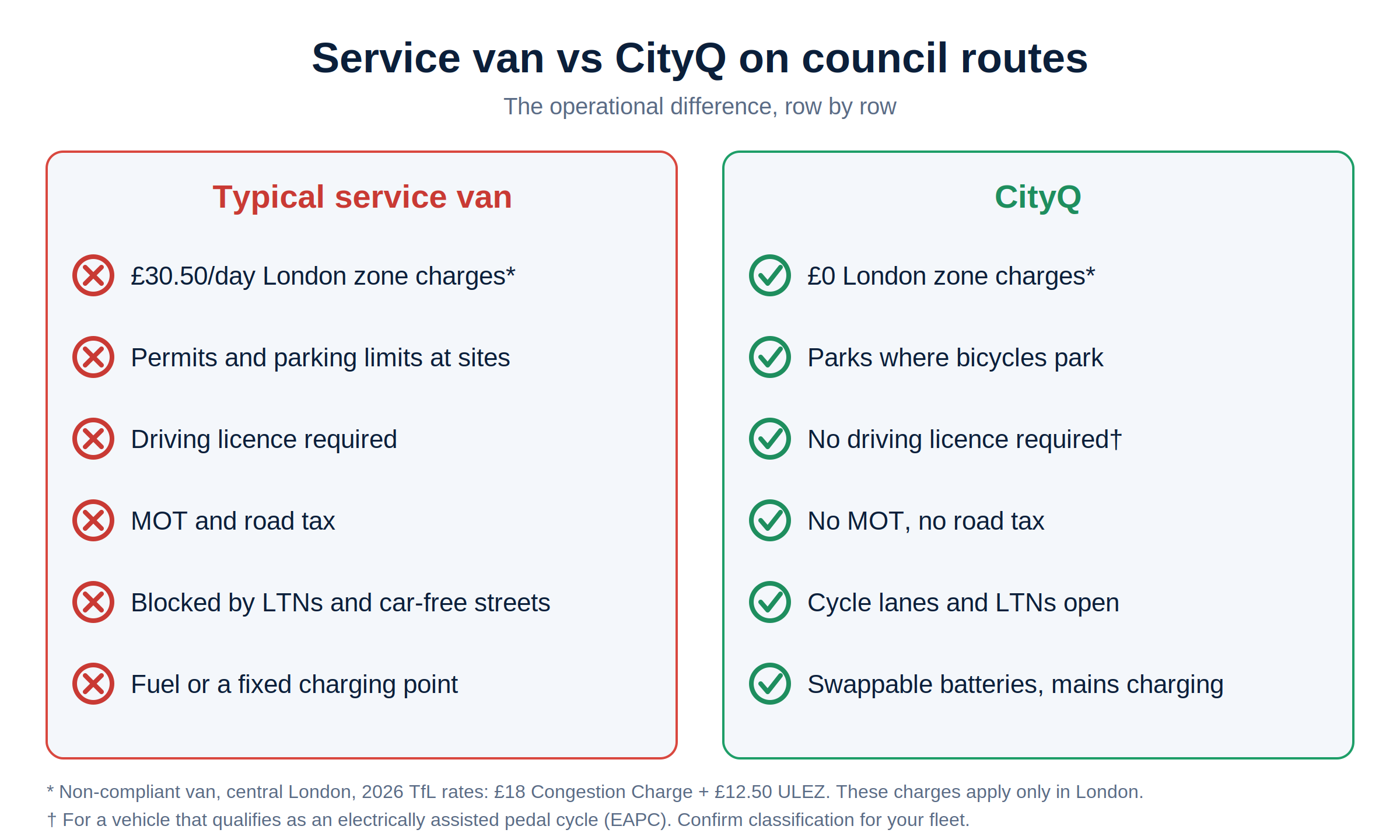
Quick answer: Yes. For dense, multi-stop urban rounds with loads under about 170kg, an electric cargo bike such as the CityQ 1200 can take the place of a service van for council and NHS teams. CityQ is built and certified as a pedal-assisted cycle (EN 15194 and EN 17860), so in CityQ’s position it needs no driving licence, pays no London Congestion Charge or ULEZ, and parks where bicycles park. It is not a full van replacement: long routes, heavy loads and out-of-town depots still need a van. As of September 2026, UK councils and NHS trusts are trialling e-cargo bikes on exactly these jobs.
Can a council use an electric cargo bike instead of a van?
For the right routes, yes. The Brighton & Hove demo day put a CityQ in front of two very different audiences. Council officers from street cleaning, postal delivery and health services tested it and commented on its stability and how easy it is to ride. Facilities managers from the University of Brighton described how hard it is to move larger vehicles around campus.
Councillor Muten’s interest was the battery. CityQ’s swappable LiFePO4 batteries swap out rather than needing a fixed charging point, which removes what is often the biggest obstacle to fleet electrification for councils running dispersed sites, and they are rated for 2,000 to 4,000 charge cycles, roughly 6 to 10 years of daily use.
The team also reported time savings on the round: about five minutes saved per bin stop and more than thirty minutes per outing. One participant summed up the licence point: “Anyone can use it — that’s a huge bonus. Some colleagues don’t drive.” A parking warden approached mid-round, found no number plate and walked away, and the council’s Head of Fleet is planning a trial for cleaning operatives.

For councils and public sector teams who want to see what a CityQ looks like on their own routes, book a free test ride and bring your site map.
Which council and NHS services suit an electric cargo bike?
The fit is strongest where a van spends more time looking for parking than driving. The table shows six service types with a real-world example for each. Only some of the examples used a CityQ, so the bike used is stated.
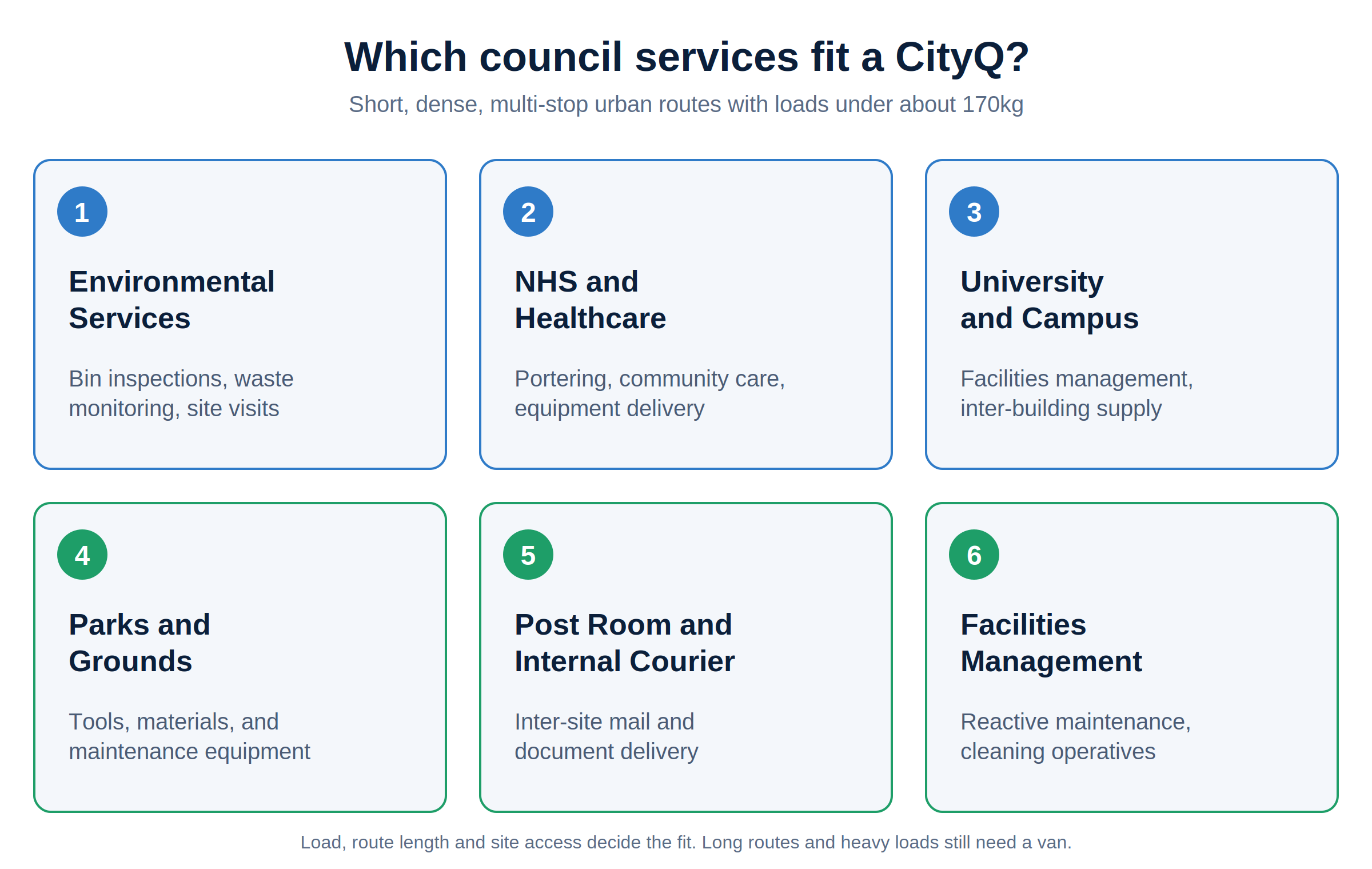
| Service | Typical jobs | Real-world example | Bike used |
|---|---|---|---|
| Environmental services | Bin inspections, street cleaning, site visits | Brighton & Hove street cleaning officers, May 2026 demo day | CityQ |
| NHS and healthcare | Portering, community care visits, equipment | Castle Hill Hospital porters; Guy’s and St Thomas’ @home team | Other e-cargo bikes |
| University and campus | Facilities management, inter-building supply | University of Brighton facilities managers, same demo day | CityQ |
| Parks and grounds | Tools, materials, maintenance equipment | The Dolmans, Benelux parks services | CityQ |
| Post room and internal courier | Inter-site mail, documents | Brighton & Hove City Council Post Room, about 30% of trips by e-cargo bike | Urban Arrow Cargo XL |
| Facilities management | Reactive maintenance, cleaning crews | JCDecaux, 16 bikes serving public infrastructure maintenance crews in Paris | CityQ |
The Paris example matters for procurement teams because it is a named, long-running public-space maintenance fleet. The London guide reports that JCDecaux tested a CityQ against 14 competitors before choosing it.
What have NHS trusts found with cargo bikes?
NHS trials so far use other suppliers’ bikes, but they show the use case clearly.
- Castle Hill Hospital (NHS Humber Health Partnership). In April 2025 the portering team began a 12-month trial of an electric quadracycle eCargo bike, carrying linen, gas cylinders and medical equipment around the 168-acre site. If it succeeds, the bike replaces a van. The project was funded by Active Travel England’s Capability Fund, and the trust has not named the model. [VERIFY: whether trial results have been published.]
- Guy’s and St Thomas’ NHS Foundation Trust. In 2024, nine members of the @home service in West Norwood used an e-cargo bike from supplier EAV instead of pool cars, public transport or personal bikes. The trust’s sustainable travel officer noted that “there are no parking restrictions or permits required”, and that the bike’s 150kg capacity was enough for @home equipment including commodes.
- Stratford-on-Avon District Council. Its free-trial scheme, funded with £60,000 of government money and matched by the council, bought ten e-cargo bikes and has loaned them to NHS physiotherapists. The scheme runs until at least 2027.
The policy pressure is real. The NHS has committed to net zero by 2040 for the emissions it controls directly, which includes its fleet, and its travel and transport strategy targets a fully decarbonised fleet by 2035, with ambulances following in 2040. Small urban service vans are among the easiest vehicles to replace.
Is a CityQ legally a bicycle, and do council riders need a licence?
CityQ’s position is that its four-wheel cargo e-bikes operate as electrically assisted pedal cycles (EAPCs). The CityQ 1200 has two 125W hub motors (250W in total), assistance that cuts off at 25 km/h (15.5 mph), and a drivetrain that requires pedalling to go beyond 6 km/h. It is certified to EN 15194 and, as the first four-wheel cargo bike certified to EN 17860, to the European safety standard written specifically for cargo bikes. For a fleet buyer, that turns “it feels stable” into a test report someone else has signed.
On that basis, there is no driving licence required to operate a CityQ, and no road tax, MOT or registration. Any capable adult can ride it from day one, which matters for teams where not every colleague drives.
One honest caveat: UK e-bike law was written around two- and three-wheeled cycles, and four wheels is the area where classification cannot be assumed. The specification and certification of the actual vehicle decide the answer. A council buying a fleet should get the classification confirmed in writing and check it with its insurer before committing.
How much does a CityQ cost to run compared with a service van?
CityQ’s own estimate for a single inner-London vehicle, over 240 working days, compares a non-compliant van with a CityQ:
| Annual cost item | Non-compliant van | CityQ |
|---|---|---|
| ULEZ (£12.50/day) | £3,000 | £0 |
| Congestion Charge (£18/day) | £4,320 | £0 |
| Parking (10 stops/day, £5 average) | £12,000 | £0 |
| Fuel | £7,000 to £9,000 | £0 |
| Charging | n/a | £300 to £500 |
| Insurance | £2,500 to £4,000 | £500 to £800 |
| Maintenance and MOT | £1,500 to £3,000 | £500 to £800 |
| Total | £30,320 to £35,320 | £1,300 to £2,100 |
That is a saving of roughly £28,000 to £33,000 a year per vehicle, using the conservative end of each range. Figures are CityQ’s own estimates, as of 2026.
Read that table as a worst case, not a universal one:
- ULEZ and Congestion Charge apply only in London, and ULEZ only to non-compliant vehicles. A compliant electric van avoids ULEZ, but since 2 January 2026 it no longer avoids the Congestion Charge: it pays £9 a day with Auto Pay.
- Council vehicles may not pay for parking in the way the table assumes, so the parking line may be lower for your fleet.
- Outside London, the case rests on parking time, fuel or charging, insurance, maintenance and staffing, so model your own routes.
Energy is a separate advantage: CityQ’s comparison puts an electric van at roughly 30 kWh per 100km and a CityQ at about 3 kWh, which is why a cargo bike uses 90% less energy per kilometre than an electric van.
Can councils get funding for electric cargo bikes?
Funding for cargo bikes has come in rounds rather than as a standing scheme, so check what is open now.
- DfT eCargo Bike Grant Fund. Launched in 2019 and administered by Energy Saving Trust, it offered up to 40% of cost in the 2021/22 round (capped at £2,500 for two-wheel and £4,500 for three-wheel models), and later rounds paid 20% to businesses and up to £200,000 per bid to local authorities. Those earlier rounds do not tell you what is available today. [VERIFY: confirm whether any DfT eCargo Bike Grant round is currently open.]
- Active Travel England Innovation Fund. It backed Brighton & Hove’s shared e-cargo bike pilot, delivered by OurBike with the council and the University of Brighton and launched in May 2026. It is a small pilot of five cycles, hosted at local venues.
- Local grants. Bristol City Council has offered grants of up to £20,000 covering 50% of costs for businesses, schools, charities and community organisations to replace vans with electric cargo bikes.
On the wider policy backdrop, the UK van market is being pushed toward zero emission: 24% of new vans sold in 2026 must be zero emission under the ZEV Mandate, although the government is consulting until 23 October 2026 on easing later-year targets.
When does a van still win for council services?
A CityQ does not replace every van, and being upfront about that helps you buy the right vehicle.
- Load. The CityQ 1200 carries 170kg in a 1.3m³ lockable box, the CityQ 850 carries 180kg in 1m³, and the Pickup & Customize reaches 200kg and 1.7m³. Bulky items, pallets and heavy plant need a van.
- Distance. Range is up to 100km per charge, with swappable batteries extending the working day. Long inter-town routes are a van job.
- Width. The bike is 89cm wide, which is wider than a two-wheel cargo bike. Check narrow cycle lanes, chicanes and bollards on your routes.
- Access rules. Cycle access to pedestrianised areas and parks is set locally, so confirm the rules for each site.
The way to find out is to test on real work. For fleet enquiries, procurement documentation and EN 17860 certification evidence, get in touch directly. You can also see the CityQ 1200 specification.
FAQ's
Q1: Can a council use a cargo eBike instead of a van for city services?
A1: Yes, for dense, multi-stop urban routes with loads under about 170kg. Brighton & Hove City Council officers tested a CityQ on a demo day in May 2026. Long routes and heavy loads still need a van.
Q2: Does a cargo eBike need a driving licence for council riders?
A2: Not if it qualifies as an electrically assisted pedal cycle. CityQ is built to EN 15194 and EN 17860 with a 250W motor rating and a 25 km/h assistance cut-off. Confirm the classification of your specific vehicle with the manufacturer and your insurer.
Q3: Is a cargo eBike exempt from ULEZ and the Congestion Charge for council fleets?
A3: In CityQ’s position, yes: as a pedal cycle it pays neither charge. A non-compliant van pays £12.50 ULEZ plus £18 Congestion Charge, £30.50 a day, in central London in 2026. These charges apply only in London.
Q4: Can a cargo eBike access pedestrian zones and restricted council sites?
A4: It can use cycle lanes and low traffic neighbourhoods that vans cannot. Guy’s and St Thomas’ noted that e-cargo bikes can travel through areas restricted to general motor traffic. Cycling in pedestrianised areas and parks is governed by local rules, so check each site.
Q5: What can a cargo eBike carry for council and NHS services?
A5: The CityQ 1200 carries 170kg in a 1.3m³ lockable box, and the CityQ 850 carries 180kg in 1m³. NHS trial bikes have carried linen, gas cylinders and community-care equipment including commodes.
Q6: Does a cargo eBike need charging infrastructure for council depot use?
A6: CityQ uses swappable LiFePO4 batteries with up to 100km of range, so no fixed charging point is needed. Batteries charge from a standard mains socket. [VERIFY: 3-pin socket claim against the battery post.]
Q7: How does a cargo eBike support council net zero fleet targets?
A7: It has zero tailpipe emissions and, on CityQ’s figures, uses about 3 kWh per 100km against roughly 30 kWh for an electric van. The NHS has committed to net zero by 2040 for the emissions it controls directly, including its fleet.
Q8: Can councils get funding to buy electric cargo bikes?
A8: Funding comes in rounds. The DfT eCargo Bike Grant Fund ran from 2019 with rates of 40% and later 20%, and Active Travel England funded Brighton’s 2026 shared-bike pilot. Check which schemes are open now.
Q9: What NHS trusts have trialled cargo bikes for hospital services?
A9: NHS Humber Health Partnership trialled a quadracycle eCargo bike at Castle Hill Hospital, and Guy’s and St Thomas’ piloted an e-cargo bike for its home team. Stratford-on-Avon District Council has loaned e-cargo bikes to NHS physiotherapists. The named trials used other suppliers’ bikes.
Q10: Is a four-wheel cargo eBike better than a two-wheel for council services?
A10: It offers full weather protection and stable handling at a stop, which suits riders who are not confident cyclists. The trade-off is width at 89cm, so check cycle lanes and bollards on your routes.


