


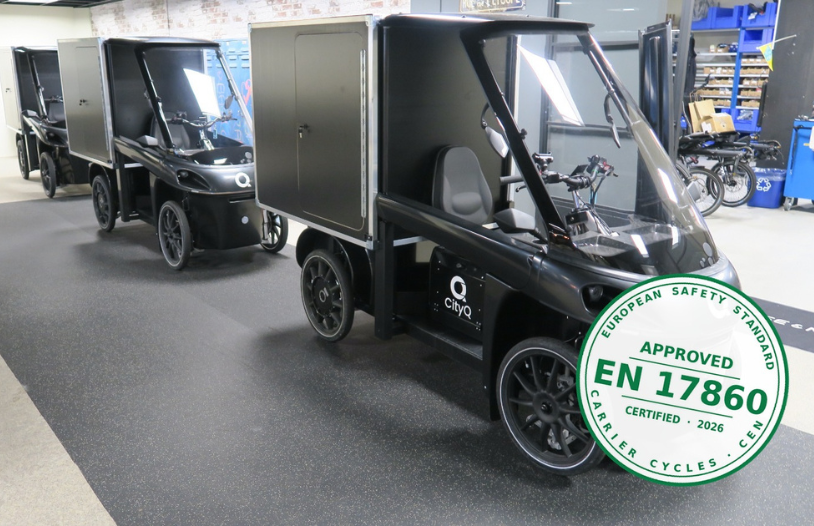
Europe now has a safety standard written specifically for cargo bikes. It includes safety for 3 and 4 wheel cargo bikes – the largest bikes with ability to replace a van.
CityQ is the first to be certified to this safety standard — EN 17860 — and is, to the best of their knowledge, the first four-wheel cargo bike in Europe to be approved. For fleet buyers, that turns “it feels stable” into a test report someone else signed.
In short: CityQ’s four-wheel cargo e-bike has been certified to EN 17860, the European safety standard for carrier cycles published by CEN in 2024–2025. It is the first four-wheel cargo bike in Europe known to hold this certification. EN 17860 is the first standard to test what actually matters on a loaded multi-track cargo bike — tipping stability, a double lane change, braking force uniformity and frame fatigue at full payload — rather than treating it as an oversized bicycle. CityQ remains legally a bicycle in the UK and EU, so no driving licence, road tax, ULEZ or Congestion Charge applies.
What exactly has been certified?
CityQ’s four-wheel cargo e-bike has been tested and certified against the EN 17860 series for carrier cycles. This sits alongside the certifications CityQ already holds: CE marking and EN 15194, the European standard for electrically power assisted cycles. The two are not alternatives. EN 15194 covers the drive system; EN 17860 covers the vehicle carrying the load.
Why being first on four wheels matters more than it sounds
Until EN 17860, cargo bikes were certified against EN 15194 — a standard written for city and trekking e-bikes, around a rider and a normal bicycle load. It says nothing about what happens when 200 kg of cargo sits above four wheels and the rider swerves to avoid a car door.
EN 17860 closes that gap, and several of its requirements exist only for multi-track vehicles. A three- or four-wheeler has to demonstrate tipping stability both statically and dynamically, stay controlled through a double lane change, prevent a wheel jamming against the steering, and brake with uniform force across the wheels. A two-wheel cargo bike is never asked these questions, because they do not arise.
That is why the four-wheel certification is the harder one to get, and why it is the one that matters to an operator putting riders into London, Paris or Oslo traffic every day.
What this changes for a fleet buyer
Very little about how a CityQ rides. Quite a lot about how it procures.
| Before EN 17860 | With EN 17860 certification | |
| Structural safety evidence | Manufacturer’s own claims, tested to an e-bike standard | Third-party test programme written for loaded carrier cycles |
| Tender and subsidy paperwork | Compliance hard to evidence consistently | Certification documentation available for procurement files |
| Insurance and duty-of-care questions | Answered case by case | Answered with a recognised European standard |
| Legal status | Bicycle (EAPC), if 250 W and 25 km/h cut-off | Unchanged — still a bicycle, not a moped |
That last row is the one people get wrong. EN 17860 is a safety standard, not a reclassification. A pedal-assist cargo bike that meets it is still a cycle under EU Regulation 168/2013 — no type-approval, no driving licence, no road tax. If you want the details on that, we covered it in do you need a driving licence for a 4-wheel e-bike in the UK. For anyone writing a cargo bike spec this year, the practical move is simple: ask every supplier for the EN 17860 certificate and the test report behind it, and check that it covers the exact configuration you are ordering.
Where this fits in CityQ's track record
CityQ was among the first to bring a chainless e-drivetrain, reverse gear, car-like seating and full weather protection — front window with wiper, roof and doors — to the cargo bike category. The certification follows the same logic: build the vehicle a van driver would actually swap into, then prove it.
“Comfort and safety of the riders is key for our customers. For riders to switch from a comfortable van to a bike it needs to feel more like a car than traditional bikes. The new safety standard is part of this, and CityQ is proud to be the first to implement this standard in Europe,” says CityQ founder Morten Rynning.
The fleet evidence is already there. DHL has run CityQ on London routes for more than two years, JCDecaux operates 16 vehicles across Paris, and Wolt uses them for quick-commerce in Oslo. Our longer account of that history is in the pioneer 4-wheel cargo eBike, and the stability argument itself in why four wheels feel safer in cities.
What certification does not do
Honesty is worth more than a stronger headline here. A certificate is not a substitute for rider training, sensible loading or maintenance, and it does not make a cargo bike the right tool for every route. Long motorway trunking, bulky pallet loads and rural multi-drop still belong to a van. EN 17860 tells you the vehicle has been engineered and tested for professional duty. It does not tell you your routes suit one — that is what a test drive is for.
FAQ
What is EN 17860?
EN 17860 is the European standard series for carrier cycles — cargo bikes — developed by CEN/TC 333/WG 9 and published between 2024 and 2025. It covers terms and definitions, lightweight single-track and multi-track cargo bikes, heavyweight multi-track cargo bikes, electrical aspects, passenger transport and trailers.
Is EN 17860 mandatory for cargo bikes in Europe?
EN 17860 is a harmonised European standard rather than a law in itself, but from 2025 onward it is increasingly treated as the operative standard for cargo bike CE conformity, and national standards that conflict with it are being withdrawn. In practice, a commercial cargo bike sold in the EU in 2026 should be able to show EN 17860 evidence alongside EN 15194.
Which cargo bike is the first four-wheeler certified to EN 17860?
CityQ is, to the best of our knowledge, the first four-wheel cargo bike in Europe certified to EN 17860.
Does EN 17860 certification mean I need a driving licence?
No. EN 17860 is a safety and structural standard. A pedal-assisted cargo bike with a 250 W motor and assistance cutting off at 25 km/h (15.5 mph) remains legally a cycle in the UK and EU, so no driving licence, road tax, MOT, ULEZ or Congestion Charge applies.
What is the difference between EN 15194 and EN 17860?
EN 15194 certifies the electric drive system of a pedal-assisted bicycle — motor rating, speed cut-off, electromagnetic compatibility and battery safety. EN 17860 certifies the cargo vehicle itself — stability, braking, steering and structural fatigue at its rated payload. A commercial electric cargo bike needs both.
How do I check a supplier’s EN 17860 certification?
Ask for the certificate, the underlying third-party test report, and confirmation of which part of the series and which vehicle configuration it covers. Payload rating, battery capacity and motor rating all affect what the certificate applies to.
See a certified four-wheeler for yourself
If EN 17860 is going into your next tender or fleet spec, the fastest way to test whether a four-wheel cargo bike fits your routes is to ride one. Book a test drive at our Oslo or Stuttgart demo centres, or at a UK demo day — and ask us for the certification documentation while you are there.