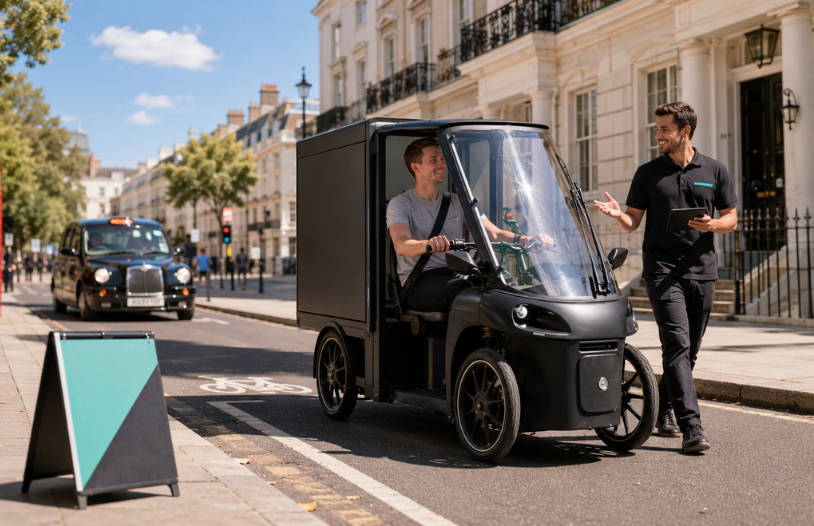
How the Bike Works When the Road Tilts Up?
Wondering how a four-wheel electric cargo bike actually behaves on real streets—especially on hills, with weight, and in all weather? Think of it as a very steady e-bike that’s been made more car-like for balance and comfort. Riders pedal normally; the system adds smooth electric assist so set-offs feel calm and cornering stays planted. If you want to skim options while you read, the full range of configurations lives in the CityQ models area where cargo, pickup and passenger set-ups sit side-by-side.

Hills without stress (what the motors and “gearing” actually do)
At low speeds the bike feels composed because the four-wheel layout resists wobble and spreads weight evenly. Electric assist is delivered by hub motors that keep your cadence steady up inclines, so you don’t hunt for gears or grind your knees think of it as “automatic help” that tops up your pedalling. When you roll down a gentle descent, regenerative braking feeds some energy back into the system and gives a predictable slowdown. Weather features doors, side protection and a wiper keep visibility and comfort when it’s wet. These are baked into the platform and visible across the models pages.
Small technical note : CityQ uses a low-maintenance drive with electronic gearing and no traditional bicycle chain or belt to oil, which means fewer mucky parts for fleets and a more “hop-in and ride” feel for new riders.
How much it carries
Payload = rider + box + cargo. If the stated payload is 180 kg and your rider is ~80 kg, you have about 100 kg for goods. Choose the model to match the volume you actually move:
- Compact cargo (CityQ 850): about 1.0 m³ in a lockable, detachable box—handy on tight streets with many stops.
- High-volume cargo (CityQ 1200): roughly 1.3 m³ plus a lower compartment; options like shelves and side doors help speed loading.
- Pickup/flatbed (CityQ Pickup & Customise): up to 1.7 m³ with modular racks/boxes and around 200 kg payload for tools, coolers or awkward items.
- Passenger: seat for 1–2 people with a small lockable compartment—useful on campuses and council loops.
Why this matters: on dense rounds the box volume is often the limiter before weight is; on service rounds the payload and open flatbed become more important.

Pick the right box (parcel, food, tools)
- Parcels & grocery: a closed cargo box keeps goods tidy and weather-safe; shelves and side doors minimise faff at each stop—ideal for 2–6 km radii and frequent door-to-door handovers.
- Food & temperature-care: add insulated inserts or a cooling box on the pickup platform so hot and cold items arrive exactly as intended. (The open flatbed makes swapping modules simple.)
- Service & repair: a pickup/flatbed with a toolbox or rack means the right kit is always within reach, and you can park at the curb right by the job—especially useful in car-free or zero-emission zones.
Real World Examples :
Street-furniture teams—such as JCDecaux in Paris—have moved maintenance from vans to cargo e-bikes so crews can park kerbside, avoid fines and keep rounds flowing; after piloting 15 different bikes, JCDecaux selected CityQ for agility, comfort and reliability across dense city streets.

And for venues, Lehrieder Catering shows how a single bike can replace long on-foot transfers across a huge tradeshow campus—saving around 11 hours per day by riding equipment directly to kitchens and outlets inside the halls.

What to try on your demo ride (a quick checklist)
- Hill start + steady climb: feel the calm set-off and how the assist holds a natural pedalling rhythm.
- Stop–start kerbside routine: park, load a crate, roll two doors down, repeat—this simulates real drops.
- Brake–roll on a mild descent: note how regen smooths speed and recovers a little energy.
- Box fit check: bring your own totes; check shelf heights and any side-door option.
- Battery swap drill: practise a quick swap and off-bike charging to see how close to all-day you can run.
If you want to compare while you plan the route, keep the models overview
If you like to keep details on file, the spec sheets live within the individual models on models, and if you’d prefer a walk-through of hills, loads and box options with your own crates or just book a test drive
FAQ’s
1) How does a four-wheel cargo bike manage hill starts and climbs?
A four-wheel cargo bike uses electric hub motors to add smooth assist at low speeds, so set-offs and climbs feel controlled rather than jerky. The four-wheel layout keeps balance on ramps, and regenerative braking helps manage speed on gentle descents.
2) What’s the difference between payload and box volume on a four-wheel cargo bike?
Payload is the total weight the bike can carry (rider + box + goods). Box volume is the space inside the cargo box (e.g., ~1.0 m³ vs ~1.3 m³). Parcel rounds often hit volume first; service jobs care more about payload and flatbed access.
3) Can a four-wheel cargo bike run all day without long charging stops?
Yes. Batteries are swappable and can be charged off the bike. With a simple swap routine aligned to shifts, most fleets keep bikes rolling across the day with minimal downtime.
4) Is a four-wheel cargo bike practical in bad weather?
Yes. Weather-ready features—doors, side protection and a front wiper—help riders stay dry and visible, which is why fleets run year-round in UK conditions.
5) Which configuration of a four-wheel cargo bike should we try first?
For dense parcels, start with compact cargo; for bigger drops, try high-volume cargo; for tools or coolers, pick pickup/flatbed; for people movement with small cargo, choose passenger. You can compare these side-by-side in the CityQ models area as you book a demo.