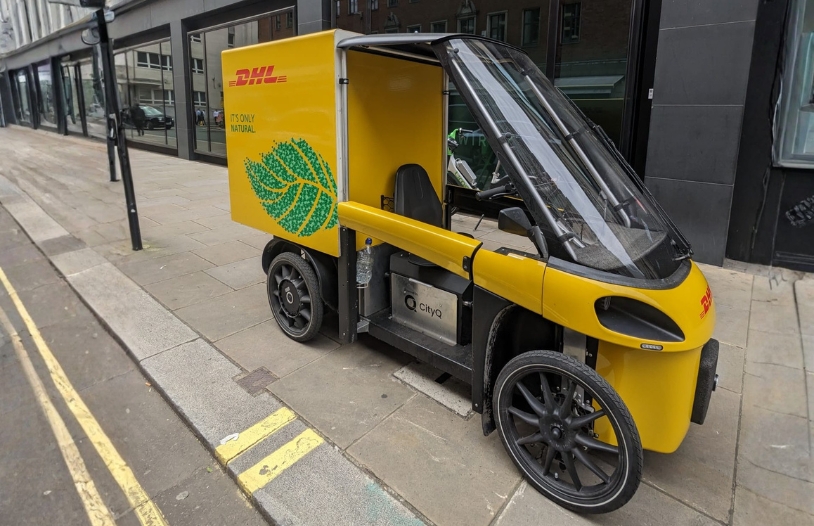
London’s last-mile delivery problem is not a new headline, but in 2026, it has reached a breaking point. The traditional solution—the diesel or petrol van—is being squeezed out by a “perfect storm” of regulation and rising costs. As the Congestion Charge hit £18 per day in January 2026 and ULEZ expanded to all 33 boroughs, smart operators shifted focus. Leading fleets are already seeing the impact of a cargo ebike for business London, moving beyond mere pilots into full-scale commercial adoption. The most significant proof point in the capital is not a press release; it is DHL, which has now completed over two years of continuous cargo bike last mile delivery London operations in real-world conditions.
Why the Van-Based Model is Collapsing in London
London is the densest major city in the UK, averaging 9,648 people per km². According to Mordor Intelligence, this density makes van-based logistics increasingly incoherent. The financial pressure is no longer a marginal concern—it is a structural threat.
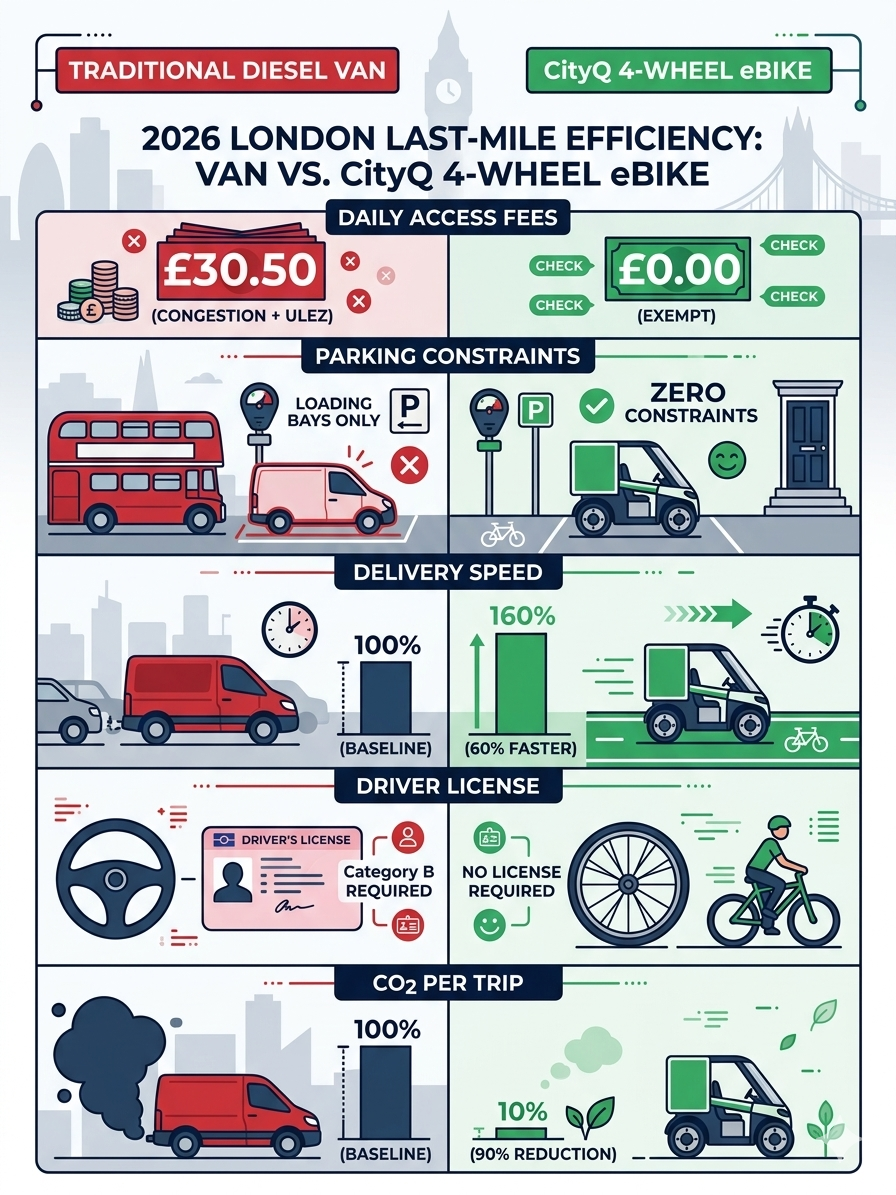
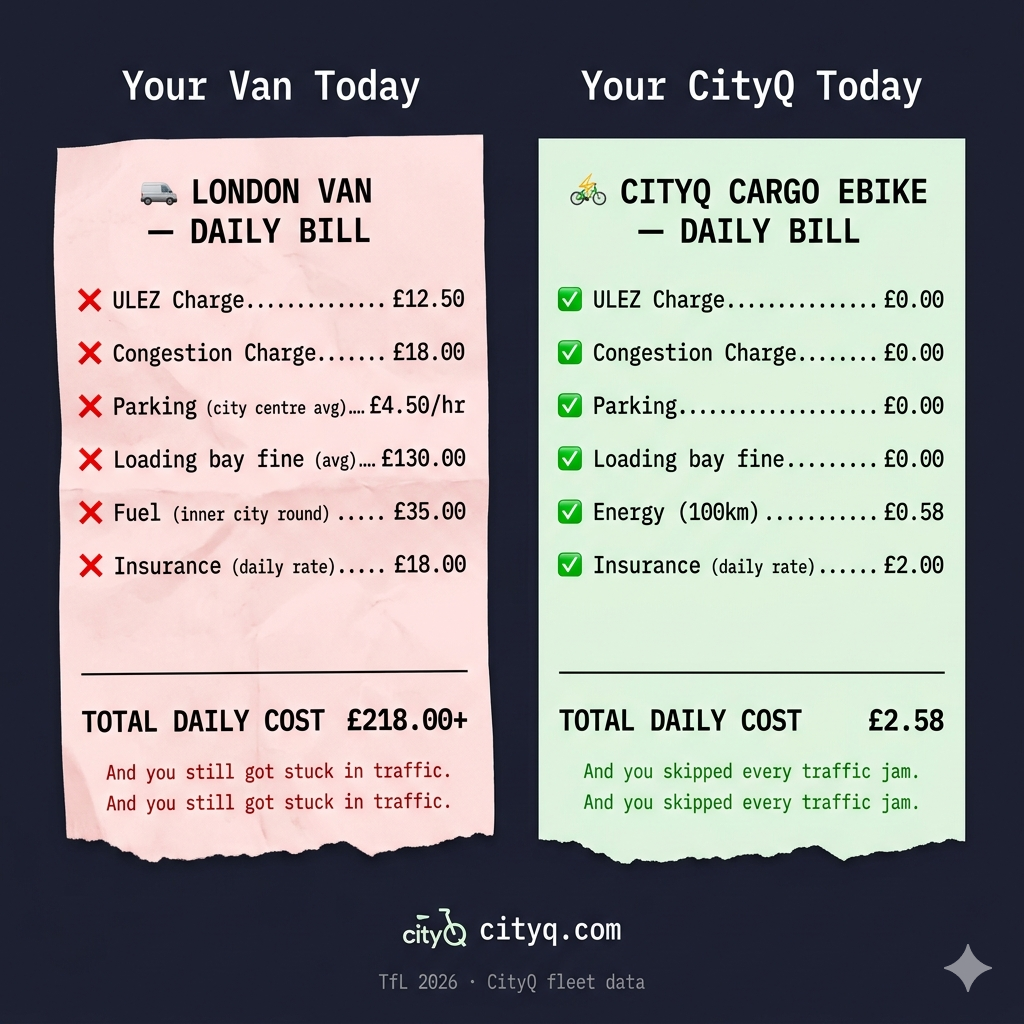
A non-ULEZ-compliant van now faces a £12.50 daily charge, while the central zone adds an £18 Congestion Charge. When you factor in parking fines, the “search time” for loading bays, and rising fuel costs, the economics of a single van route simply do not scale. According to TfL data, replacing just 15% of London delivery vans with cargo bikes would remove 28,750 van journeys daily.
The 2026 Efficiency Matrix: Van vs. CityQ
To understand the shift, we have to look at the hard numbers. Below is how the “van logic” compares to the “4-wheel e-bike logic” in 2026 London.
What DHL’s London Operation Actually Demonstrates
DHL began operating CityQ cargo bikes in London as part of a long-term commercial integration. This was not a trial; it was the start of an operational shift. Because the CityQ 1200 is classified as an EPAC (Electrically Power Assisted Cycle) under EN15194, it is legally treated as a bicycle.
What DHL’s sustained operation proves is that this model is commercially repeatable. The bikes carry a 165 kg net payload across 1.3 m³ of cargo volume with a 100 km range. For high-density London postcodes, this combination of volume and cycle-lane access means a cargo e-bike route is structurally faster than a van route on the same stops.
The Speed Advantage: Backed by London Data
The performance advantage of cargo bikes in congested environments is documented. Research from the University of Westminster found that cargo e-bikes complete deliveries 1.6 times faster than vans in London. The reason is structural: vans spend a massive portion of their day “unproductive”—circling for parking or idling in traffic.

By using cycle lanes and parking directly at the delivery point, a CityQ rider eliminates the “walking time” and “parking search” that kills van productivity. This is why CityQ’s data shows over one million operational kilometres logged with zero reported rider injuries; it is about smarter movement, not just faster pedaling.
Why Four Wheels Change the Logic for London Delivery
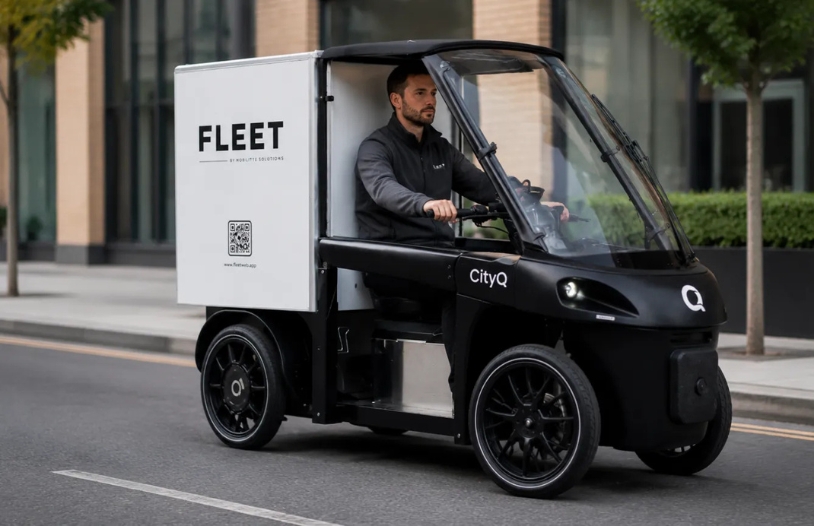
While two-wheel cargo bikes are common, London’s operating environment—wet cobblestones, tramlines, and speed bumps—presents stability challenges. CityQ is the only CE-certified four-wheel, fully enclosed cargo e-bike in its class.
-
Stability: Four contact patches mean the vehicle does not lean or wobble under heavy loads, even on slick London surfaces.
-
Weather Protection: The enclosed cabin ensures 365-day uptime. DHL riders have reported that they can maintain efficiency in winter conditions that would typically sideline two-wheelers.
-
Maintenance: The chainless drivetrain removes the single most common failure point in urban cycling, while regenerative braking recovers energy on stop-start London routes.
The 2026 Inflection Point
For fleet operators, 2026 is the year the “wait and see” approach became too expensive. The cargo e-bike fleet market is projected to reach $15.4 billion by 2036 (15.7% CAGR), and London is at the forefront of this curve. With TfL’s 2023 Cargo Bike Action Plan now fully influencing planning and micro-hub logistics, the infrastructure is built for bikes, not vans.
Understanding how London businesses are switching from vans to cargo eBikes is no longer optional. The van cost structure for inner-city routes is effectively unrecoverable through optimisation — the only solution is a change in vehicle platform.
What Fleet Managers Are Learning
The DHL London model has provided three key takeaways for the wider industry:
-
Onboarding is Fast: Riders reach full confidence in hours, not days.
-
Parking is Fixed: It is no longer a variable. It is always free and always available.
-
Rider Retention: Drivers prefer the comfort of the CityQ cabin and the lack of parking-related stress, which reduces staff turnover in a high-churn industry.
FAQs
How much faster is a cargo bike than a van in London?
University of Westminster research shows cargo bikes are 1.6 times faster (60% increase in efficiency) in congested London areas due to cycle lane access and kerbside parking.
Do I need a license for a CityQ?
No. It is classified as an EPAC, meaning any adult can ride it without a driving license, registration, or MOT. This drastically simplifies hiring.
What is the payload capacity?
The CityQ 1200 carries up to 165 kg of net payload and 1.3 m³ of volume, making it the ideal “sweet spot” for parcel delivery.
Is it really ULEZ exempt?
Yes. As a bicycle, it is 100% exempt from ULEZ and the £18/day Congestion Charge.
Two Years Proves the Case
The results from DHL’s two-year operation are in: the model works. It isn’t just about reducing emissions; it is about reclaiming the time and money previously lost to London’s gridlock. For any operator still running vans in inner London, the window to transition is now.
Explore the latest 2026 updates on cargo 4-wheel eBikes in the UK or contact the team at CityQ to book a London fleet assessment.