Which should your business actually buy?
In the 4 wheel cargo ebike vs 2 wheel comparison, a four-wheel cargo ebike, like the CityQ 1200, is self-stable, fully weatherproof and carries more — a two-wheel cargo bike is narrower, lighter and cheaper. Much of that stability advantage comes down to four-wheel cargo e-bike safety, which holds up even in the wet, low-speed stop-start conditions most last-mile routes involve. Central London’s cargo bike counts nearly doubled in a single year, from 4,915 to 6,998 recorded daily, and almost every one of those bikes falls into one of these two formats. They are not interchangeable tools, and picking the wrong one means either giving up capacity and weatherproofing, or occasionally finding a delivery point your bike physically can’t reach.
Quick answer: A 4-wheel cargo ebike wins on stability, weather protection and rider accessibility — it needs no balance skill, stands unaided at a stop, and keeps riders dry and warm year-round, which matters most for high-frequency, all-weather delivery and trade work. A 2-wheel cargo bike wins on access — it’s no wider than a standard bicycle, so it clears narrow cycle lanes, bollards and pinch points a 4-wheeler may not fit through. The right choice depends on your routes, not on which format is generically “better.”
Why the Decision Matters More Than It Used To
Cargo bike use has grown sharply as UK businesses shift last-mile and trade work off vans, but “cargo bike” isn’t one category — the two dominant formats solve different problems. Picking the wrong one for your routes means either giving up capacity and weatherproofing, or occasionally finding a delivery point your bike physically can’t reach.
Stability: which format is easier — and safer — to ride loaded?
This is where the two formats diverge most. A four-wheel cargo ebike distributes weight across four contact points, which is what makes it far harder to tip than a two-wheeler, especially at low speed and when stationary. In practice, that means:
- No balance skill required. A loaded two-wheel cargo bike still requires the rider to balance the bike and its cargo, especially at junctions and when starting from a stop. A four-wheeler doesn’t.
- Stands unaided. A four-wheeler needs no kickstand and won’t tip while parked mid-round — useful for frequent stop-start delivery work.
- Wider hiring pool. Because riding a four-wheeler doesn’t depend on cycling confidence, businesses can recruit and train riders faster, including people who wouldn’t consider themselves confident cyclists.
CityQ has written previously about why four wheels feel safer in hectic cities — full suspension, planted handling at junctions, and predictable control in wet or icy conditions are the same stability case made there, applied here specifically against a two-wheel alternative.
A two-wheel cargo bike isn’t unstable in the way a bicycle in general isn’t unstable — an experienced rider handles one confidently. The difference is the skill floor: a four-wheeler removes it.
Weather Protection and Year-Round Reliability
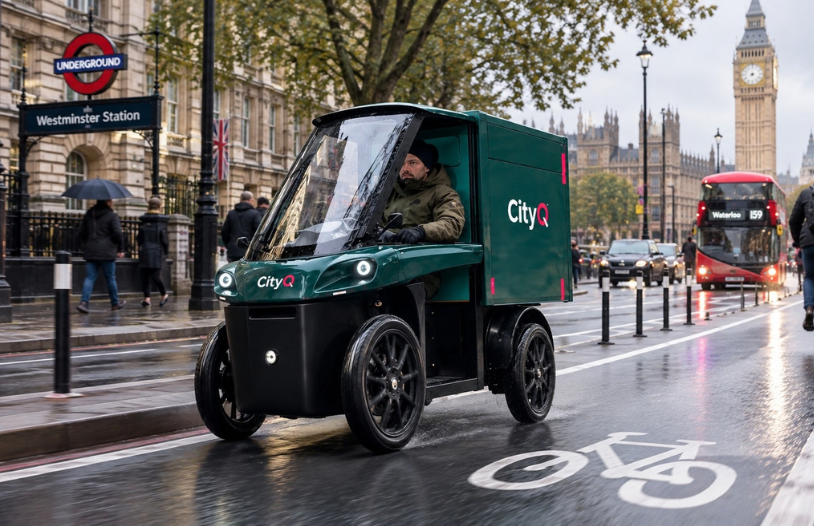
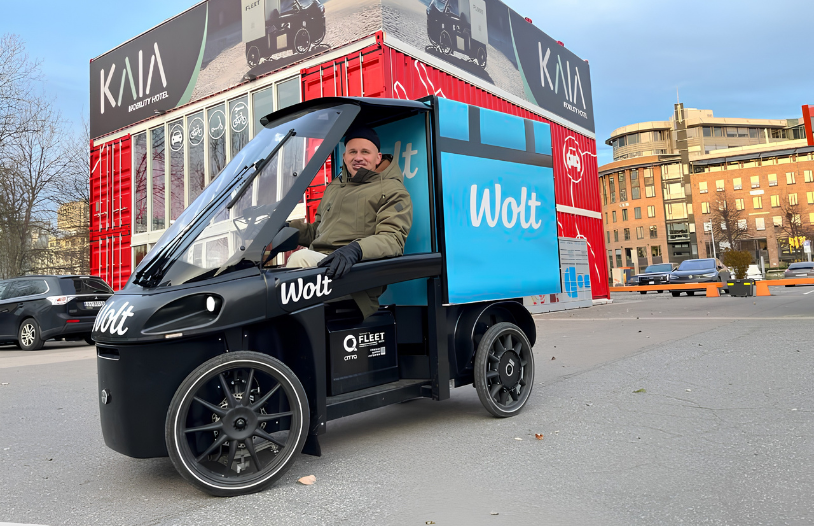
A two-wheel cargo bike leaves the rider exposed to rain, wind and cold, the same as any bicycle. A four-wheel cargo ebike with an enclosed cabin — roof, front body and a wiper-equipped windscreen — keeps the rider dry and the cargo protected in the same conditions. For businesses running routes every working day regardless of weather, this isn’t a comfort detail; it’s an operational reliability factor, since exposed riders are more likely to slow down, skip rounds, or need cold-weather kit and breaks that eat into route time.
Payload and Cargo Volume — and the Trap in How It's Measured
Payload comparisons between formats are only useful if you’re comparing the same kind of number, and manufacturers don’t always publish the same kind. Some cargo bike listings quote gross weight capacity (bike + rider + load combined) rather than cargo-only payload — a distinction worth checking carefully before comparing two spec sheets side by side.
| Format | Cargo payload | Cargo volume | Width | Notes |
|---|---|---|---|---|
| CityQ 1200 (4-wheel) | 170kg | 1.3m³ | 89cm | Lockable, weatherproof box |
| CityQ 850 (4-wheel) | 180kg | 1m³ | 89cm | Compact 4-wheel entry model |
| Typical 2-wheel cargo bike | 80–100kg | 0.2–0.5m³ | ~65cm (bike-width) | Open or soft-pannier storage on most models |
CityQ figures are drawn from published CityQ product specifications. The 2-wheel row reflects the typical published range across the mainstream 2-wheel cargo bike market, since capacity varies by individual model.
Four-wheelers consistently carry more, in a fully enclosed, lockable box — but a two-wheeler’s lower payload is rarely the limiting factor for parcel or food delivery rounds, where box volume and stop frequency matter more than raw kilograms.
The Trade-Off Most Cargo Bike Guides Don't Mention: Cycle-Lane and Bollard Access
This is the genuinely under-discussed point. Transport for London’s own Cycle Freight Study states plainly that cargo cycles “can be wider than a typical cycle” and that “narrow access points, such as closely-spaced bollards, should be avoided” when planning for them — an explicit, official acknowledgement that width, not payload, is the real constraint on some routes. The same guidance notes that London aims for 1.5m-wide cycle lanes wherever possible, with a 1.2m minimum accepted in constrained locations. (Full source linked at the bottom of this article.)
- A two-wheel cargo bike, at roughly the width of its handlebars, clears almost any standard cycle infrastructure without a second thought.
- A four-wheel cargo ebike, at around 89cm–1.1m depending on the model, comfortably clears the preferred 1.5m lane width and the 1.2m minimum — but can be blocked by older, closely-spaced bollards that predate current design guidance.
The honest takeaway: this is a genuinely improving situation, not a fixed limitation, as UK cities actively revise junction and cycle lane design to accommodate larger cycles as adoption grows. For now, it’s worth checking your specific delivery routes for older pinch points before committing a four-wheel fleet to them — most modern cycle infrastructure poses no problem at all.
Which Format Fits Which Business?
| Best fit | 4-wheel cargo ebike | 2-wheel cargo bike |
|---|---|---|
| High-frequency, all-weather delivery rounds | ✅ | |
| Tool/trade work needing secure, weatherproof storage | ✅ | |
| Narrow historic streets with older bollards/pinch points | ✅ | |
| Recruiting riders without strong cycling confidence | ✅ | |
| Tight budget / lower upfront cost | ✅ | |
| Maximum manoeuvrability in dense pedestrian areas | ✅ |
FAQ's
Q1. 4-wheel or 2-wheel cargo ebike — which is more stable?
A1. A 4-wheel cargo ebike is more stable than a 2-wheel one. Its four contact points distribute weight more evenly, making a loaded four-wheeler significantly harder to tip than a two-wheel cargo bike, particularly at low speed and when stationary.
Q2. Can a 4-wheel cargo bike fit through standard UK cycle lanes?
A2. Yes, in most cases. Transport for London’s preferred cycle lane width is 1.5m and its accepted minimum is 1.2m — both wider than a typical 4-wheel cargo ebike. The exception is older, closely-spaced bollards, which TfL’s own guidance flags as a route-specific constraint worth checking before you commit a fleet.
Q3. Do 4-wheel cargo ebikes need a driving licence in the UK?
A3. No. A 4-wheel cargo ebike certified as an Electrically Assisted Pedal Cycle (motor 250W or less, assistance cutting off at 15.5mph, working pedals) is legally a bicycle in the UK — no driving licence, road tax or MOT is required.
Q4. Which carries more, a 4-wheel or 2-wheel cargo ebike?
A4. A 4-wheel cargo ebike carries more, both by weight and by enclosed cargo volume. The CityQ 1200 carries 170kg in a 1.3m³ lockable box, and the CityQ 850 carries 180kg in a 1m³ box — both well above a typical 2-wheel cargo bike’s 80–100kg capacity.
Q5. Is a 4-wheel cargo ebike more weatherproof than a 2-wheel one?
A5. Yes. 4-wheel models like the CityQ 1200 have a fully enclosed cabin with a roof and windscreen wiper. 2-wheel cargo bikes leave the rider exposed to the weather, the same as a standard bicycle.
Q6. Is a quadricycle the same thing as a 4-wheel cargo bike?
A6. Yes. “Quadricycle” is the technical term for a four-wheeled pedal cycle, and it’s the classification CityQ’s own bikes fall under.
Q7. Which is cheaper, a 4-wheel or 2-wheel cargo ebike?
A7. A 2-wheel cargo bike is cheaper to buy upfront than a 4-wheel model. The trade-off is capacity and weatherproofing — a 4-wheeler costs more but carries more and works reliably in all weather, which can offset the higher purchase price through fewer missed or delayed rounds.
Q8. How wide is a 4-wheel cargo ebike compared to a 2-wheel one?
A8. A 4-wheel cargo ebike like the CityQ 850 or CityQ 1200 is 89cm wide. A 2-wheel cargo bike is roughly the width of its handlebars, typically around 65cm — narrow enough to clear almost any standard cycle lane or pinch point.
Q9. Can a 4-wheel cargo ebike handle hills and inclines?
A9. Yes. CityQ’s four-wheel cargo ebike models are rated for an 18% gradeability, meaning they’re built to climb typical UK urban gradients under pedal assist, with the four-wheel platform keeping the load stable on the way up.
Q10. Do I need insurance for a 4-wheel or 2-wheel cargo ebike in the UK?
A10. No — neither format legally requires insurance in the UK when it’s classified as an Electrically Assisted Pedal Cycle (EAPC), the same rule that removes the driving licence requirement. Many businesses still choose commercial cargo/goods-in-transit cover voluntarily to protect the vehicle and its load.
The Bottom Line
Neither format is universally better — they’re built for different routes. If your business runs high-frequency, all-weather rounds and wants to widen its hiring pool beyond confident cyclists, a four-wheel cargo ebike like the CityQ 1200 is the stronger fit. If your routes run through tight, historic streets with older cycle infrastructure, a two-wheeler’s narrower footprint may get you there faster. Most fleets end up choosing based on their actual delivery patterns rather than the format alone — which is exactly why it’s worth booking a CityQ test drive against your real routes before deciding.
For the wider economics behind why major operators are moving from vans to cargo eBikes at all, see CityQ’s related piece, CityQ vs Electric Van: Which One Actually Makes More Sense, on LinkedIn.