


A diesel van working inside London’s charging zones pays £30.50 every day before it has delivered a single parcel: £12.50 for the ULEZ plus £18 for the Congestion Charge. A CityQ pays £0 on both, and the cargo ebike ULEZ exempt London question comes down to one legal definition rather than a discount, a permit or an application. Most of what a fleet manager needs to know about running an electric cargo bike in London for business comes down to the charges first, so here is how they work: what the ULEZ and Congestion Charge are, why an EAPC sits outside them, and what that is worth per vehicle every year.
What is the ULEZ and why doesn't it apply to cargo eBikes?
The ULEZ is a charge of £12.50 per day on motor vehicles driven within the zone. Since August 2023 it has covered all of Greater London inside the M25, 24 hours a day, seven days a week.

The important word is “motor”. The scheme applies to motor vehicles and nothing else. Under UK law, an EAPC (Electrically Assisted Pedal Cycle) is a bicycle, not a motor vehicle. A qualifying cargo eBike is therefore not “exempt” in the sense of being granted a reduced rate or a special status. It is simply outside the scope of the scheme, so the ULEZ charge is zero, not discounted.
What is the Congestion Charge in 2026, and do cargo eBikes pay it?
The Congestion Charge rose from £15 to £18 per day on 2 January 2026. At the same time, the electric vehicle exemption came to an end on 25 December 2025. Electric cars now pay £13.50 per day in the zone and electric vans pay £9 per day.
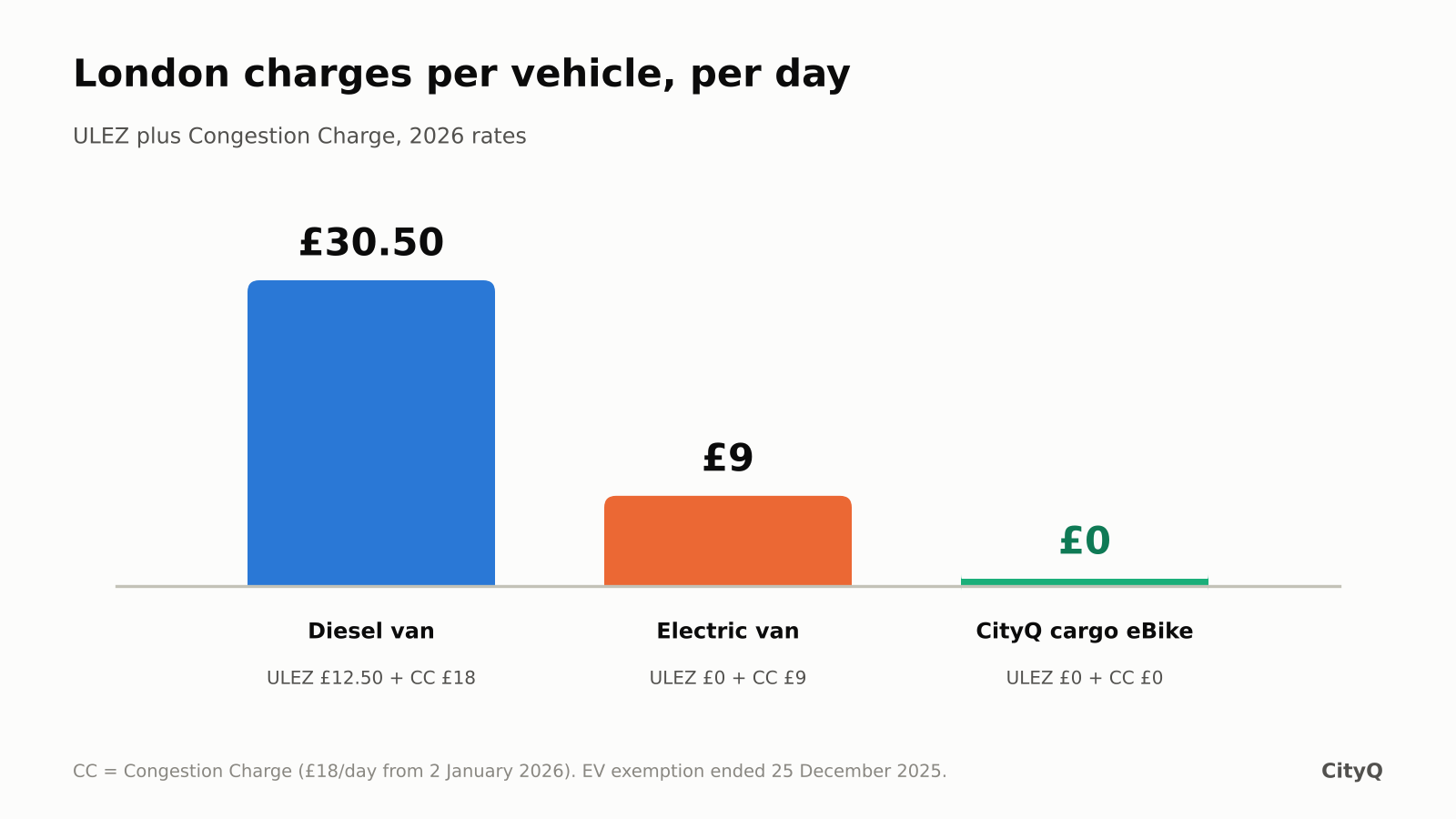
An EAPC pays £0. It is not a motor vehicle, so the Congestion Charge scheme does not apply to it at any time or on any day. Here is how the three options compare per day:
| Vehicle | ULEZ per day | Congestion Charge per day | Combined per day |
|---|---|---|---|
| Diesel van | £12.50 | £18 | £30.50 |
| Electric van | £0 | £9 | £9 |
| CityQ cargo eBike (EAPC) | £0 | £0 | £0 |
Zero charges are only half the cost story, because a cargo eBike tax deductible in the UK purchase also changes the payback sums for your business.
What EAPC classification means in practice
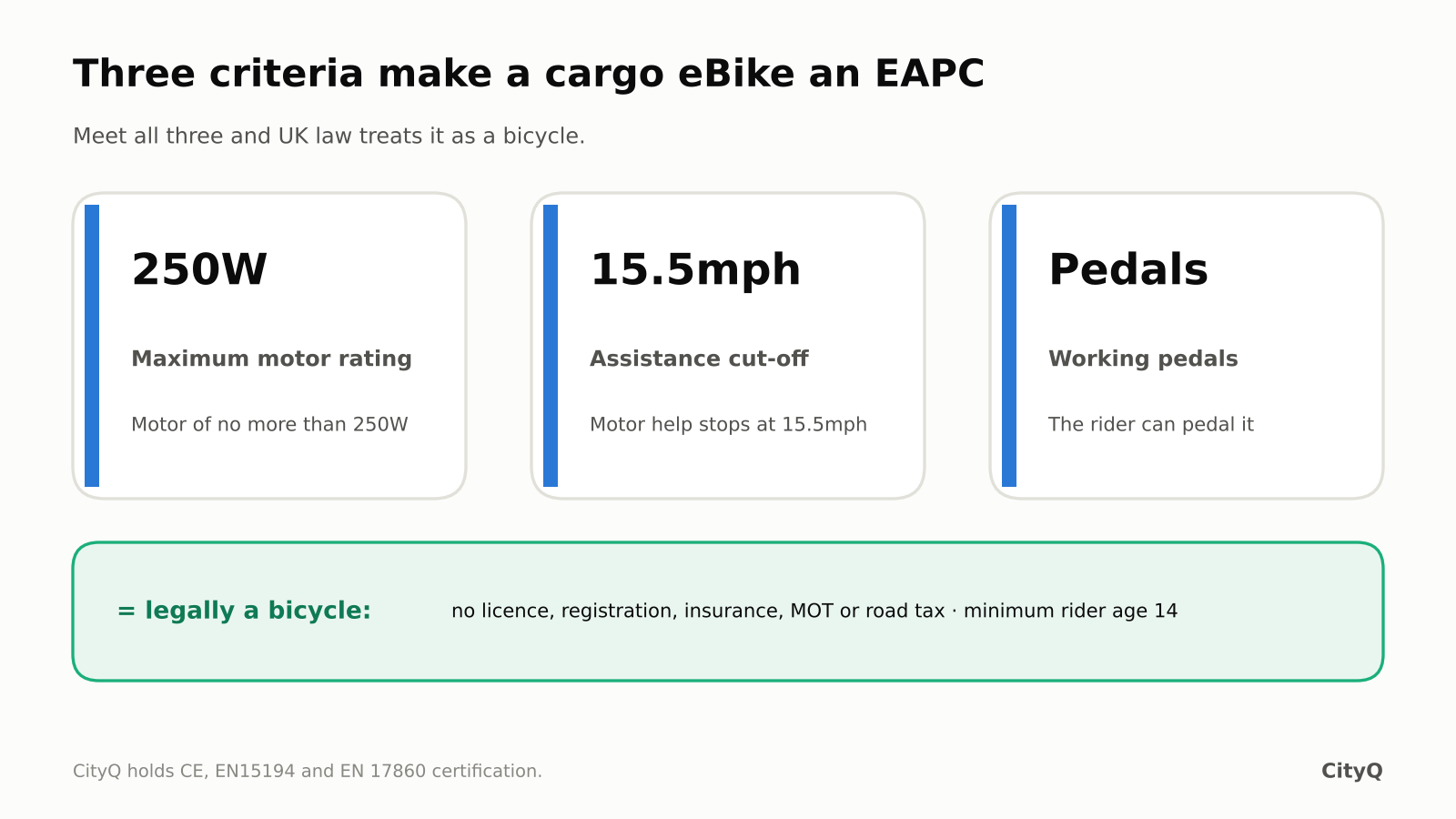
Three criteria decide whether a cargo eBike is legally a bicycle:
- Motor of no more than 250W. The motor’s rated output cannot exceed 250 watts.
- Assistance that cuts off at 15.5mph. The motor stops helping once the vehicle reaches 15.5mph.
- Working pedals. The rider must be able to pedal the vehicle.
A vehicle that meets all three is classed as a bicycle. That means no driving licence, no registration, no insurance, no MOT and no road tax. The minimum age to ride is 14. In practice, any member of staff who can ride a bicycle can operate one.
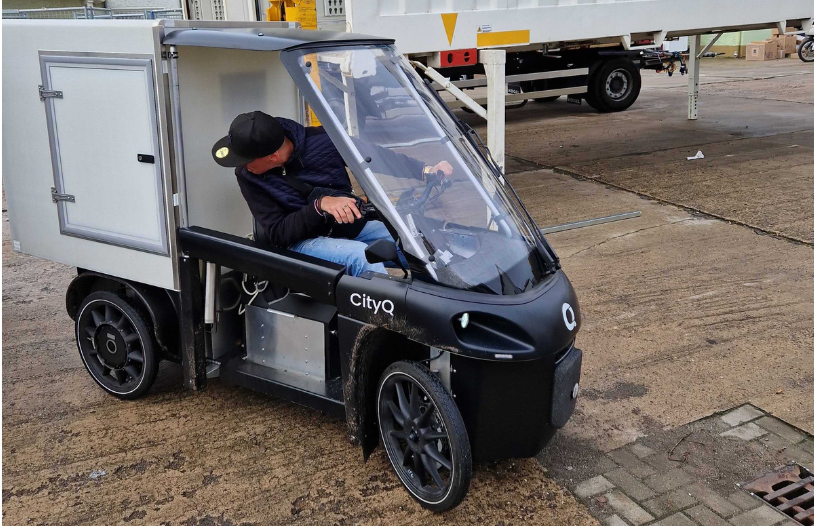
CityQ is one of the pioneers of 4-wheel cargo bikes, and the CityQ 1200 holds CE, EN15194 and EN 17860 certification, so it qualifies as an EAPC. For a business that wants to replace a delivery van with a cargo eBike, that classification is what removes the charges, the paperwork and the licence requirement in one step. A van still has a role for loads beyond a cargo eBike’s payload, so the sensible question is which of your current routes fit a CityQ.
Do cargo eBikes avoid charges in other UK cities too?
Yes. The same logic applies everywhere, because every UK Clean Air Zone class (A to D) targets motor vehicles only, and EAPCs are not included in any of them. Active zones in 2026 include:
- London (ULEZ)
- Birmingham
- Bath
- Bristol
- Bradford
- Newcastle/Gateshead
- Portsmouth
- Sheffield
- Aberdeen, Dundee, Edinburgh and Glasgow (the Scottish Low Emission Zones)
- Oxford (Zero Emission Zone)
A cargo eBike that pays nothing in London pays nothing in any of them. For operators running routes in more than one city, that makes the charge saving repeatable rather than a London-only advantage.
What does this save a London business over a year?
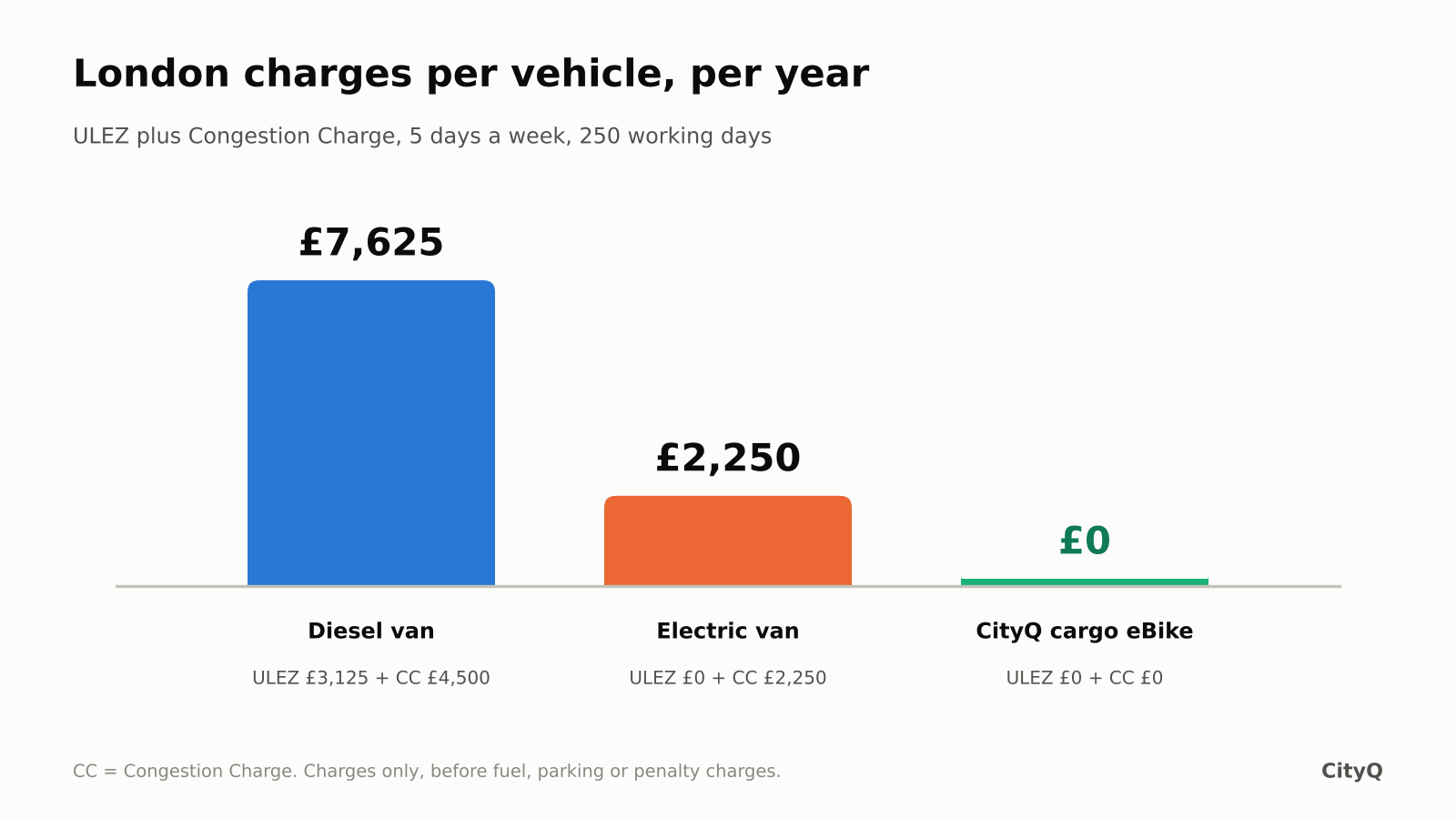
Based on five working days a week (250 working days), the annual charges per vehicle look like this:
| Vehicle | ULEZ per year | Congestion Charge per year | Total charges per year |
|---|---|---|---|
| Diesel van | £3,125 | £4,500 | £7,625 |
| Electric van | £0 | £2,250 | £2,250 |
| CityQ cargo eBike (EAPC) | £0 | £0 | £0 |
The CityQ’s daily running cost is under £2 in electricity.
The numbers are not theoretical. DHL’s two-year cargo bike operation in London has logged over 1 million kilometres on London routes with CityQ, with zero reported rider injuries. That is a working fleet on real routes in the same zones this post is about.

Access that no charge payment can buy
Charges are only part of the picture. A van can pay £18 and still be blocked: by a cycle-lane-only street, a low-traffic neighbourhood filter, a pedestrianised zone or a full kerbside. Payment buys entry to the Congestion Charge zone, not a place to stop.
Because an EAPC is legally a bicycle, a CityQ has access to cycle lanes and kerbside loading, and in some cases to pedestrianised zones and low-traffic neighbourhood routes where motor vehicles are excluded. That access comes from the legal classification, not from a local permit, so it does not depend on a council decision for each street. Where a van circles the block looking for a legal place to stop, a CityQ goes straight to the door.
FAQ's
Q1: Are cargo eBikes exempt from the London ULEZ?
A1: Yes. A cargo eBike that qualifies as an EAPC (Electrically Assisted Pedal Cycle) under UK law is legally classified as a bicycle, not a motor vehicle. The ULEZ charges only apply to motor vehicles. EAPCs are entirely outside the scheme and pay no ULEZ charge — not a reduced rate, zero.
Q2: Do cargo eBikes have to pay the London Congestion Charge?
A2: No. The London Congestion Charge applies to motor vehicles entering the Central London zone. An EAPC-classified cargo eBike is a bicycle under UK law and is not subject to the charge. The current rate of £18 per day (as of January 2026) does not apply to EAPCs at any time or on any day.
Q3: Did electric vans lose their Congestion Charge exemption in London?
A3: Yes. The Cleaner Vehicle Discount for electric vehicles expired on 25 December 2025. From 2 January 2026, electric cars pay £13.50/day and electric vans pay £9/day in the Congestion Charge zone. Only vehicles that are not motor vehicles — such as bicycles and EAPCs — remain fully outside the charge.
Q4: What is an EAPC and does a CityQ qualify?
A4: An EAPC (Electrically Assisted Pedal Cycle) must have working pedals, a motor rated at no more than 250W, and assistance that cuts off at 15.5mph. A vehicle meeting all three criteria is legally a bicycle under UK law. The CityQ 1200 meets all three criteria and holds CE and EN15194 certification, making it a legally classified EAPC in the UK.
Q5: How much does a diesel van cost per day in London charges vs a cargo eBike?
A5: A diesel van running in London five days a week faces £12.50/day in ULEZ charges and £18/day in Congestion Charge — £30.50/day combined, or over £7,600 per vehicle per year. A CityQ cargo eBike classified as an EAPC pays neither charge. Its daily operating cost is under £2 in electricity.
Q6: Are cargo eBikes exempt from UK Clean Air Zones outside London?
A6: Yes. UK Clean Air Zones in cities including Birmingham, Bath, Bristol, Bradford, Newcastle, Portsmouth, and Sheffield target motor vehicles only. EAPCs are legally classified as bicycles and do not fall within any CAZ charge class (A through D). A cargo eBike that avoids charges in London avoids them in every active UK Clean Air Zone.
Q7: Do I need a licence to ride a cargo eBike in London?
A7: No. A cargo eBike classified as an EAPC requires no driving licence, vehicle registration, road tax, MOT, or insurance under UK law. The minimum legal age to ride an EAPC on public roads is 14. Any member of staff who can ride a bicycle can legally operate an EAPC cargo eBike in London.
Q8: Can a cargo eBike use cycle lanes in London?
A8: Yes. Because an EAPC is legally a bicycle, it has access to cycle lanes, kerbside loading bays, and in some cases pedestrianised zones and low-traffic neighbourhood routes where motor vehicles are excluded. This access is a function of the legal classification, not a local permit or exemption.
Q9: How much does a CityQ cargo eBike save vs a van per year in London?
A9: On London urban routes five days a week, a diesel van pays over £7,600 per year in ULEZ and Congestion Charge alone — before fuel, parking, or penalty charges. A CityQ EAPC pays none of those charges. Over a working year per vehicle, the charge saving alone exceeds £7,600; across a five-vehicle fleet, that is over £38,000 annually back in the business.
Q10: Is a cargo eBike still cheaper than an electric van in London?
A10: Yes. Electric vans lost their full Congestion Charge exemption in January 2026 and now pay £9/day in the zone. A CityQ EAPC pays neither ULEZ nor Congestion Charge — saving over £2,250/year per vehicle vs an electric van on the Congestion Charge alone, plus lower fuel and maintenance costs.


