


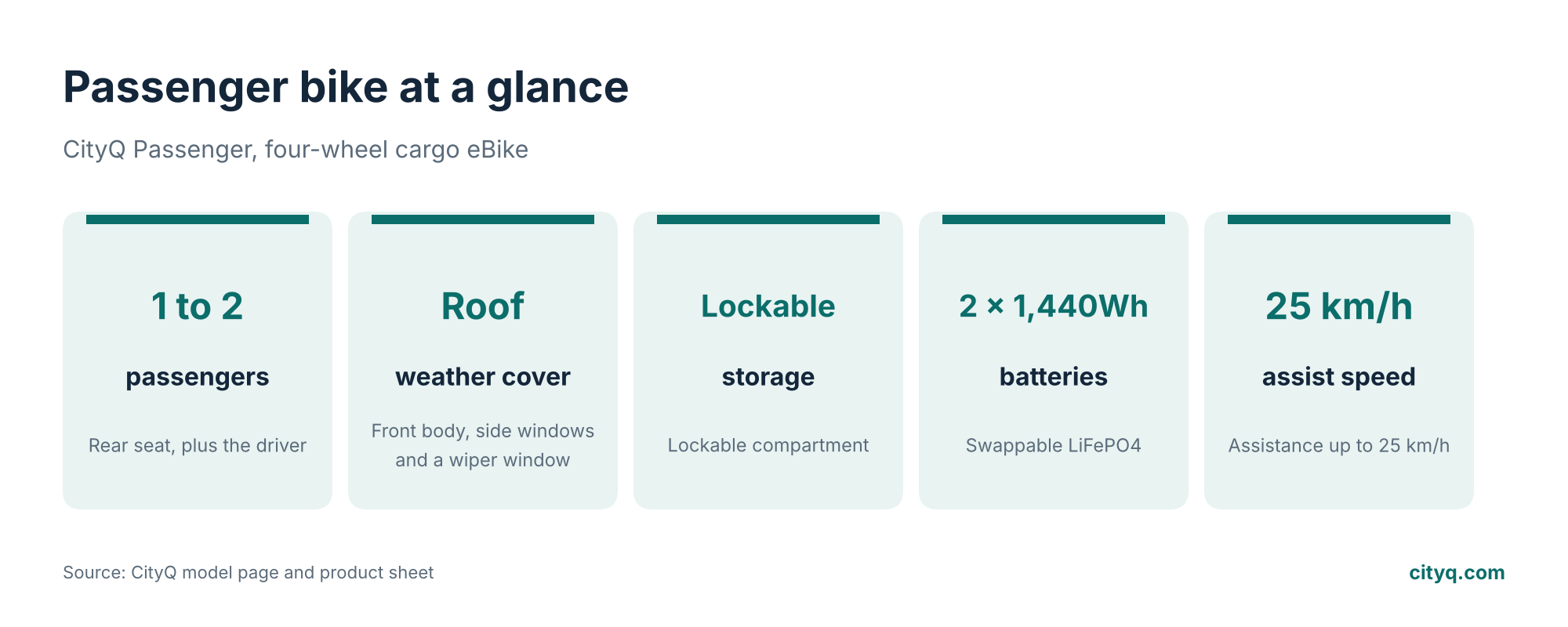
A passenger ebike UK sites can use on private ground carries people and loads. The CityQ Passenger is a four-wheel cargo eBike with a rear seat for one to two passengers, plus a roof, side windows and a lockable compartment.
Quick answer: The CityQ Passenger suits private ground such as campuses, resorts and gated communities, where your own staff move guests, colleagues and visitors without a fare. It carries 260 kg including the driver, runs 45 km on one 1,440Wh battery and costs about 38p for a full charge. A qualifying electrically assisted pedal cycle needs no licence under GOV.UK rules, but ask your insurer before you carry passengers.
CityQ Passenger, a covered passenger ebike UK sites can use, on a calm London street in morning light
What is a passenger ebike?
A passenger ebike is an electrically assisted cycle built to carry people as well as loads. Buyers search for it in several ways: a 4 wheel passenger ebike, an ebike with passenger seat, a covered passenger ebike or a cargo ebike with seat. The CityQ Passenger fits all four descriptions. It is a four-wheel cargo eBike with a rear seat for one to two passengers, a roof, side windows and a lockable compartment.
CityQ, one of the pioneers of 4-wheel cargo bikes, presented the Passenger at an event at Transport for London’s office in November 2025. Magnus Berggren of CityQ told Zag Daily on 18 November 2025: “We’re not trying to compete with bikes. We’re competing with cars.” That is the comparison to hold in mind as you read on: the Passenger sits against the car for short journeys on a site. It also joins CityQ’s wider 4 wheel electric cargo bike UK range, with a seat for people where other models carry freight.

What is inside the CityQ Passenger
Here is what the CityQ Passenger carries, from the roof down to the batteries.
| Feature | CityQ Passenger |
|---|---|
| Seats | Rear seat for one to two passengers, plus the driver |
| Payload | 260 kg including the driver |
| Weather cover | Roof, front body, side windows and a wiper window |
| Suspension | All four wheels |
| Brakes | Hydraulic brakes with a parking brake, plus regenerative braking |
| Motors | Two 125W motors |
| Batteries | Two swappable 1,440Wh LiFePO4 batteries |
| Assistance | Up to 25 km/h |
| Range (product sheet) | 45 km on one battery, 90 km on two |
| Gradeability | 16% |
| Turning radius | 6 m |
| Dimensions | 260 x 89 x 168 cm |
| Storage | Lockable compartment, plus a 1.1 m3 cargo box as a pickup with the rear seat folded |
| Safety features (product sheet) | Seatbelt and detachable doors |
| Tracking | Optional IoT tracking |
Two swappable batteries mean a drained pack can come out and a charged one can go in. Longer-term questions about cargo ebike battery life have their own page on CityQ’s site, and the figures in this article come from the product sheet. CityQ also explains why four-wheel cargo eBikes feel safer in cities for the people who ride them, and the Passenger shares that four-wheel layout.
Where a passenger ebike fits
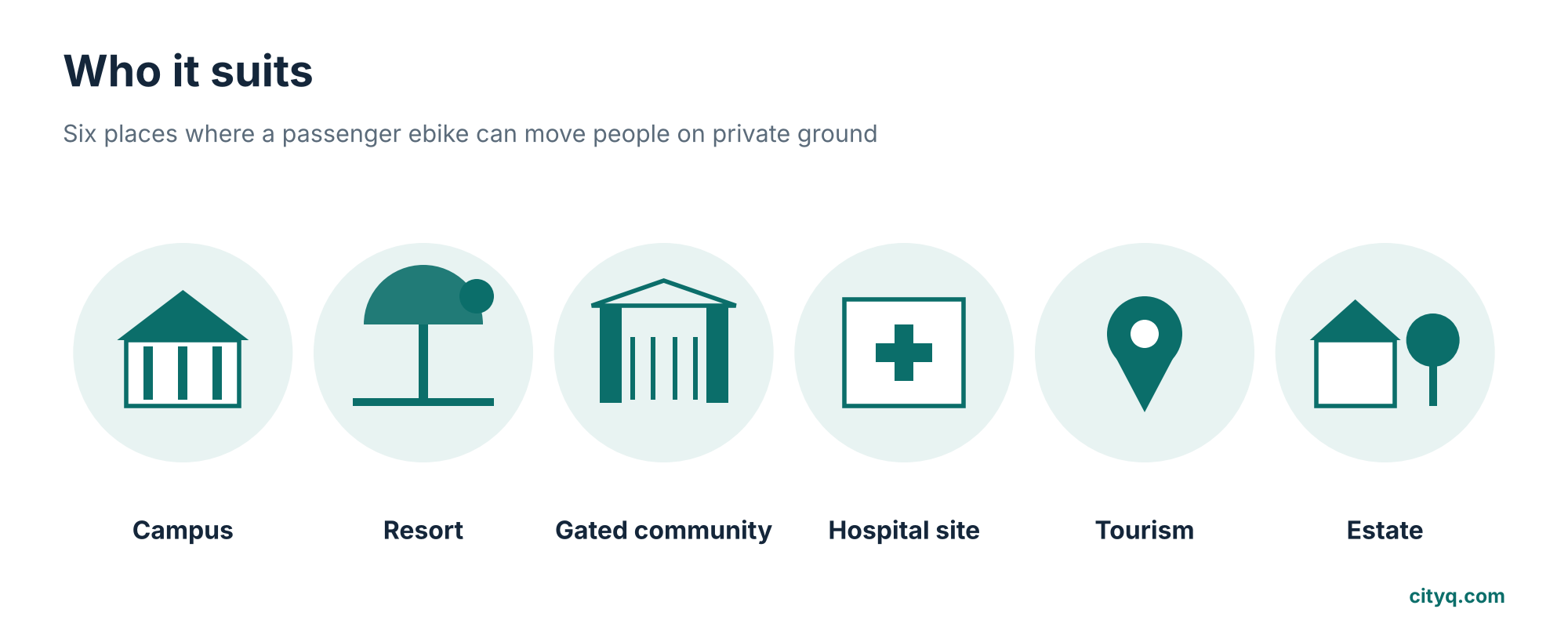
CityQ lists campuses, resorts and gated communities as uses for the Passenger. Hospital sites, estates and tourism businesses ask the same question: how do we move people across ground we own, without starting a car? Teams weighing the four-wheel cargo e-bike benefits for freight will find the passenger case follows the same logic, with a seat added.
The examples below involve similar vehicles in use. They are not CityQ customers.
- University of Mannheim: since September 2025, two electric tricycles have been lent to staff with limited mobility to cover about 1,200 m between buildings. One quote from the scheme reads: “With this vehicle, I’m suddenly mobile.”
- The Tawny, Staffordshire: this 70-acre estate hotel offers free bikes and electric tricycles to guests after a pilot in autumn 2025 (Express & Star, 26 January 2026).
- Hospital sites: NHS Humber Health Partnership has run a portering trial at Castle Hill Hospital since April 2025, using a four-wheel eCargo bike on a 168-acre site. No results have been published, so this article makes no claim about outcomes.
- Tourism: VisitBritain forecast 43.4 million inbound visits and £33.7 billion of visitor spend for 2025, in a forecast published on 18 February 2025. Hotels, resorts and attractions share that audience.
The passenger ebike UK rules in plain words
Electrically assisted pedal cycles
GOV.UK sets the conditions for a qualifying electrically assisted pedal cycle (EAPC):
| Rule | What GOV.UK says |
|---|---|
| Motor | 250W or less |
| Assistance | Cuts off at 15.5 mph |
| Pedals | Must be working |
| Licence, registration, tax, insurance | None needed |
| Rider age | 14 or over |
| Where | Cycle paths yes, pavements no |
Anyone asking about a driving licence for a 4 wheel e-bike will find the longer answer on CityQ’s site, and for a qualifying EAPC the short version is that none is needed. CityQ also covers the ebike speed limit UK rules for cargo models in more depth. Compare the Passenger’s figures in the table above, two 125W motors and assistance up to 25 km/h, with these conditions.
Carrying passengers and employing riders both change insurance needs, so ask your insurer before you start.

London pedicab rules
London has its own rules for vehicles that carry paying passengers. The Pedicabs (London) Act 2024 defines a pedicab as a pedal cycle, or one with a trailer, built or adapted to carry passengers and made available with a driver for hire or reward.
- Driver and operator licences became mandatory on 30 October 2026.
- Vehicle licences follow in February 2027 (Transport for London).
- Londonist reported on 18 February 2026 a proposal, subject to approval, for a fare cap of £5 base, £1 a minute and £3 per extra passenger, with fees of £114 per driver and £100 per vehicle.
These rules are aimed at fare-charging operators. The Passenger is built for private ground, where your own staff move guests, colleagues and visitors without a fare. For paid public rides in London, speak to Transport for London first.
What it costs to run
A full 1,440Wh charge costs about 38p at the Ofgem standard rate of 26.32p/kWh for October to December 2026 (CityQ calculation: 1.44 x 26.32p). Here is a worked example for a site shuttle.
| Step | Figure |
|---|---|
| Journeys | 10 round trips of 1.2 km each way |
| Distance | 24 km |
| Share of one 45 km battery | About 53% |
| Electricity cost | About 20p |
That is electricity only, and it shows why a short on-site shuttle is easy to budget. Count your own trips and the sum takes a minute.
How to test one on your site
- Walk the route. Check gradients against the 16% gradeability, and corners against the 6 m turning radius and the 260 x 89 x 168 cm dimensions.
- Count trips. Add up daily journeys and distance, then compare them with 45 km on one battery and 90 km on two.
- Decide who drives. Choose which of your own staff will drive. GOV.UK sets 14 as the minimum rider age for a qualifying electric bike, and your site may set stricter rules.
- Check insurance and site rules. Ask your insurer about carrying passengers and employing riders, and read your site’s own rules on who may ride and where.
- Book a free trial. Take a free cargo ebike trial on your own route, with your own drivers, before you decide.
FAQ's
Q1: What is a passenger ebike?
A1: A passenger ebike is an electrically assisted cycle built to carry people as well as loads. The CityQ Passenger is a four-wheel cargo eBike with a rear seat for one to two passengers, a roof, side windows and a lockable compartment, designed for private sites such as campuses, resorts and gated communities.
Q2: Is a passenger ebike legal in the UK?
A2: A qualifying electrically assisted pedal cycle is legal under GOV.UK rules: motor of 250W or less, assistance that cuts off at 15.5 mph, and working pedals. Check the CityQ Passenger’s specification against those conditions. Carrying passengers changes insurance needs, so ask your insurer, and speak to Transport for London before running paid rides in London.
Q3: Do I need a licence?
A3: According to GOV.UK, a qualifying electrically assisted pedal cycle needs no licence, registration, tax or insurance, and the rider must be 14 or over. Carrying passengers and employing riders change insurance needs, so ask your insurer. Your site may also set its own rules on who can drive.
Q4: How many people can it carry?
A4: The CityQ Passenger has a rear seat for one to two passengers, plus the driver. Payload is 260 kg including the driver, which covers passengers and load together. With the rear seat folded, the vehicle becomes a pickup with a 1.1 m3 cargo box.
Q5: Does it work in rain?
A5: The CityQ Passenger is built with weather cover: a roof, front body, side windows and a wiper window. It also has suspension on all four wheels and hydraulic brakes with a parking brake. Test your own route in wet conditions during a trial to see how it suits your site.
Q6: How far does one charge go?
A6: CityQ’s product sheet gives a range of 45 km on one battery and 90 km on two. The two 1,440Wh LiFePO4 batteries are swappable. A full 1,440Wh charge costs about 38p at the Ofgem standard rate of 26.32p/kWh for October to December 2026.
Q7: Can it climb hills?
A7: The CityQ Passenger has a gradeability of 16% and two 125W motors providing assistance. Gradients vary from site to site, so walk your steepest slope with CityQ during a trial. The turning radius is 6 m, which is worth checking against the tightest corners on your route.
Q8: How fast is it?
A8: Assistance on the CityQ Passenger goes up to 25 km/h. Under GOV.UK rules, a qualifying electrically assisted pedal cycle has assistance that cuts off at 15.5 mph. Compare the specification with those conditions, and set a site speed limit that suits the paths your drivers will use.
Q9: Is it safe for children?
A9: CityQ’s product sheet lists a seatbelt and detachable doors on the Passenger. That describes the features and is not a safety guarantee, so check your own site’s rules, your insurer’s requirements and any policy on carrying children before you plan journeys that include them.
Q10: Can I try one before buying?
A10: Yes. CityQ offers a free trial or test drive, so you can drive the CityQ Passenger on your own route before you decide. Book through CityQ’s test drive page, and bring your route, trip count and driver list from the five steps above.
Book a free trial or test drive
You have the route, the trip count and the driver list. The next step is to book a free trial or test drive and take the CityQ Passenger round your own site. So who will carry your first guest across it tomorrow morning?


