


A diesel van that fails the ULEZ standard pays £30.50 for a day in London’s Congestion Charge zone: £18 for the Congestion Charge plus £12.50 for ULEZ. A full charge for one CityQ battery costs about 38p. That contrast is why cargo eBike last mile delivery UK teams now test their rounds one at a time, often starting with whether they can replace a delivery van with a cargo ebike on a single route.
Quick answer: A round suits a cargo eBike when it has many drops close together, loads that fit a 1 m3 to 1.3 m3 cargo box and a hub within easy reach. CityQ’s four-wheel cargo eBikes carry that load under a roof, with swappable 1,440Wh batteries and assistance up to 25 km/h. The surest way to know is to test-drive one on your own round and count the drops.
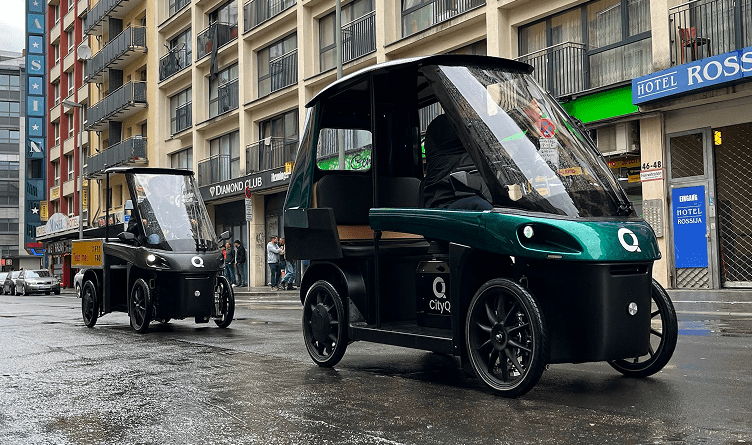
Four-wheel cargo eBike parked at the kerb during a parcel drop on a busy UK high street
What does cargo eBike last mile delivery UK work look like?
Last mile delivery is the final leg of a parcel’s journey, from a hub or depot to the customer’s door. In UK cities, that leg is where a cargo eBike can take over repeat rounds from a van. A four-wheel cargo eBike carries the load in a cargo box, with a roof, front body and a window with a wiper over the rider, plus a wide floor and side doors for loading.
CityQ, one of the pioneers of 4-wheel cargo bikes, builds two models for delivery rounds: the CityQ 850 and the CityQ 1200, which share the same drive and battery set-up and differ in the size of the cargo box.
| Feature | CityQ 850 | CityQ 1200 |
|---|---|---|
| Cargo capacity | 1 m3 | 1.3 m3 |
| Cargo box (L x W x H) | 97 x 88 x 108 cm | 131 x 89 x 115 cm |
| Motors | Two 125W wheel-hub motors | Two 125W wheel-hub motors |
| Batteries | One or two swappable 1,440Wh LiFePO4 packs | One or two swappable 1,440Wh LiFePO4 packs |
| Assistance | Up to 25 km/h | Up to 25 km/h |
| Weather cover | Roof, front body, window with wiper | Roof, front body, window with wiper |
| Brakes | Hydraulic with parking brake, plus regenerative braking | Hydraulic with parking brake, plus regenerative braking |
| Options | Shelves, branding, tracking, fleet management, digital lock | Shelves, branding, tracking, fleet management, digital lock |
| Certification | CE, EN 15194, EN 17860 | CE, EN 15194, EN 17860 |
Which last mile rounds suit a cargo eBike?
Independent data shows why rounds in dense areas are the place to start:
- A 2021 University of Westminster study found an e-cargo bike delivery was on average 1.61 times faster than a van making the same journey in central London, using data from 13,735 Pedal Me deliveries.
- Transport for London’s cargo bike guidance reports central London daily cargo bike counts up 42% from 2022 to 2023, from 4,915 to 6,998. TfL’s research found the sector could replace up to 17% of van kilometres in central London by 2030.
- Evri ran a peak-season cargo bike trial from November 2025 to January 2026, delivering about 14,000 parcels, and reported a 15% rise in drops per hour. It credited route flexibility and less time spent parking. This was not a CityQ deployment.
DHL has run CityQ cargo eBikes in inner-city operations in London for more than two years, and CityQ’s platform data logs over one million kilometres with no reported rider injuries. The wider story of cargo bike last mile delivery Londonoperations is set out on CityQ’s site.
Use this table to see where your own rounds sit:
| What to look at | Strong fit | Test first |
|---|---|---|
| Drops | Many drops close together | A few drops far apart |
| Load | Fits a 1 m3 to 1.3 m3 cargo box | Loads close to the size of the box |
| Hub | Hub or depot within easy reach | Long legs from the hub |
| Parking | Frequent stops where finding a space takes time | Open loading bays at every drop |
Cargo eBike last mile delivery UK round fit checklist

What does it cost to run a cargo eBike on a delivery round?
A full charge of one 1,440Wh battery costs about 38p at the Ofgem standard rate of 26.32p/kWh for October to December 2026 (CityQ calculation: 1.44 x 26.32p). Both models take two batteries, so a full charge of both costs about 76p. CityQ says a single pack takes about 5 to 7 hours to charge, so swapping to a charged pack keeps the bike working while the other one charges.
| Cost line | Figure |
|---|---|
| One full charge (one 1,440Wh battery) | About 38p |
| Both batteries fully charged | About 76p |
| Five shifts a week, both batteries charged every day | About £3.79 a week |
| For comparison: zone charges for a non-compliant diesel van in central London, per day | £30.50 (£18 Congestion Charge plus £12.50 ULEZ) |
These figures cover electricity only. Purchase price, insurance, maintenance and rider time sit on top, and they are the lines to price up before you decide.
What are the UK rules for a cargo eBike on delivery rounds?
GOV.UK sets the conditions for a qualifying electrically assisted pedal cycle (EAPC):
| Rule | What GOV.UK says |
|---|---|
| Motor | 250W or less |
| Assistance | Cuts off at 15.5 mph |
| Pedals | Must be working |
| Licence, registration, tax, insurance | None needed |
| Rider age | 14 or over |
| Where | Cycle paths yes, pavements no |
Both CityQ models are certified to EN 15194, the European standard for electrically power assisted cycles, and list two 125W motors with assistance up to 25 km/h, which is 15.5 mph. For a qualifying EAPC the answer on a driving licence for a 4 wheel e-bike is that none is needed. Employing riders changes insurance needs, so check what cargo ebike insurance UK cover your business should hold and ask your insurer before the first shift.

How do you test a round with a cargo eBike?
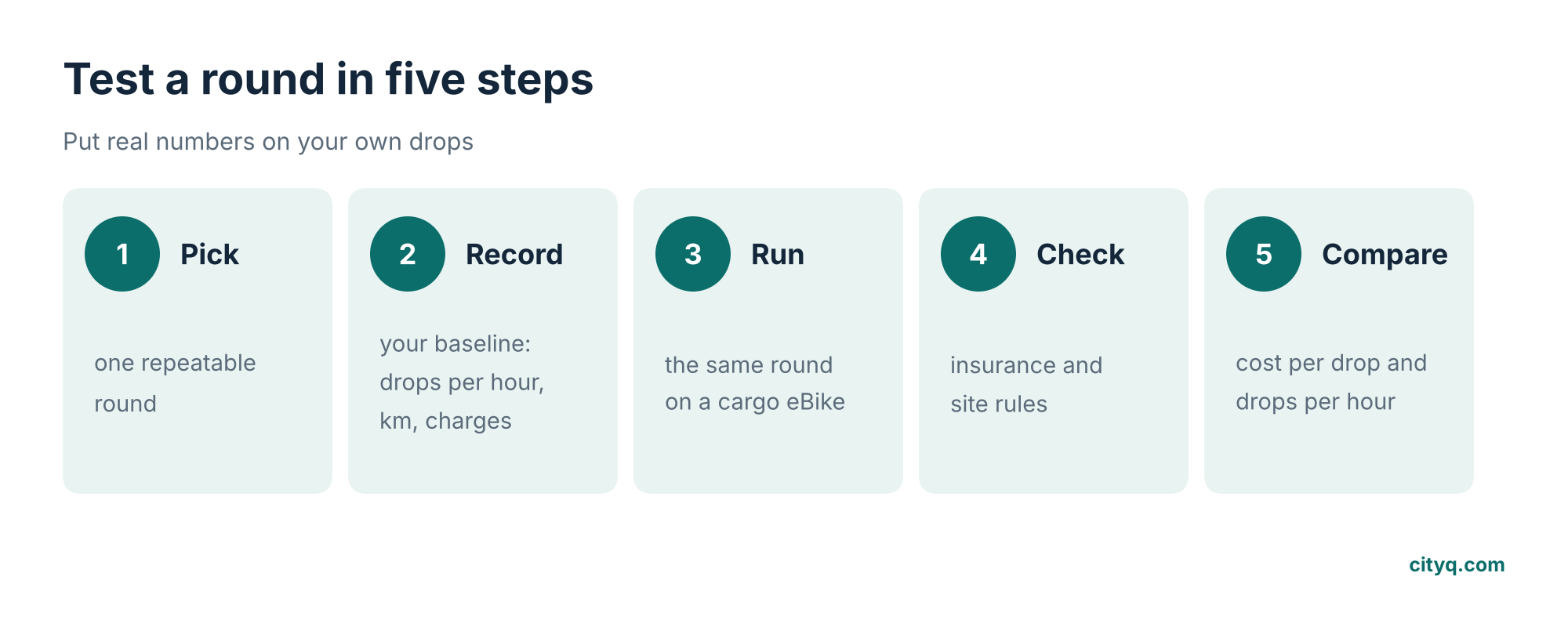
- Pick one repeatable round. Choose a round with the same hub, similar drops and the same hours each day.
- Record your baseline. Note drops per hour, minutes parked per drop, kilometres driven and the daily charges or fuel you pay now.
- Run the same round on a cargo eBike. Use a CityQ test drive on your own route and time every drop. Black Friday falls on 27 November 2026, so a cargo ebike Christmas delivery UK test is worth booking before the peak builds.
- Check insurance and site rules. Ask your insurer about employing riders, and confirm any depot or site rules on who may ride and where.
- Compare and decide. Set cost per drop, drops per hour, battery use and rider feedback against your baseline. Book a free cargo ebike trial, a no-obligation test drive, to put real numbers on each line.
FAQ's
Q1: What is cargo eBike last mile delivery?
A1: Cargo eBike last mile delivery means using an electrically assisted cargo cycle for the final leg from a hub or depot to the customer. CityQ’s four-wheel cargo eBikes carry loads in a 1 m3 or 1.3 m3 cargo box under a roof, so rounds with many close drops can run on them.
Q2: Do I need a driving licence?
A2: A qualifying electrically assisted pedal cycle needs no driving licence, according to GOV.UK, and the rider must be 14 or over. It needs a motor of 250W or less, assistance that cuts off at 15.5 mph and working pedals. Your employer’s policy and your insurer may set their own rules for riders.
Q3: How much can it carry?
A3: The CityQ 850 has a 1 m3 cargo capacity and the CityQ 1200 has 1.3 m3. Payload is listed per model on CityQ’s model pages, so weigh your heaviest drop against it, and measure your largest parcel against the cargo box before your test drive.
Q4: Is a cargo eBike faster than a van?
A4: A 2021 University of Westminster study found an e-cargo bike delivery was on average 1.61 times faster than a van making the same journey in central London, using data from 13,735 Pedal Me deliveries. Results depend on the round, so time your own drops against your current van.
Q5: How much does it cost to charge?
A5: A full charge of one 1,440Wh CityQ battery costs about 38p at the Ofgem standard rate of 26.32p/kWh for October to December 2026. Charging both batteries fully costs about 76p. That figure covers electricity only, not purchase, insurance, maintenance or rider time.
Q6: Does it work in rain and winter?
A6: CityQ’s cargo eBikes have a roof, front body and a window with a wiper, plus side doors and a wide floor. Cold weather can make batteries discharge faster and charge slower, according to CityQ, so test your own round in the conditions you work in before you commit to a fleet.
Q7: Do I need insurance?
A7: GOV.UK says a qualifying electrically assisted pedal cycle needs no insurance by law. Employing riders changes your insurance needs, so ask your insurer what cover your business should hold for the bike, the rider and the load, and agree it before your test drive.
Q8: Which CityQ model suits delivery?
A8: Both CityQ models share two 125W motors, swappable 1,440Wh LiFePO4 batteries, assistance up to 25 km/h and weather cover. The CityQ 850 has a 1 m3 cargo capacity and the CityQ 1200 has 1.3 m3, so pick by the size of your largest regular drop.
Q9: Can I track the bikes?
A9: CityQ lists optional tracking, fleet management and a digital lock with app or RFID. The CityQ 1200 page mentions tracking distance and theft tracking through a communication module. Ask CityQ which options suit your round when you book your test drive, so the data you need is switched on from the start.
Q10: Can I try one before buying?
A10: Yes. CityQ offers a free, no-obligation test drive, so you can run your own round on a cargo eBike before you decide. Record your drops per hour, kilometres and battery use on the day, then compare them with your van’s figures to see where the gap sits.
Book a free test drive
Pick the round with the most drops in the smallest area, then book a free test drive and run it on a CityQ cargo eBike for yourself. Which of your rounds would you hand over first?


