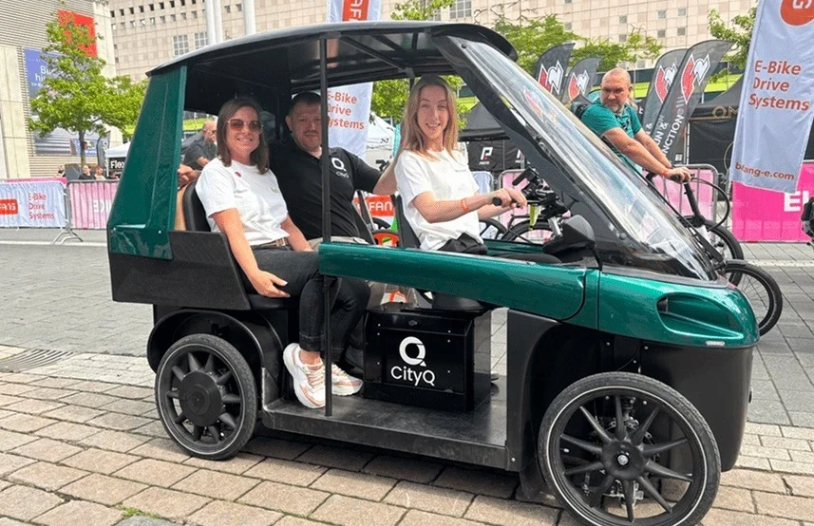
NHS teams are already testing cargo eBikes for home visits and site work, and the case for an eBike for community nurses UK services is now being tried in practice rather than argued on paper. On 12 March 2024, Guy’s and St Thomas’ NHS Foundation Trust announced that nine members of its @home service, based at Elmcourt health centre in West Norwood, would use a cargo eBike from the supplier EAV with up to 150 kg of storage. The bike was to replace pool cars, public transport and personal bikes for home visits, and it needs no parking permit.

What has the NHS tried so far?
The table below lists the public NHS trials we found. None has published results, so every outcome below is a plan or an aim, not a finding.
| Trust | What was tested | Start | Status |
|---|---|---|---|
| Guy’s and St Thomas’ NHS Foundation Trust (@home, West Norwood) | Cargo eBike for home visits by nine staff, with training from a Bikeworks instructor | March 2024 | No results published yet |
| NHS Humber Health Partnership (Castle Hill Hospital, Hull) | 12-month trial of an electric cargo eBike for the portering team across a 168-acre site | April 2025 | No results published yet |
| Guy’s and St Thomas’ with Cross River Partnership (Lambeth and Southwark) | Four eBikes across two community sites supporting clinicians on visits; GPS journey data, surveys and interviews | March to June 2026 | Evaluation under way; results pending |
| Dorset HealthCare (Purbeck, Dorchester, Bournemouth) | Mobile nursing teams moved from cars to eBikes; the trust gave £2,000 to encourage more nurses to take part | August 2021 | No results published yet |
At Guy’s and St Thomas’ in 2024, deputy service lead Harriet Slade said the trial “could mean our staff are able to reach patients homes faster.” Sustainable travel officer Tim Le Rougetel said cargo eBikes “can travel through areas restricted to general motor traffic”, with no parking restrictions or permits to deal with. Neither statement is a result. Both describe what the trust hopes to learn.
At Castle Hill, the portering bike carries linen, gas cylinders, medical equipment and supplies. It is funded by Active Travel England’s Capability Fund, and if the trial succeeds it would replace one of the site’s vans. Head of sustainability Marc Beaumont called it “a fantastic addition to our fleet” and hopes to charge the batteries from the site’s solar power. The trust has not named the supplier, and we are not claiming it is a CityQ.
Why are trusts looking at cargo eBikes?
Three pressures sit behind these trials: carbon targets, running costs and access.
Net zero targets. NHS England’s net zero travel and transport strategy sets two dates. The Carbon Footprint, which covers direct emissions including NHS fleet and business travel, is due to reach net zero by 2040, with an 80% cut between 2028 and 2032. The Carbon Footprint Plus, which covers indirect emissions and mainly staff commuting, is due to reach net zero by 2045. The strategy puts annual direct fleet emissions at about 177 kt CO2e, business travel at about 223 kt CO2e and staff commuting at about 560 kt CO2e. All business travel is targeted to be zero emission by 2040.
Business travel and grey fleet. Staff who use their own cars for work journeys sit in the business travel figure. The strategy’s recommended measures include EV and eBike pools, and it notes that GP practices in Sheffield, Exeter and Newquay already use eBikes for home visits.
Access and parking. A cargo eBike needs no parking permit, and Guy’s and St Thomas’ points to access to areas closed to general motor traffic. On a large site, the same logic applies to pedestrianised routes, courtyards and car-free zones.
Meet the CityQ Passenger
The CityQ Passenger is a four-wheel cargo eBike with a rear seat for one or two passengers, placed behind the driver. It has a roof, a front body, side windows and a wiper, so staff are covered in rain. The passenger ebike UK overview explains who it suits in more detail.
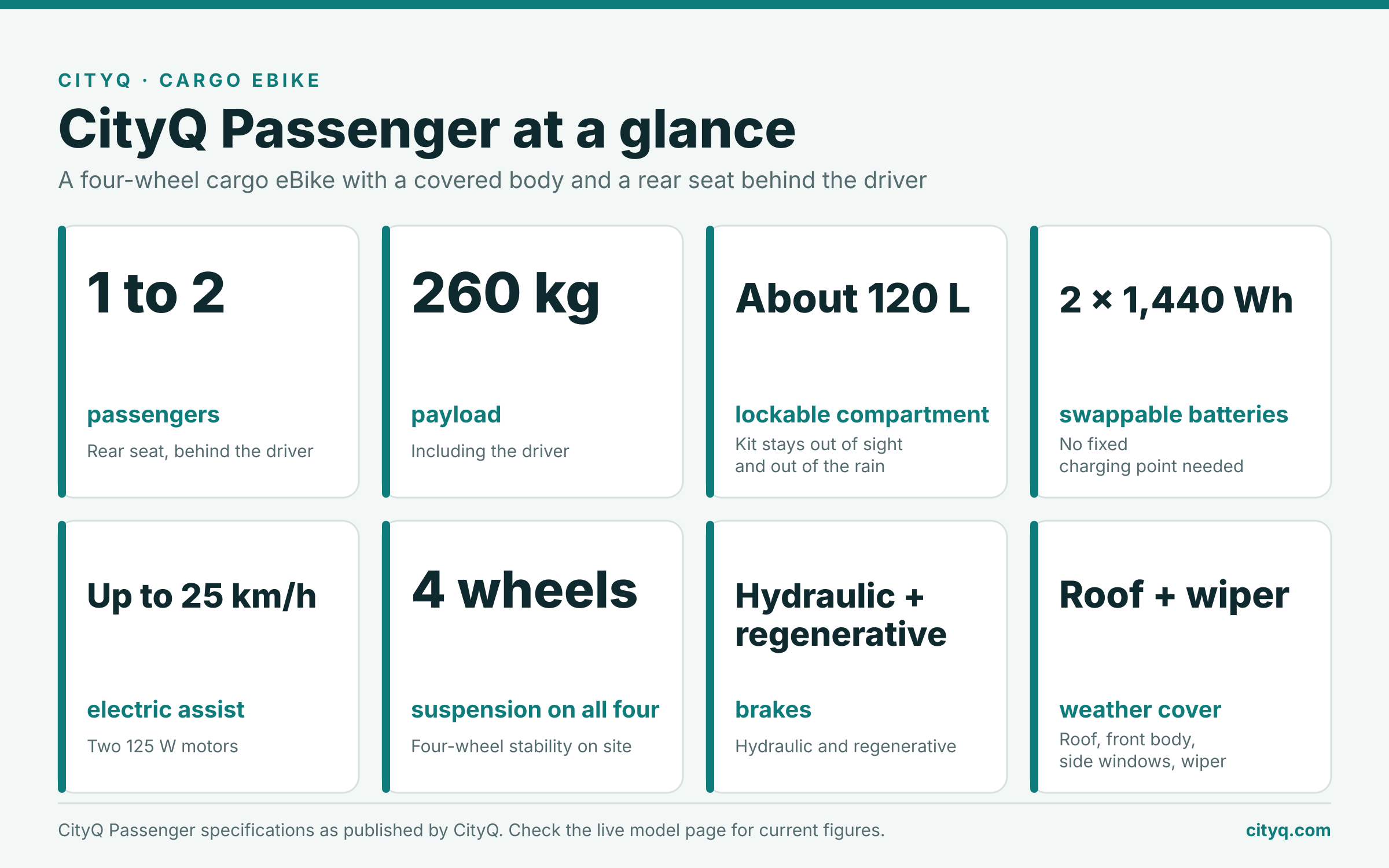
- Seating: rear seat for 1 to 2 passengers, behind the driver.
- Weather cover: roof, front body, side windows and a wiper.
- Payload: 260 kg including the driver.
- Storage: lockable compartment of about 120 L, so bags, paperwork and equipment stay out of sight and out of the rain.
- Power: two 1,440 Wh swappable batteries, so no fixed charging point is needed. The cargo ebike battery life UKfigures show how long a charge lasts and what it costs.
- Assist: electric assist up to 25 km/h, from two 125 W motors.
- Ride and braking: suspension on all four wheels, with hydraulic and regenerative brakes.
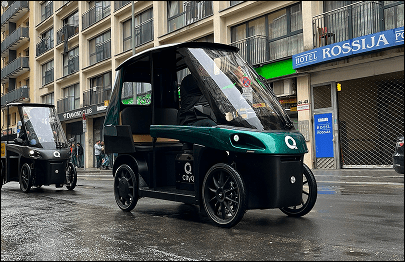
No NHS trust has said it uses a CityQ. The Passenger is built for the journeys described next, and a trial on your own site is the way to test it.
Six journeys on a hospital or care site
These are examples of short site journeys, not reports from any trust. Passengers always sit behind the driver, and kit goes in the lockable compartment. Whether a given journey is allowed is a matter for your trust’s policy and a risk assessment.
- The end-of-shift ride. A driver takes one or two colleagues from the main building to a distant car park, bus stop or staff accommodation block. Late finishers get a covered ride, and the roof, side windows and wiper keep them dry.
- The new-starter tour. A workforce or sustainability lead shows one or two new starters around a large site on their first day. The seat behind the driver means they can see the layout while the driver keeps their eyes on the route.
- The visitor escort. An estates or facilities colleague takes a visiting contractor or guest to a department on the far side of the site. The visitor rides behind the driver, with bags in the lockable compartment.
- The estates walk-round. Instead of walking a long perimeter, an estates officer and a colleague cover it by Passenger, with tools and checklists locked in the compartment. They can stop at each point and carry on.
- The satellite-clinic run. A team member and a colleague travel between a main site and a nearby satellite clinic, with paperwork and kit in the compartment. No parking permit is needed at either end.
- The open-day tour. On a recruitment day or open day, guests ride behind the driver on a short loop of the site. The covered body means the tour can run in changeable weather.

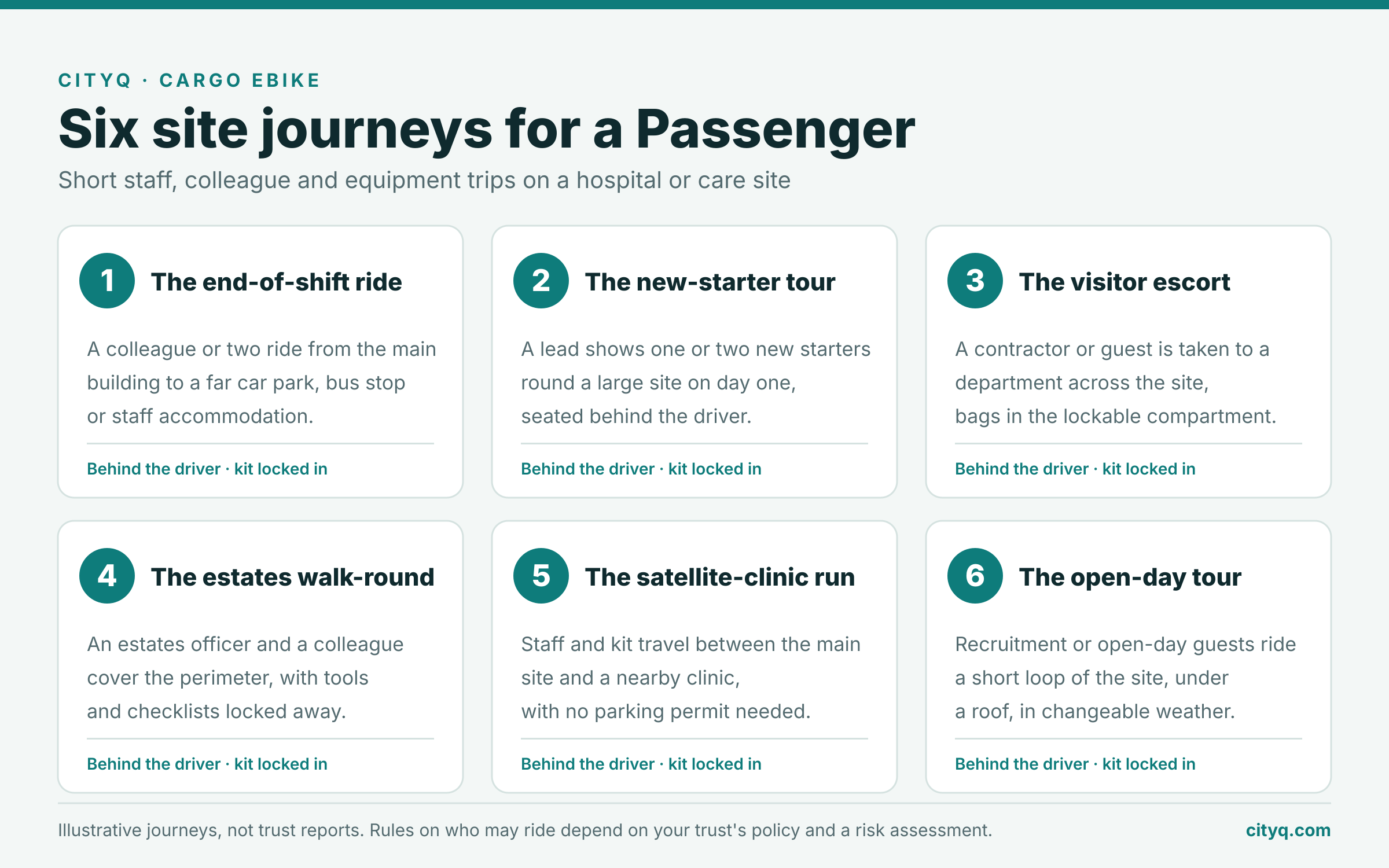
Hospital site Passenger journeys Six short journeys a covered four-wheel cargo eBike could cover on a hospital or care site.
What about weather, hills and ordinary staff?
Dorset HealthCare’s 2021 move shows the weather and hills question has been tested by working nurses. District nurses in Purbeck, Dorchester and Bournemouth swapped cars for eBikes. Hattie Taylor, lead district nurse for Purbeck, said: “Purbeck isn’t quite as flat as Holland, so we found electric bikes worked better.” She also said: “Our patients love it when we turn up with our helmets on.” Those are her words about two-wheel eBikes in Dorset, not a CityQ result.
A more recent public-sector demo points to the ordinary-staff question. In May 2026, officers from street cleaning, postal delivery and health services in Brighton and Hove tested a CityQ, as covered in CityQ’s own look at what happens when an electric cargo bike for councils is trialled by public-sector teams. Cabinet Member Trevor Muten rode it, and his interest was the swappable battery, which needs no fixed charging point. His comment: “Anyone can use it — that’s a huge bonus. Some colleagues don’t drive.” University of Brighton facilities managers said moving larger vehicles around campus is difficult, and the council’s Head of Fleet plans a cleaning-operatives trial.
The point for NHS teams is simple. A trial that depends on staff holding a driving licence limits who can take part, so check what applies to the model you choose.
How do we start a site trial?
Five-step hospital trial plan A five-step route from first idea to a measured trial on your own site.
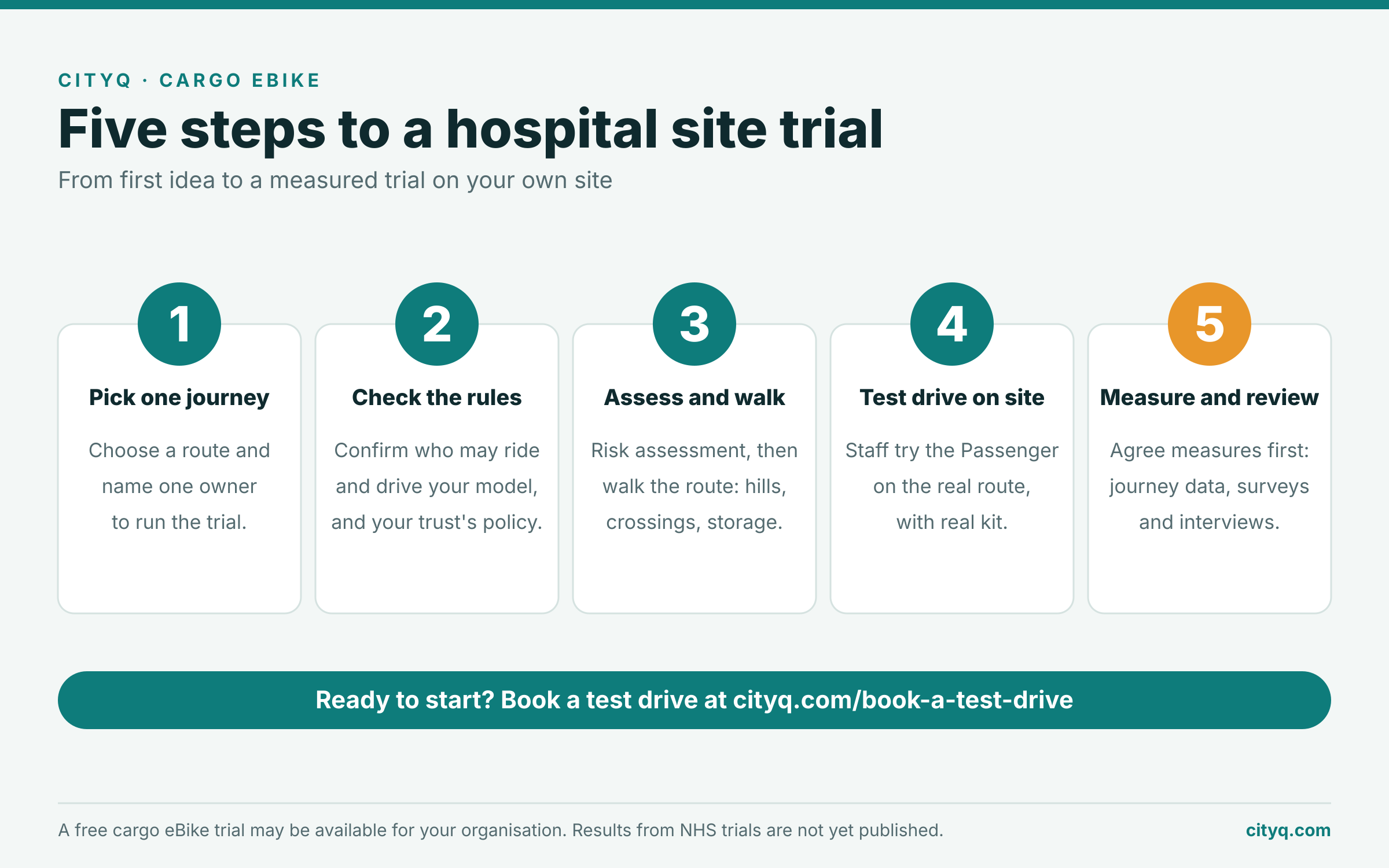
- Pick one journey and one owner. Choose a route from the six above, or your own, and name the person responsible.
- Check the rules. Confirm who may ride and drive. The driving licence for a 4-wheel e-bike rules depend on the vehicle’s classification, so confirm them for your model, and check your trust’s policy on passengers.
- Run a risk assessment and walk the route. Look at gradients, crossings, shared paths and storage for the bike and batteries.
- Book a test drive on your site. Staff try the Passenger on the real route, with real kit.
- Decide what to measure, then review. Guy’s and St Thomas’ used GPS journey data, surveys and interviews to look at efficiency, environmental impact and staff experience. A site trial could use the same three lenses.
Funding is worth asking about early. A free cargo ebike trial UK may be available for your organisation, and CityQ can explain what is on offer.
FAQ's
Q1. Can community nurses use an eBike for home visits in the UK?
A1. Yes, in trials. Guy’s and St Thomas’ tested a cargo eBike with nine @home staff in West Norwood in 2024, then ran a four-eBike evaluation across two community sites in Lambeth and Southwark from March to June 2026. No results have been published yet, so the benefits are still being tested.
Q2. Are district nurses already using eBikes?
A2. Yes. Dorset HealthCare moved mobile nursing teams from cars to eBikes from 2021, starting in Purbeck and spreading to Dorchester and Bournemouth. Lead district nurse Hattie Taylor said: “Purbeck isn’t quite as flat as Holland, so we found electric bikes worked better.” NHS England’s net zero travel and transport strategy also notes GP practices in Sheffield, Exeter and Newquay using eBikes for home visits.
Q3. What are NHS cargo bike trials testing?
A3. They are testing whether a cargo eBike can get staff to patients faster, avoid parking permits and reach areas closed to general motor traffic. Guy’s and St Thomas’ said its 2024 trial “could mean our staff are able to reach patients homes faster.” Its 2026 evaluation measures operational efficiency, environmental impact and staff experience through GPS journey data, surveys and interviews.
Q4. Is there a hospital eBike in the UK for portering?
A4. Yes. Castle Hill Hospital in Hull, part of NHS Humber Health Partnership, began a 12-month trial in April 2025 of an electric cargo eBike for its portering team. It carries linen, gas cylinders, medical equipment and supplies around a 168-acre site, and would replace one of the site’s vans if the trial succeeds. The trust has not published results.
Q5. What should a cargo bike for community health teams offer?
A5. Look for weather cover, secure storage, enough payload and a way to carry a colleague. The CityQ Passenger has a roof, side windows and a wiper, a lockable compartment of about 120 L, a payload of 260 kg including the driver and a rear seat for 1 to 2 passengers behind the driver. It runs on two swappable 1,440 Wh batteries and has suspension on all four wheels.
Q6. Do community nurses need a driving licence to ride a cargo eBike?
A6. CityQ’s position is that its cargo eBikes are built to meet the electrically assisted pedal cycle conditions, in which case no driving licence is needed. Four-wheel classification is less clear-cut than for two or three wheels, so the rules on a driving licence for a 4-wheel e-bike depend on your model; check them, and your trust’s policy, before staff ride.
Q7. How could an NHS team fund a cargo eBike?
A7. Castle Hill’s portering bike was funded by Active Travel England’s Capability Fund, in partnership with East Riding of Yorkshire Council. Funding varies by area, so ask your local council’s sustainable transport team and your trust’s sustainability lead what is open to you.
Q8. What insurance does an NHS team need for a cargo eBike?
A8. Even where the vehicle itself does not need insurance by law, a trust will normally want cover for staff, passengers, equipment and third parties, so talk to your insurer about cargo ebike insurance UK options early, including what a business legally needs and what it should cover anyway.
Q9. Is a four-wheel passenger eBike safe on hospital grounds, and can patients ride?
A9. On a busy hospital site, four-wheel cargo e-bike safety starts with stability: the CityQ Passenger has four wheels, hydraulic and regenerative brakes and suspension on all four wheels. Zag Daily reported on 17 September 2026 that CityQ says it is the first European four-wheel cargo bike manufacturer certified against EN 17860, tested by ACT-LAB, covering the cargo, Pickup and Passenger models; the “first” claim is CityQ’s and ACT-LAB’s. Colleagues and escorts can ride behind the driver, but whether patients can ride depends on your trust’s policy and a risk assessment, and CityQ makes no clinical claims.
Q10. How does an NHS site start a cargo eBike trial?
A10. Start with one journey and one named owner, check the rules for your model, run a risk assessment and walk the route, then book a test drive on site and agree what to measure. Because a free cargo ebike trial UK may be available for your organisation, you can test the Passenger on your own route before deciding anything.
Try the Passenger on your site
Pick the journey that costs your site the most time, then see how the CityQ Passenger handles it on your own route, with your own kit and your own staff.