


One number decides whether a cargo eBike is a bicycle or a moped in the eyes of the law: 15.5mph. The ebike speed limit UK rules are the same rules that decide whether you need a driving licence for a 4-wheel e-bike at all, and for a compliant cargo eBike the answer is no. Here is what UK law actually says, in plain English.
Quick answer: In the UK, an electric bike is an electrically assisted pedal cycle (EAPC) if its motor is 250W or less, stops assisting at 15.5mph (25km/h) and the bike has working pedals. The rules have not changed. Cargo eBikes follow the same rules, and four wheels are allowed. An EAPC needs no licence, registration, tax or insurance, and the rider must be 14 or over.

What is the ebike speed limit in the UK?
The ebike speed limit UK riders hear about is a limit on the motor, not on the rider. An electric bike that qualifies as an electrically assisted pedal cycle (EAPC) has a motor that must stop assisting at 15.5mph (25km/h). The motor must also have a continuous rated power of no more than 250W, and the pedals must be able to propel the bike.
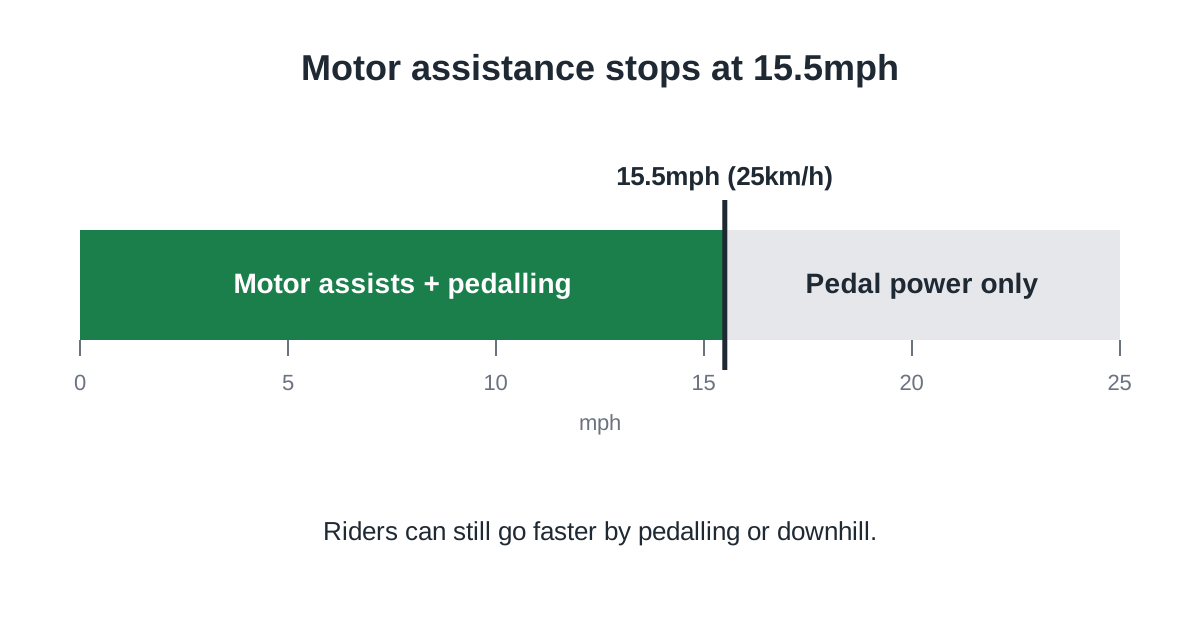
Above 15.5mph, the power comes from the rider. You can still go faster by pedalling or going downhill. GOV.UK sets no other speed limit for riding an EAPC on the road.
That is the cargo ebike speed limit UK operators need to know. Cargo eBikes follow the same rules as any other electric bike, so there is no separate limit for a cargo eBike.
It helps to read the rule as a hand-over point. Up to 15.5mph, the motor assists while you pedal. Beyond it, the motor stops and the speed comes from the rider’s legs or from gravity. The 250W figure is a rating of the motor, not the battery, so a bigger battery does not change a bike’s legal status on its own.
The pedals matter as much as the numbers. A bike that cannot be propelled by its pedals does not qualify as an EAPC, however low its power.
Two more details matter when you check a bike:
- Markings. An EAPC must show its continuous rated power, the manufacturer, and either the battery voltage or the maximum motor-assisted speed.
- Throttle. On e-bikes sold since 1 January 2016, a throttle may only give starting assistance up to 6km/h (3.7mph). Throttle-only assistance up to 15.5mph needs vehicle approval.
Is the UK changing the ebike speed limit?
No. The Department for Transport (DfT) consulted on raising the motor power limit from 250W to 500W and on allowing throttle assistance up to 15.5mph. It received 2,121 responses. On 28 January 2025 the government said it would not take those proposals forward.
The DfT has said it may look at the issues again if broader micromobility changes are proposed. Until then, the 250W and 15.5mph limits stand, and we are not aware of any change to the rules in 2026. It is still worth checking GOV.UK before you sign a purchase order.
If you are planning a fleet purchase, the practical advice is simple: buy to the rules as they stand today. A bike built to 250W and 15.5mph is compliant now, and that is the position the government confirmed when it left the limits in place.
Do road speed limits apply to ebikes and cargo eBikes?
Statutory speed limits under the Road Traffic Regulation Act 1984 apply to motor vehicles. A compliant EAPC is not a motor vehicle in law. That means the 20mph and 30mph limits that apply to cars and vans do not apply to an EAPC in the same way, and a cargo eBike is treated like any other pedal cycle.
That does not mean anything goes. Careless or dangerous riding can still be an offence, and parks, estates and other private land may set their own rules. Check local rules, and ride to the conditions, especially with a full load.
For a fleet manager, the legal position is a starting point, not a safety policy. Nothing stops a business from setting its own site rules and its own riding standards for staff, and a loaded cargo eBike in a pedestrian-heavy street is a good place to use them. Be honest with your team about one more thing: with assistance ending at 15.5mph, a cargo eBike will not keep pace with a van on open, fast roads. Its advantage is in the city, where cycle lanes and short stops decide the day.
Can a cargo eBike have four wheels?
Yes. The Electrically Assisted Pedal Cycles (Amendment) Regulations 2015 (SI 2015/24) replaced “bicycles and tricycles” with “pedal cycles with two or more wheels”. The explanatory note says this permits more than three wheels, and the same amendment removed weight limits. ETA also states that there are no legal restrictions on the number of wheels, weight or size.
CityQ is one of the pioneers of 4-wheel cargo bikes, and it states that its four-wheel cargo eBikes are built to the EAPC rules, with a 25km/h motor cut-off, and to the EN 15194 and EN 17860 standards. Legal status is one layer, and the cargo bike safety standard that applies, EN 17860, is the other that buyers should ask to see.
GOV.UK also covers tricycles within the EAPC rules, so the idea that a pedal-assisted vehicle must have two wheels is out of date. What counts is whether the bike meets the conditions, not how many wheels it has.
Each model must still meet the other EAPC conditions, so ask any supplier for the certificate and its scope for the exact model you plan to buy.
What happens if an ebike goes beyond the EAPC rules?
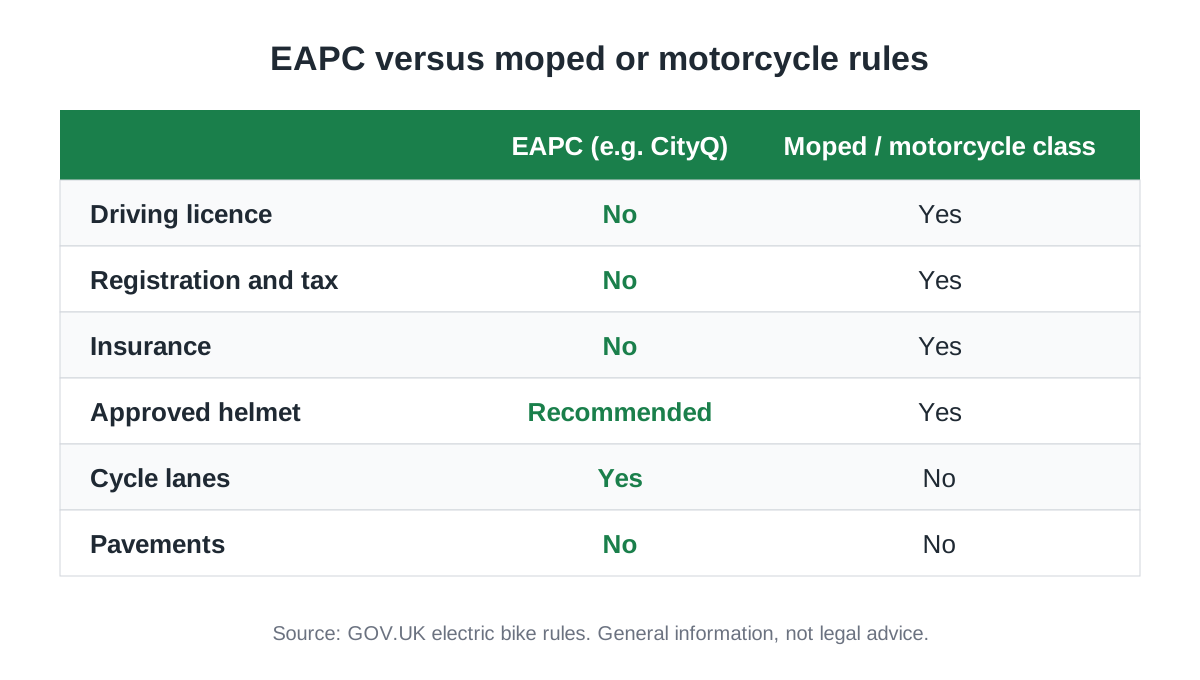
It stops being an EAPC. GOV.UK says an e-bike that does not meet the rules is classed as a motorcycle or moped. That brings in the full set of road rules for those vehicles.
| EAPC (e.g. CityQ) | Moped / motorcycle class | |
|---|---|---|
| Driving licence | No | Yes |
| Registration and tax | No | Yes |
| Insurance | No | Yes |
| Approved helmet | Recommended | Yes |
| Cycle lanes | Yes | No |
| Pavements | No | No |
Source: GOV.UK electric bike rules.
One legal commentator quoted by Cycling Weekly puts it plainly. A derestricted e-bike would likely fall under the motor-vehicle rules, and a rider is more likely to be prosecuted for riding an illegal bike than for speeding. That is an opinion, not a statute, but it shows where the real risk sits.
The lesson for buyers is simple. Buy a bike that meets the EAPC rules as built, and keep it that way. Changing a bike’s motor limits changes its legal status, and it is the rider who then carries the consequences.
Where can a cargo eBike go?
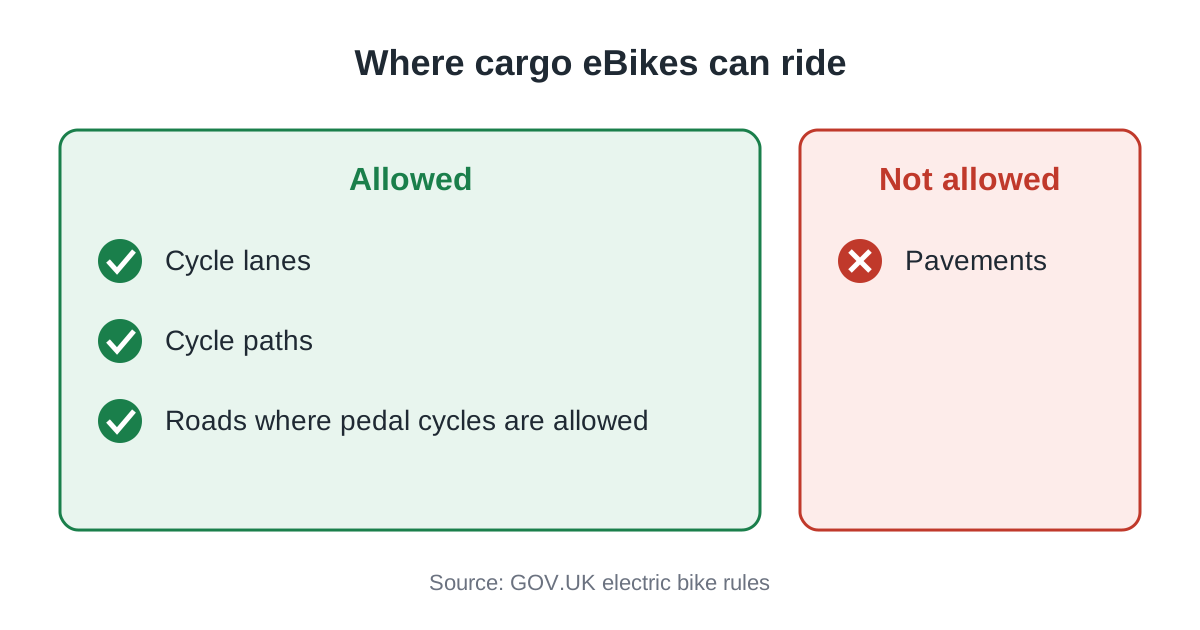
A compliant EAPC can be ridden on cycle paths and anywhere else pedal bikes are allowed. It cannot be ridden on pavements. The rider must be 14 or over.
Cycle-lane access is where a cargo eBike earns its keep on busy routes. Public sector teams that want to check the rules first can see what happens when councils and city services try one before they commit.
What does this mean for a business?
Because a compliant cargo eBike is a bicycle in law, the 15.5mph line brings a short list of practical benefits:
- No driving licence. You are not limited to hiring or rostering licensed drivers.
- No registration, tax or insurance requirement for the bike itself.
- Cycle-lane access on routes where a van would sit in traffic.
- No ULEZ or Congestion Charge. Because it is a bicycle in law, it is also cargo eBike ULEZ exempt and pays no Congestion Charge.
Every one of those benefits depends on the bike staying inside the EAPC rules. That is why the checklist below matters more than any brochure claim. A bike that is compliant on the day you buy it, and stays that way, keeps the licence-free, registration-free status that makes the business case work in the first place.
To see what this looks like on real routes, read how DHL and UPS use cargo e-bikes in the UK every day. The same logic works at a much smaller scale. For a small trade business, the story of how Elite Vinduspuss replaced the van with CityQ shows the idea in daily work.
The same rules apply to every EAPC, so the same questions work whether you are buying one cargo eBike or a fleet. Your finance team, your depot manager and your riders all get the same set of answers.
What is your legal checklist before you buy?
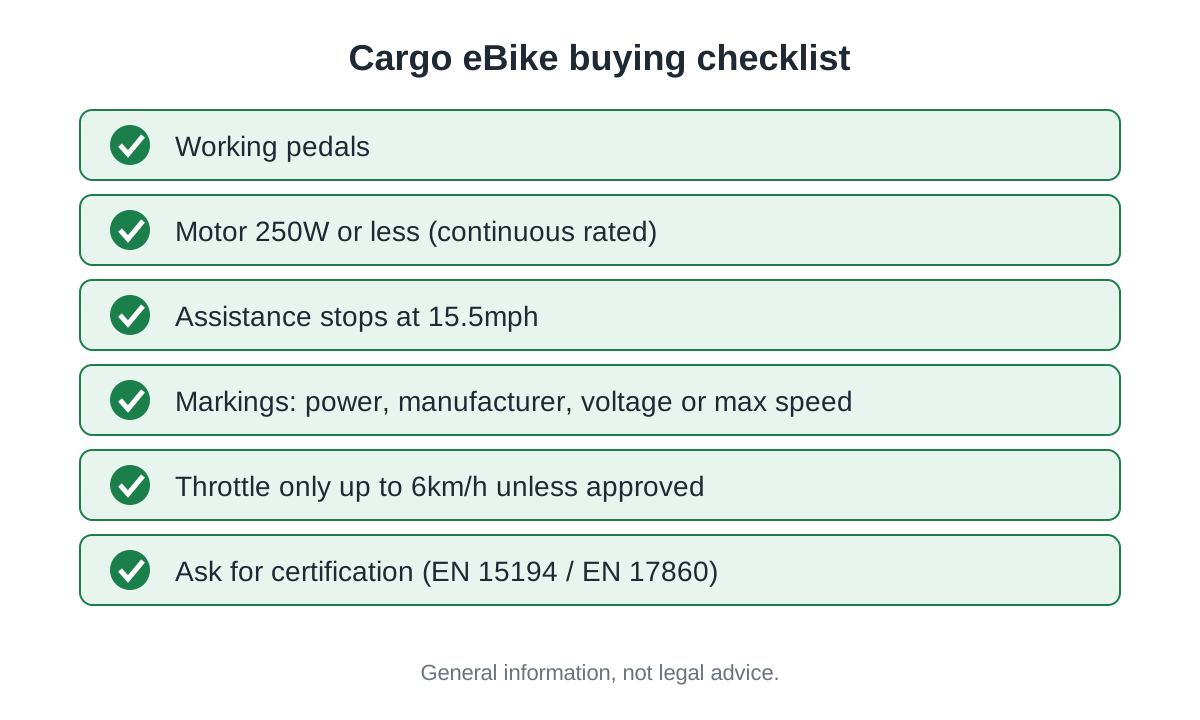
Legal compliance is easy to check if you know what to ask. Run through these six checks with any supplier, CityQ included:
- Working pedals that can propel the bike.
- Motor of 250W or less (continuous rated power).
- Assistance that stops at 15.5mph.
- Markings showing power, manufacturer, and battery voltage or maximum assisted speed.
- Throttle limited to starting assistance up to 6km/h unless the bike has vehicle approval.
- Certification for the exact model: ask for the certificate and its scope (EN 15194 and EN 17860).

FAQ's
Q1. What is the ebike speed limit in the UK?
A1. An electric bike that qualifies as an electrically assisted pedal cycle (EAPC) has a motor that must stop assisting at 15.5mph (25km/h). Riders can still go faster by pedalling or downhill. GOV.UK sets no other speed limit for riding an EAPC on the road.
Q2. Is the UK changing the ebike speed limit or power limit?
A2. No change has been made. The Department for Transport consulted on raising motor power from 250W to 500W and on throttle assistance up to 15.5mph. On 28 January 2025 it said it would not take those proposals forward, though it may revisit them if broader micromobility changes are proposed.
Q3. Do you need a licence for an electric bike in the UK?
A3. No, if it meets the EAPC rules. An EAPC needs no driving licence, registration, tax or insurance, and the rider must be 14 or over. A bike that does not meet the rules is classed as a moped or motorcycle and needs all of them.
Q4. Can ebikes use cycle lanes in the UK?
A4. Yes. A compliant EAPC can be ridden on cycle paths and anywhere else pedal bikes are allowed, but not on pavements. A bike that is not an EAPC is treated as a moped or motorcycle and cannot use cycle lanes or tracks.
Q5. Are cargo bikes legal in the UK?
A5. Yes. A cargo eBike is legal as a pedal cycle if it meets the EAPC conditions: working pedals, a motor of 250W or less, and assistance that stops at 15.5mph. ETA states there are no legal restrictions on the number of wheels, weight or size.
Q6. Can a cargo eBike legally have four wheels in the UK?
A6. Yes. The Electrically Assisted Pedal Cycles (Amendment) Regulations 2015 cover pedal cycles with “two or more wheels”, and the explanatory note says they permit more than three wheels. The same amendment removed weight limits. Each model must still meet the other EAPC conditions.
Q7. What is the maximum power of an ebike motor in the UK?
A7. The motor must have a continuous rated power of no more than 250W. It is a rating of the motor, not the battery. A throttle may only give starting assistance up to 6km/h (about 3.7mph) on e-bikes sold since 1 January 2016, unless the bike has vehicle approval.
Q8. Do 20mph and 30mph speed limits apply to ebikes?
A8. Statutory speed limits in the Road Traffic Regulation Act 1984 apply to motor vehicles, and a compliant EAPC is not a motor vehicle in law. Careless or dangerous riding can still be an offence, and parks or private land may set their own rules, so ride to the conditions.
Q9. What happens if an ebike can go faster than 15.5mph under motor power?
A9. It is no longer an EAPC. GOV.UK says it is classed as a motorcycle or moped, which must be registered and taxed, insured, ridden by a licensed rider wearing an approved helmet. Removing a speed limiter therefore changes the bike’s legal status.
Q10. Is a CityQ cargo eBike legal to ride in the UK?
A10. CityQ states that its four-wheel cargo eBikes are built to the EAPC rules, with a 25km/h motor cut-off, and to the EN 15194 and EN 17860 standards. As with any supplier, ask for the certificate and its scope for the model you plan to buy.


