


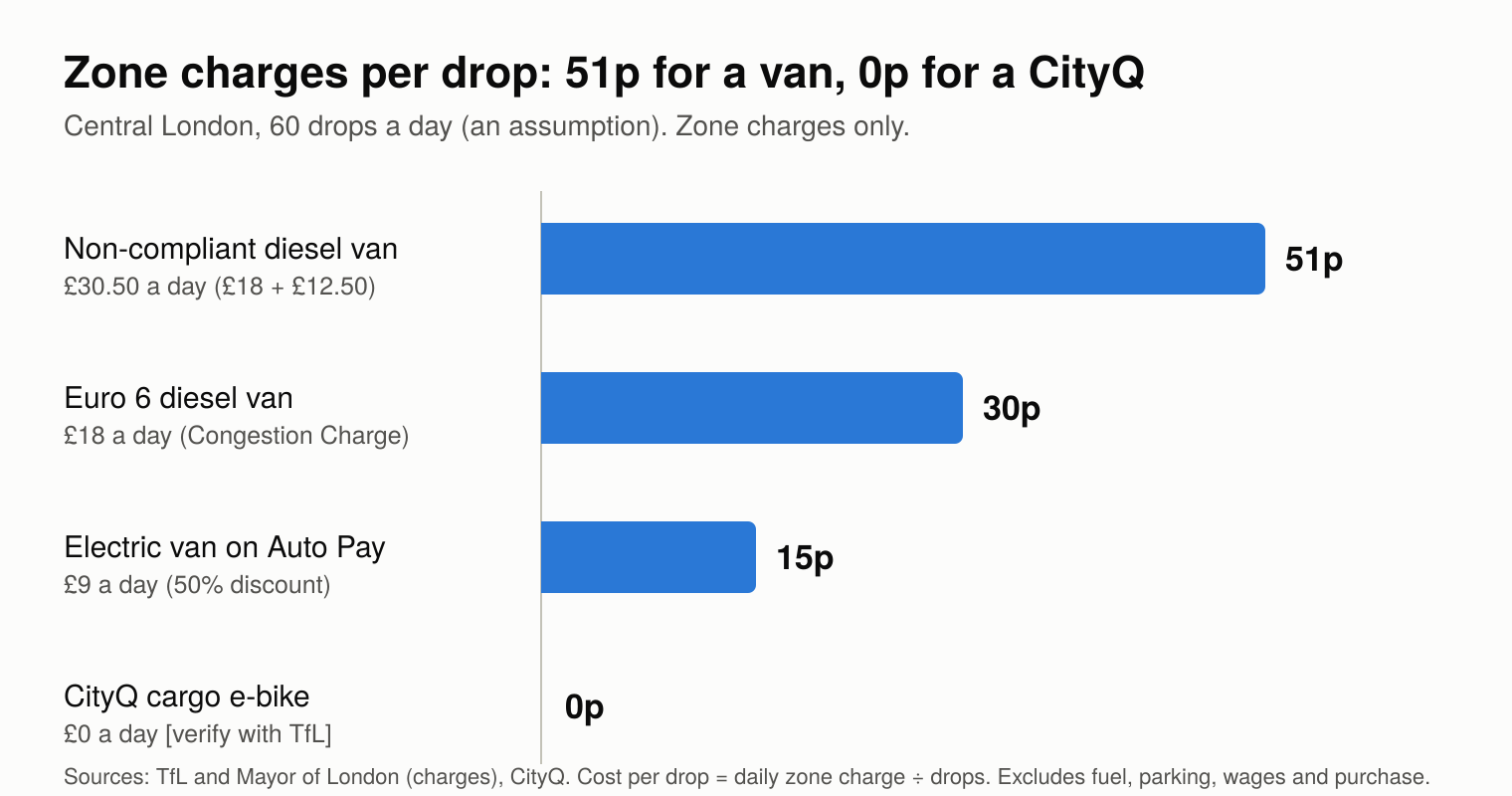
A diesel van that fails ULEZ pays £30.50 a day to work in central London before it delivers a single parcel. Spread over 60 drops, that is about 51p per drop in zone charges alone. One full charge of a CityQ cargo e-bike battery costs about 38p.
Quick answer: For last mile delivery in UK cities, a cargo e-bike usually costs least per drop when drops are close together, loads fit in 1 to 1.7 m³ and the round sits inside a charging zone. A van still wins on heavy loads and long routes. The CityQ cargo e-bike is a four-wheel, pedal-assisted vehicle that needs no driving licence when it meets the electrically assisted pedal cycle rules.
What are the main last mile delivery vehicles in the UK?
Most UK operators choose between four: a diesel van, an electric van, a two-wheel cargo e-bike and a four-wheel cargo e-bike. They differ most on payload, cargo space and what the law asks of the driver.
GOV.UK says an electrically assisted pedal cycle (EAPC) can have more than two wheels, for example a tricycle. The rider must be 14 or over, and the motor must be 250 watts or less and stop assisting at 15.5 mph. A bike that meets those rules needs no licence, registration, tax or insurance. Our guide to the driving licence for a 4-wheel e-bike covers what happens if a model does not.
| Vehicle | Typical payload | Cargo volume | Licence |
|---|---|---|---|
| Small panel van (CityQ’s typical range) | 500–800 kg | 2.5–3.5 m³ | Driving licence |
| Two-wheel cargo e-bike (typical) | 80–100 kg | 0.2–0.5 m³ | None, age 14+ |
| CityQ 850 | 180 kg | 1 m³ | None, age 14+ |
| CityQ 1200 | 170 kg | 1.3 m³ | None, age 14+ |
| CityQ Pickup & Customize | 200 kg | 1.7 m³ | None, age 14+ |
Last mile delivery vehicles compared on payload, cargo volume and licence

The CityQ figures come from the CityQ models page. The van and two-wheel ranges are the typical figures CityQ uses in its own comparisons. They are not a specific make or model.
How much do zone charges add to each drop?
In central London the Congestion Charge rose from £15 to £18 a day on 2 January 2026. ULEZ is £12.50 a day for vehicles that do not meet the standard. A non-compliant diesel van therefore pays £30.50 a day. A Euro 6 diesel van avoids ULEZ but still pays the £18. TfL’s new tiered discount gives electric vans registered for Auto Pay 50% off, which is £9 a day.
CityQ says its cargo e-bike pays none of these, because an EAPC is a pedal cycle and not a motor vehicle.
The sum that matters is daily charge divided by drops. The table uses three drop counts as illustrations. They are assumptions, not measured rounds.
| Vehicle (central London) | Zone charge a day | 40 drops | 60 drops | 80 drops |
|---|---|---|---|---|
| Non-compliant diesel van | £30.50 | 76p | 51p | 38p |
| Euro 6 diesel van | £18 | 45p | 30p | 23p |
| Electric van on Auto Pay | £9 | 23p | 15p | 11p |
| CityQ cargo e-bike | £0 | 0p | 0p | 0p |
| Your round | Daily charge | Daily charge ÷ 40 | Daily charge ÷ 60 | Daily charge ÷ 80 |
These charges apply only in London, so savings elsewhere will be smaller. Our note on Clean Air Zone charges outside London covers other cities. The figures also leave out fuel, parking, wages and the purchase price.
Zone charges per drop in central London at 60 drops a day
How much faster is a cargo e-bike than a van in a city?
The best independent figure is from London. A 2021 University of Westminster study used Pedal Me GPS data and found cargo bikes were on average 1.61 times faster than vans. In central London the bikes made nearly seven parcels an hour against four for vans. That study used Pedal Me’s bikes, not CityQ’s.
CityQ’s own operator data points the same way. CityQ reports routes about 50% faster across six deployments, and JCDecaux in Paris reports a 50% cut in transport time on affected routes after testing 15 competing platforms. DHL has run CityQ four-wheel bikes in London for over two years. DHL has run CityQ four-wheel bikes in London for over two years, part of a wider move by DHL and UPS to use cargo e-bikes in the UK. All of these figures come from CityQ’s own operator data, so treat them as reported rather than independently checked.
A CityQ cargo e-bike making a kerbside drop in a UK city street

What does a four-wheel cargo e-bike cost to run?
Electricity is the small number. One CityQ battery holds 1,440 Wh, which is 1.44 kWh. At Ofgem’s October to December 2026 price cap of 26.32p per kWh, that is about 38p for a full charge. That cap is a household rate, so check your own business tariff.
| Sum | Result |
|---|---|
| 1.44 kWh x 26.32p | About 38p for one full charge |
| Two batteries, 2.88 kWh x 26.32p | About 76p |
| Your cost | Battery size in kWh x your price per kWh |
CityQ estimates annual running costs for a CityQ cargo e-bike at £1,300 to £2,100, including maintenance. For a non-compliant van in central London, CityQ’s own comparison, which assumes 10 paid stops a day over 240 working days, gives £30,320 to £35,320. Both are CityQ’s figures. They exclude rider wages and the purchase price, which CityQ puts at roughly £11,000.
CityQ rates its LiFePO4 batteries at 2,000 to 4,000 charge cycles, which it puts at 6 to 10 years of daily commercial use. That is the cargo ebike battery life UK figure, and a flat pack swaps in about 30 seconds instead of waiting to recharge. On energy, CityQ’s numbers for a cargo bike vs electric van put a four-wheel cargo bike at about 3 kWh per 100 km against 30 kWh for a large electric van.
When does a van still win?
A van wins whenever the job is heavy, far or sparse. CityQ says as much on its own pages.
| Situation | Better choice | Why |
|---|---|---|
| Loads over about 170–200 kg, or bulky items | Van | Small vans carry 500–800 kg and 2.5–3.5 m³ |
| Long or rural routes, more than about 60 miles a day | Van | CityQ says a 60-mile day is near a cargo e-bike’s limit |
| Few drops per hour over long distances | Van | A University of Washington pilot, as reported by Lyft, found a truck visiting 20 locations an hour against 5 for the e-bike |
| Narrow historic streets and tight bollards | Two-wheel cargo bike | A typical two-wheel bike is about 65 cm wide against 89 cm for the CityQ 850 and 1200 |
| Close, frequent drops under 1.7 m³ inside a charging zone | Cargo e-bike | Zone charges, parking and congestion all fall away |
The choice between a 4-wheel vs 2-wheel cargo ebike comes down to stability and access. Four wheels stand unaided and need no balance skill, which helps if your riders are not confident cyclists, while a two-wheel bike fits through the narrowest gaps. For a straight swap, replacing a delivery van with a cargo ebike works on dense, short rounds and gets harder as loads get heavier or routes get longer.
How do you test cost per drop on your own round?
Pick one repeatable round and measure it before you change anything.
- Record a week of baseline figures: drops per day, minutes parked per drop, daily zone charges, fuel and parking.
- Find your heaviest and bulkiest drop and check it against the payload and the 1 to 1.7 m³ cargo space.
- Run the same round on a CityQ cargo e-bike. Which rounds suit a four-wheel model lists what to look for.
- Work out cost per drop for both vehicles: daily cost divided by drops per day.
- Ask the rider what was harder, and check your insurance and site rules.
CityQ lists a free cargo ebike trial for UK businesses, so you can run the test on your own streets.
FAQ's
Q1. What is last mile delivery?
A1. Last mile delivery is the final leg of a parcel’s journey, from a depot or hub to the customer’s door. In UK cities vans face congestion, parking searches and zone charges on this leg. A CityQ cargo e-bike, a four-wheel pedal-assisted vehicle, is one way to run it.
Q2. Is a cargo e-bike cheaper than a van for last mile delivery?
A2. It can be on dense city rounds inside charging zones. A non-compliant diesel van pays £30.50 a day in central London zone charges, about 51p per drop at 60 drops, while a full CityQ cargo e-bike battery charge costs about 38p. Outside London the savings are smaller.
Q3. Do you need a licence to deliver by cargo e-bike in the UK?
A3. No driving licence is needed to ride a cargo e-bike that meets the UK electrically assisted pedal cycle rules, according to GOV.UK. It needs no registration, tax or insurance, and the rider must be 14 or over. CityQ describes its cargo e-bikes as meeting these rules.
Q4. Does a cargo e-bike pay the London Congestion Charge or ULEZ?
A4. CityQ says its cargo e-bike pays neither the £18 Congestion Charge nor the £12.50 ULEZ charge, because it is classed as a pedal cycle and not a motor vehicle. A non-compliant diesel van pays both, £30.50 a day. Confirm the position with TfL before planning routes.
Q5. How much does it cost to charge a four-wheel cargo e-bike?
A5. A full charge of one 1,440 Wh CityQ cargo e-bike battery costs about 38p at Ofgem’s October to December 2026 household rate of 26.32p per kWh. Two batteries cost about 76p. Business tariffs differ, so multiply the battery size in kWh by your own price per kWh.
Q6. How much can a CityQ cargo e-bike carry compared with a van?
A6. CityQ lists payloads of 170 to 200 kg and cargo space of 1 to 1.7 m³ across its cargo models. CityQ’s typical small van figure is 500 to 800 kg and 2.5 to 3.5 m³. Check your heaviest drop against the payload before you switch.
Q7. When is a van better than a cargo e-bike for last mile delivery?
A7. A van is better for loads over about 170 to 200 kg, bulky items, and long or rural routes beyond roughly 60 miles a day. It also suits sparse rounds with few drops per hour. A CityQ cargo e-bike suits close, frequent drops in cities.
Q8. How much faster is a cargo e-bike than a van in a city?
A8. A 2021 University of Westminster study of Pedal Me deliveries found London cargo bikes were on average 1.61 times faster than vans. That study did not use CityQ bikes. CityQ separately reports routes about 50% faster across six deployments, which is its own operator data.
Q9. Can you try a CityQ cargo e-bike before buying?
A9. Yes. CityQ lists a free trial for UK businesses, so you can run a CityQ cargo e-bike on your own delivery round before you decide. Bring your route, your drops per day and your heaviest load, then compare cost per drop. Book through CityQ’s test drive page


