


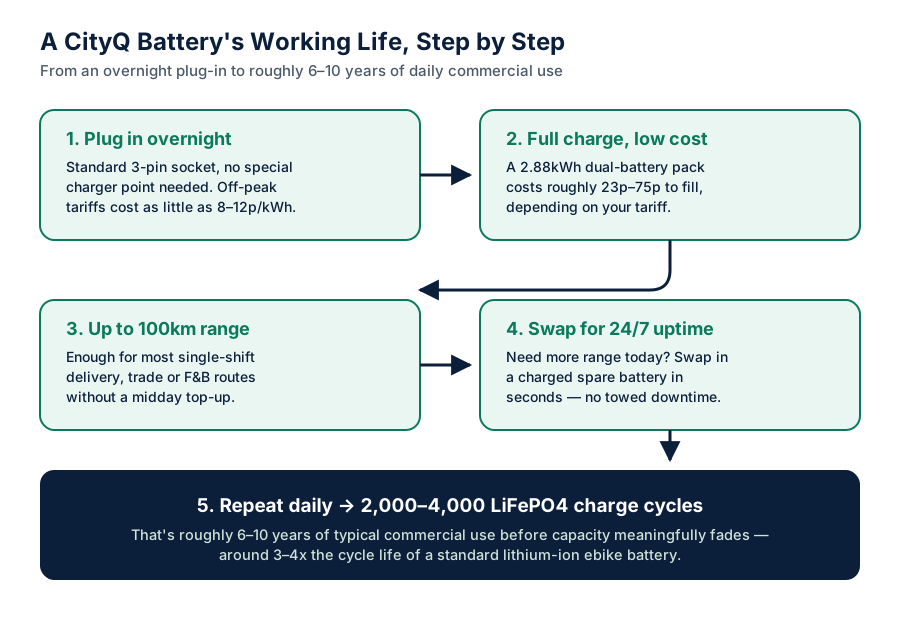
Cargo ebike battery life UK operators can plan around comes down to chemistry more than anything else: LiFePO4 cells typically handle 2,000 to 4,000 full charge cycles, or roughly 6-10 years of daily business use, and they’re a big part of why cargo e-bike delivery business costs stay so low compared with running a van. Charging one costs as little as 12p and rarely more than 75p per full charge, for up to 100km of range. That’s the short answer. Here’s the detail behind it, with the exact numbers a UK operator needs to plan a fleet around.
How Long Does a Cargo eBike Battery Actually Last?
Battery life for a commercial cargo ebike comes down to cell chemistry more than anything else, and this is where most generic “how long does an ebike battery last” guides miss the point for business buyers.
Most consumer ebikes use standard lithium-ion (NMC) cells, which handle roughly 500-1,000 full charge cycles before dropping to 80% of original capacity — around 2-4 years for a bike charged daily. CityQ’s 1200 uses an AES SuperPack built on LiFePO4 (lithium iron phosphate) cells instead, rated for 2,000-4,000 full cycles at 80% retention. Charged once a day, that’s a working life in the region of 6-10 years before you’re planning a replacement — roughly three to four times the cycle life of a standard lithium-ion pack, with slower capacity fade in storage too (about 2% a year versus 8-12% for NMC cells in warm conditions).
| Battery chemistry | Typical cycle life | Daily-charge lifespan | Common in |
|---|---|---|---|
| Standard lithium-ion (NMC) | 500-1,000 cycles | ~2-4 years | Most consumer ebikes |
| LiFePO4 (CityQ 1200’s AES SuperPack) | 2,000-4,000 cycles | ~6-10 years | Commercial-grade cargo ebikes |
For a business running a delivery, trade, or F&B route five or six days a week, that difference isn’t academic — it’s the gap between budgeting for one battery pack over a vehicle’s working life and budgeting for three or four.
Watch: The Cargo Bike That Runs on Any Wall Socket — Zero Infrastructure (CityQ, YouTube) — a short walkthrough of exactly this: no dedicated charge point, no commercial electrical work, just a standard socket.
How Much Does It Cost to Charge a Cargo eBike in the UK?
This is where the cargo ebike charge cost UK question gets genuinely interesting for a fleet operator, because the range is wide depending on when you plug in.
A single CityQ 1200 battery holds 1,440Wh (1.44kWh). The CityQ 1200 can run one or two of these packs, so a full dual-battery charge is 2.88kWh. At the current Ofgem standard variable price cap of 26.11p/kWh (the rate in force from 1 July to 30 September 2026), that’s:
| UK electricity tariff | Rate (p/kWh) | Single battery (1.44kWh) | Dual battery (2.88kWh) |
|---|---|---|---|
| Octopus Go off-peak (11:30pm-5:30am) | 8p | 11.5p | 23.0p |
| Typical off-peak / business night tariff | ~12p | 17.3p | 34.6p |
| Ofgem standard variable cap (Jul-Sep 2026) | 26.11p | 37.6p | 75.2p |
Even at the standard daytime rate, a full charge costs less than a coffee. Plug in overnight on an off-peak or smart business tariff and it drops to around 12p-23p — cheap enough that electricity cost barely registers as a line item next to fuel, congestion charging, or parking tickets for a van. Spread across CityQ’s stated up-to-100km range, that works out to roughly 0.23p-0.75p per km depending on tariff — a fraction of a penny to move a loaded cargo bike one kilometre through a city.
Electricity is one of the smallest lines in a CityQ 1200‘s running costs, well behind insurance, racking, and driver time for most fleets.
How Long Does It Take to Charge a Cargo eBike Battery?
CityQ batteries charge from any standard 3-pin domestic or business wall socket — no dedicated charge point or commercial electrical work required. Based on typical charging profiles for a LiFePO4 pack of this size (roughly 4-6A on a standard charger), a full charge for a single 1,440Wh battery typically takes somewhere in the region of 5-7 hours — comfortably an overnight charge — with faster commercial chargers cutting that down further.
Because the battery is swappable and removable in seconds, fleets that need more than one shift’s range in a day don’t have to wait out a full charge at all — they swap in a second charged pack and keep the depleted one on the charger.
How Far Can You Go on One Charge? Real-World Range for a Loaded Cargo eBike
CityQ states up to 100km of range per charge for the 1200 — the figure behind the “electric cargo bike range UK” and “cargo ebike 100km range UK” numbers operators search for. As with any ebike, real-world range on a fully loaded cargo bike run is affected by payload (up to 170kg on the CityQ 1200), terrain, stop-start urban traffic, and how much pedal-assist versus throttle-equivalent power a rider draws — so a route with a lot of hills and frequent stops will sit toward the lower end of that range, while a flatter, steadier round will get closer to the maximum.
For most last-mile, trade, or F&B delivery routes in UK towns and cities, a single shift’s mileage sits well inside that 100km ceiling, which is why most CityQ operators charge once overnight rather than mid-shift. Fleets running longer routes or double shifts typically rely on the swappable dual-battery setup rather than pushing a single pack to its limit.
What Does It Cost to Replace a Cargo eBike Battery?
Because LiFePO4 cycle life is so much longer than standard lithium-ion, replacement is a less frequent cost — but it’s still worth budgeting for over a vehicle’s working life. Across the UK ebike market generally, replacement battery packs run from roughly £250 for smaller consumer-grade batteries (300-500Wh) up toward £700-£1,000+ for larger, higher-capacity packs.
The more useful way to think about cargo ebike battery cost UK 2026 for a fleet is cost-per-year of use rather than the sticker price of a single pack: a LiFePO4 battery lasting 6-10 years effectively spreads that cost over roughly double to quadruple the years of a standard lithium-ion pack, even before accounting for the labour and downtime saved by not swapping cells every 2-3 years.
Electricity is a genuinely small line item against what a delivery van costs to run and park in a UK city. It’s honest to say a van still wins on raw payload capacity and unbroken long-distance range — a cargo ebike isn’t the right tool for every route. But for the urban, stop-start, last-mile work most operators are searching this topic for, the battery economics are hard to ignore: businesses that have made the switch report up to a 70% reduction in total cost of ownership per kilometre versus a traditional van, with total annual running savings in the region of £28,000-£33,000. Charging cost is a small part of that picture, but it’s the part that’s cheapest to verify yourself with a plug-in energy meter and your own electricity bill.
Most operators only run these numbers once they’re seriously ready to replace a delivery van with a cargo eBike, and that’s usually when the fuel-versus-electricity gap becomes impossible to ignore.
1. How long does a cargo ebike battery last?
A LiFePO4 cargo ebike battery, like the one in the CityQ 1200, typically lasts 2,000-4,000 full charge cycles — roughly 6-10 years of daily commercial use — versus 500-1,000 cycles (2-4 years) for a standard lithium-ion battery found in most consumer ebikes.
2. How much does it cost to charge a cargo ebike in the UK?
A full charge for a CityQ 1200 dual-battery pack (2.88kWh) costs between 23p on an off-peak tariff like Octopus Go and around 75p at the Ofgem standard variable price cap (26.11p/kWh, Jul-Sep 2026). A single 1,440Wh battery costs roughly half that, from 11.5p to 37.6p.
3. How far can a cargo ebike travel on one charge?
CityQ states up to 100km of range per charge for the CityQ 1200, though real-world distance varies with payload (up to 170kg), terrain, and how stop-start the route is.
4. How long does it take to charge a cargo ebike battery?
A full charge typically takes somewhere in the region of 5-7 hours on a standard charger — an easy overnight charge from any 3-pin domestic or business socket — with the swappable dual-battery design meaning fleets rarely need to wait out a full charge mid-shift.
5. How much does it cost to replace a cargo ebike battery?
Replacement costs vary by capacity; across the UK ebike market, packs range from around £250 for smaller consumer batteries up to £700-£1,000+ for larger, higher-capacity packs. Contact CityQ directly for an official replacement price on the 1,440Wh AES SuperPack.
6. Is a LiFePO4 battery better than a standard lithium-ion ebike battery for business use?
For commercial use, yes on longevity: LiFePO4 delivers roughly three to four times the charge cycles of standard lithium-ion (NMC) cells and degrades more slowly in storage, which is why CityQ uses it in the 1200’s AES SuperPack rather than a consumer-grade lithium-ion cell.
7. How much does it cost to charge a cargo ebike per mile or kilometre?
At current UK electricity rates, a CityQ 1200 dual-battery pack costs roughly 0.23p to 0.75p per km (about 0.37p to 1.21p per mile) to run, depending on whether you’re charging on an off-peak tariff or the Ofgem standard variable rate — a fraction of a penny per kilometre either way.
8. Do I need a special charger to charge a cargo eBike battery?
No — CityQ batteries charge from any standard 3-pin domestic or business wall socket, so no dedicated charge point, commercial electrical work, or specialist charger is needed.
9. Does cold weather affect a cargo eBike’s battery life or range?
Like all lithium batteries, a cargo eBike battery discharges a little faster and takes slightly longer to fully charge in cold conditions, which can temporarily reduce range. This is a short-term performance effect rather than lasting damage — overall battery lifespan is driven far more by total charge cycles and storage habits than by day-to-day temperature swings.
10. Can I swap a cargo eBike battery instead of waiting for it to charge?
Yes — CityQ’s batteries are designed to be removed and swapped in seconds, so fleets running longer routes or double shifts can drop in a second charged pack instead of waiting out a full charge mid-shift.
11. Are electric cargo bikes legal in the UK?
Yes — as long as a cargo eBike meets EAPC (Electrically Assisted Pedal Cycle) rules, UK law treats it as an ordinary bicycle. No licence, insurance, road tax, or MOT is required, though riders must be at least 14 years old.
12. What is an EAPC, and does the CityQ 1200 qualify?
An EAPC is an Electrically Assisted Pedal Cycle under UK law: the motor must be rated at no more than 250W, assistance must cut out once the bike reaches 15.5mph (25km/h), and the pedals must be in motion for the motor to assist. CityQ’s models are built and certified (EN15194) to meet these EAPC requirements, which is why they’re classified and ridden as bicycles rather than mopeds.
13. What’s the maximum speed for a legal e-bike in the UK?
UK law caps motor assistance at 15.5mph (25km/h) for any EAPC-classified e-bike or cargo eBike. A rider can still pedal faster under their own power, but the motor must stop providing assistance once that speed is reached.
14. Are throttle or “twist-and-go” electric bikes legal in the UK?
Only in a limited form. Since 2016, a throttle on a legal EAPC can provide “start-up” assistance without pedalling only up to 3.7mph (6km/h) — beyond that, further assistance requires pedalling, up to the 15.5mph limit. A full twist-and-go throttle that works above 3.7mph without pedalling isn’t legal as an EAPC and would need separate registration, tax, and a licence as a moped instead.
15. Has UK e-bike law changed in 2026?
No. The Department for Transport consulted in 2024 on raising the motor power limit to 500W and extending throttle-only riding to 15.5mph, but rejected both proposals in 2025, citing insufficient evidence. The original EAPC rules — 250W motor, 15.5mph assisted limit — remain in force in 2026, and CityQ’s 1200 is built to those existing rules rather than any proposed change. For the full breakdown of what that means for licensing, see do you need a driving licence for a 4-wheel e-bike.


